What you'll learn
- Sort your work into three bucketsRegular optimizations and checks (search terms, negatives, ads), one-off high-impact improvements like advanced conversion tracking, and experiments. Each bucket gets planned and prioritized differently.
- Set the frequency per clientUse the same checklist for every client, but change how often you do each check. An account spending €1,000 a month needs search term reviews far less often than one spending €50,000, and logging the date of each check tells you what's due next.
- Score experiments on impact, confidence and easeBob uses the ICE model: give every experiment idea a score from 1 to 10 for each, add them up and start with the highest. A big idea that's hard to set up moves down the list.
- Do the regular work first, then experimentHe spends about 70% of his time per client on regular optimizations and 30–40% on experiments and one-off improvements. For a client he's had for seven years, where the search terms barely need work anymore, it's mostly experiments.
- Know when to roll backOne ecom client's switch from ROAS to POAS bidding made volume drop, and it never came back. After two weeks they went back to ROAS and kept POAS as a secondary conversion to help set ROAS targets.
About this episode
There’s always more to do in a Google Ads account than you have hours for.
So how do you decide what to work on first?
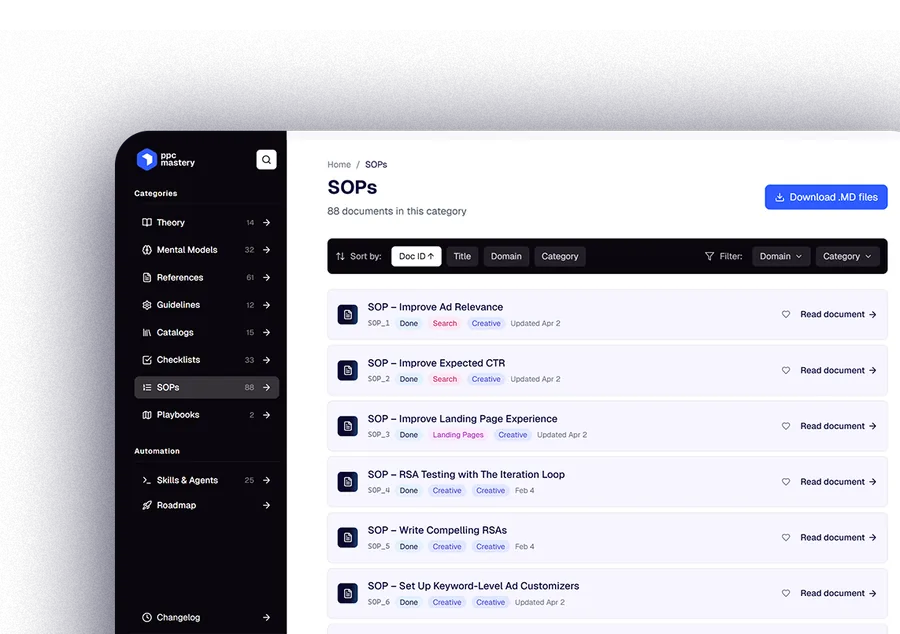
When we recorded this, Bob was building a big optimization checklist for The PPC Hub, with more than 200 checks across every campaign type. So I asked him how he plans his own week.
In this episode, we go through:
- The three buckets every task falls into: regular checks, one-off improvements and experiments
- Why he tracks regular work in a Google Sheet, not a project management tool
- The simple scoring model he uses to pick the next experiment
- How he splits his time per client, and why that changes as an account matures
- The ROAS to POAS switch that backfired, and why he rolled it back after two weeks
- The 90-day roadmap he plans and shares with his clients
His advice if you’re starting out: plan your work ahead. You’ll know exactly what to do every time you open an account, and it takes a lot of stress away.
Chapters
- 00:00Getting ready for Q4
- 00:30Intro: the optimization checklist Bob is building
- 02:05What optimization means: the three buckets
- 04:49Tracking regular checks in one Google Sheet per client
- 07:07Why not a project management tool?
- 09:42Picking experiments with the ICE model
- 11:40Splitting time between regular work and experiments
- 13:24Experiment ideas: ads and assets
- 15:11Testing landing pages for lead gen clients
- 19:22Tools: Adalysis and TrueClicks
Mentioned in this episode
Full transcript
Read the full transcript (4,804 words)
Auto-generated from the video, so expect the odd typo. Click a timestamp to watch from that moment.
00:00it's almost Q4 Black Friday Cyber Monday is coming up so when are we going to create offers when is the deadline for well the Black Friday Cyber Monday landing pages when do we need to have the Black Friday ceremony specific seal ads inside of our account how are we going to make sure that everything runs battery smooth so what types of automation are we going to use automatic rules scripts etc etc do you have GM everybody welcome back to the PPC Mastery podcast today we have a really nice topic and it is how to prioritize work throughout your week or specifically optimizations so let's just dive in man because you're working on something really cool optimization checklist like maybe just briefly introduce like that what what are you what are you building right now I think it's because it's going to be really really cool is going to be epic at least that's what what we think so what are we building we're building a really extensive detailed optimization checklist that is covering all of the different campaign types from search to Performance Max to video for Action campaigns it is telling you what things to monitor what checks to perform but also what kind of optimizations you can do or should do or at least take a look at what frequency is applicable to the checks and the optimizations and what the potential impact of these checks and optimizations could be so this is a really well a sort
01:38of mastered document that you can use to to plan optimizations experiments monitoring slash checks across your work week for all of your different clients if you work for different clients at least so it's going to be a kick-ass document with a lot of rows a lot of checks yeah so it's going to be epic yeah I've seen I've seen V1 and it's already like now what it is now it's already so good but can't wait until we until we finish it so in the in the realm of optimization can you maybe Define what you think optimization means in the context of Google Ads and what are the categories that apply within that optimization structure um yeah so I think when people are mentioning optimizations they also mean monitoring and Performing checks checking performance performances week on week month on month checking performances for different segments like location devices audiences keyword segments Etc it is not solely just optimization optimizations it's also checks monitoring and experimentation as well and I think all of that is part of the the category optimization when we talk about optimization so basically we have three overarching optimization categories at least that's how I feel feel it and how I look at things number one those are the regular monitoring checks and regular optimizations so these are the things that come back every single week every single two weeks every single month and every single
03:16quarter so the regular stuff like keywords adding keywords going through your search and Report excluding negatives optimizing your your ads assets experimenting with well optimizing your campaign structure so these are all your regular optimization checks then we have number two and these are your one-off high impact improvements or potentially high impact improvements and these are often the bigger one-off tasks like implementing specific Advanced conversion tracking features that you haven't implemented before but are on your to-do list on your backlog so that's number two and then number three we have the experiments so next to your regular optimizations going through your social reports excluding negatives etc etc you also have a experiment bucket where you have to continuously work on in order to bring your account to a higher level and look for ways to drastically improve performance for example finding offers experimenting with different RSA assets experimenting with different fun URLs in order to improve conversion rates so these are not regular optimizations these are always different and they should be prioritized differently so that's the core overarching few I think that's I think it's interesting view because I think a lot of people struggle with the with the experimentation side and running solid experiments and I think we'll get to that in a second so since there is always so much so much that you can do at the same time how do
04:55you prioritize your optimization so how do you allocate your time in your week do you use any systems to keep track of your optimization of the of the progress and how do you communicate the importance of prioritization to your stakeholders any thoughts there yeah so we're talking regular optimizations over here so these are the things that are returning every single over a single time period weekly bi-weekly monthly quarterly so I have built a extensive Google sheet for myself in the past that I use for all of my clients that I'm refining right now in order to use sapc Mastery product but I keep track of all of my regular optimizations inside of basically a big big Google sheet that is tailored towards every single client so the frequency and the potentially potential impact of certain optimizations is different for every single client so if you have a client that's doing 1 000 Euros per month in terms of spend you need a lot of data in order to optimize your ads for example or go through your search and Report because you need a lot of data in order to find a lot of irrelevant Search terms so the frequency can be lower in comparison to a client that is doing 50 000 Euros a month in terms of spend because you have way more volumes over there and the potential impact of specific optimizations can wildly differ so basically I use the same document but with the same regular optimizations but then I tailored the frequency and impact
06:32per client I keep track of the optimization date inside of that document as well so it's easy for me to see when the last time when the when the last time was that I performed a certain optimization so I can look back in the document to see hey this is something I did two months ago I need to perform this check or this optimization every quarter so next month I have to prioritize this over a specific other optimization inside of the checklist yeah so that's how I keep track of The Irregular optimizations then we have the other two categories as well so we have can I just quickly ask yeah so about that you add in the date to the sheet that's really solid do you usually work from that spreadsheet or do you also use a project management tool like a notion Trello Asana Etc for the regular optimizations and checks I use the Google sheet I've tried experimenting with a project project management tool like Asana for this in the past but since there are so many checks and so many optimizations per campaign type per sub category like ads assets campaign structure keyword Search terms it is becoming wildly well unmanageable messy unmanageable if you if you if you try to put this in a project management tool yeah and if you try to add well due dates to all of the tasks it just becomes a re just becomes a mess because sometimes you need to shift and prioritize some priority optimizations over orders as well and it is really hard to keep track of all of these
08:11separate tasks if you manage more than one client if you have just one account I think it is good for your overview to use a product management tool for this but if you manage multiple clients and you were to incorporate all of these single optimizations which are more than 200 I think I think easily more than 300 then you're going to have a hard time and in the in one of the previous episodes you you thought you said something that Dickie Bush often often says about the project management tools right can you repeat that yeah so if a lot of times project management tools can be a distraction of actually doing the work because people people try to build the perfect productivity system and I try to do that in the past as well but then in the end I was spending more time in the tool like Asana or notion than actually doing the task so yeah you need to think to yourself like if you have a good productivity system and it works for you then by all means but if you are trying to keep it perfect then you're probably just distracting yourself and running away from the task it is actually important so if that's the case and that's so true foreign so for regular optimizations and checks I do not use a project management tool yeah for exactly that reason yeah but for the other for the other regions experimentation and one-off high impact improvements I do use a project management tool I do use notion for that specific part yeah Okay cool so when it comes to the experiments which is the the second part of it how do you prioritize those
09:50because in the in the master class we also have a lot of experiments that we showed that was the everybody's favorite Workshop all the time or during every master class but how do you prioritize your experiments and how much time do you allocate to those versus the regular optimizations yeah so I like to use a really simple framework a model to help me with the prioritization of experiments and that's called the ice scoring model the I stands for impact the potential impact the C stands for confidence so how sure am I that this will actually perform well and the E stands for ease so how easy is it to set up and those three combined actually give you a score so I tend to use a score ranging from 1 to 10 for every single metric impact confidence is and just add up all of the scores combined and I just start with the experiment that that has the highest score because something that you think has a great impact that you're really confident about and that is really easy to set up well those are the experiments you need to start off with right if you have a experiment idea that has a potential high impact a high confidence rate but is really difficult to set up then you have to de-prioritize that over the ones that are really easy to set up so that's a really simple framework to use at least that I like to use to prioritize my experiments so I basically have one big bucket of all of my experiments ideas per
11:28client I add them inside of just one big experiment backlog and then use this prioritization model in order to to prioritize where to begin with and when it comes to the time allocation how much spend how much time do you spend between the experiments versus the regular optimizations yeah good question so I always try to find a good balance between the regular optimizations and the experiments between within an account generally I try to allocate as much as time needed within the available hours per client for regular optimizations and checks so I do not want to skip all of the important regular work and all of the time that is left I try to allocate towards one-off high impact improvements or experiments and generally I think gut feeling wise I spent 70 percent of my time towards regular optimizations and 30 percent maybe up to 40 percent towards one-off improvements and experiments that's how I try to allocate my my time per client but it differs it differs per client because some accounts are really mature and all of the regular optimizations have already been performed in the past so I have one client that is with me for seven years already and if I check this search and Report The Search terms are so so relevant and they're converting so good that I almost
13:06didn't have any work to do checking the sdrs but also doing engram exclusions for example so for that client I have way more time allocated towards the experiment side of things because that's the way to grow that specific account yeah so it differs yeah that sounds like a logical way to go about your account as well like the the foundation in that account as you said specifically is really solid so then it makes sense to spend a lot of time experimenting and do you have some examples of the types of experiments that you that you like to run yeah sure there multiple multiple high level categories where you can experiment in and within every single category of multiple experiments that you can run obviously so when we take a look at the high level experimentations then you can think about experimenting with your ads that could be your responsive search ads Dynamic search ads responsive display ads HTML5 ads video ads and inside of all of those ad types you can experiment with different items or different assets then how you would like to call them so you can swap out certain headlines description lines that's with certain images that's with different videos test with auto well not kind of auto-generated videos but the ones you create inside of the creative Studio versus the ones you you have from your client so there are different ways to experiment with your ads already you can set them up in different ways you can you can optimize your low perform
14:43forming assets and swap them out for new ones according to your ad testing backlog and the ones you have prioritized as well you can also add in add variants or add variations in order to split test certain headlines for example benefits versus features or swap out different call to actions so there are already multiple ways you can test within the asset category only or ads and asset category then you have find URLs so I really like to test with finding URLs for my Legion clients it's something that I try to to control it's something that I like to pull away from my clients and pull towards myself so I'm responsible for the whole customer Journey so to say so I want to be in control of the ads people see the the Search terms my ads are being shown for the targets that I have set the bidding strategies that I use but also the URLs that people are being redirected to and what offer is being pushed towards those potential clients and I really like to split tests and optimize my landing pages right now which is really cool to do for Legion clients specifically because it isn't really complicated to set up relevant landing pages it is more complicated for Ecom businesses because you have all of these products right and bundles and well it doesn't make sense inside of the the the the the the e-commerce navigation so to say but for services SAS companies this is way easier to do and that's why I like this
16:22vertical because I can influence the whole before the click all the way to the potential conversion good point and those are really really really high impact optimizations or experiments so to say so it's something that I try to allocate more of my time towards right now because if you were to improve your conversion rates by 25 that's a lot so that's a lot that's a lot that's so much more bidding power and it opens up so much more volumes inside of your Google Ads campaigns where it also opens up doors for experimenting with mid and upper funnel campaign types because those campaign types can become well could have a good could have a good Roi right now because your conversion rates are improved so that's another way to to experiment with different campaign types do additional work for your clients as well yeah then we have some some other categories as well think about campaign and AD group structures testing with different bidding strategies and or targets audiences keywords testing with offers on your landing pages so these are some high level categories that I like to experiment with yeah and there's an endless list of things you can try to experiment with so there's always something to do yeah and that's going to be the checklist yeah let's go to videos that's going to be yeah but I like how you emphasize the the landing page optimization or cro whatever you want to call it it is probably part of cro but that is so it is so crucial it means we've been saying
18:00it for the last year or so like what happens after the click is probably even more important than what happens before or at least the same and this is the number one skill I think next to mastering conversion tracking I think the number one skill that you also need to be developing in the upcoming months and years if you want to stick out as a as a standout as a Google ad specialist like really definitely own yeah and what you're doing now with those landing pages you're really owning the whole infrastructure for this client which helps you drive the results that you want because we've seen those examples especially in Legion where someone just builds a page with huge forms or you know those kinds of mistakes and if you control the entire landscape then it's easier for you to drive those results but you need to put in the time to actually Master the craft and and be able to build those landing pages so yeah I'm really looking forward to build a a mini course for this maybe something that's called landing page Mastery or something like that really looking forward for that specific course because I think there's so much knowledge to be gained over there that can be utilized by a lot of Google Specialists that are that are stuck inside of the the app the Google Ads interface right now but I think the impact is being made outside of Google Ads absolutely and are you using any tools for your optimization experimentation Etc yeah so I have my big checklist with all of the regular checks monitoring optimization checks but I also like to
19:37use two core tools that help me with prioritization analysis and through clicks those are the two that are I think complementary to it to each other so they have different checks different categories they prioritize things differently and by combining these two tools you can easily see where to begin your your your your your work day with for example inside of analysis they give you a alert a high impact alert if they see that a specific ad group with high volume keywords that drive a lot of conversion volume is well is dropped or dropped volumes and conversion rates significantly or where the quality score dropped so those are the things that needs to be addressed immediately if you are starting to work for that specific client and you can combine these kinds of alerts or suggestions with your own Master checklist so to say so that's what I like to to do yeah yeah cool so what I what I this what I dislike and what I try to prevent as much as possible is to do all of the manual analytics and segmenting myself inside of my account because the tools like analysis and true clicks can do that way faster and way better than you so they just tell you hey Bob if you're going to to to work on this account these are the problem areas that needs to be addressed right now so you do not have to find out yourself after an hour
21:15of segmenting out your your weekly performances on ad group level keyword level whatever yeah yeah and since there's you know not everything always goes as planned with experimentation with optimization is there any example that you can share from something that didn't go according to plan and what did you do to to change that to Pivot I think a raised example was within a an Ecom account that I had where we try to transition from a revenue-based row as bidding strategy to a profit-based rower strategy yeah so essentially from row as to POS if you would like to call it that way yeah and it completely backfired so during the transition phase we saw our volumes drop dramatically and we try to do our best to ramp up the volumes right after the transition but we really couldn't couldn't get the volumes On Target anymore at least on the targets that we were running prior to the transition so after two weeks we decided to revert back to the revenue based strategy and we decided to use the profit on ad spend metrics as a secondary well conversion just for insights to decide what kind of row as Target would be applicable for certain categories and certain campaigns so that completely backfired unfortunately yeah so I've had four transitions in the past and from
22:54the other three transitions it worked like a charm and of course we had like a dip when we transitioned from Rose to Boaz but then everything went went back to normal and we got traction again but for this specific case yeah it backfired and the client became a little bit anxious like yeah this is going this is going in there in the right direction or not should really referred I'm missing a lot of Revenue so yeah I agreed with him and I I said well let's go back yeah yeah yeah there you you see that it doesn't always go according to notebooks no no that's why you need to know what to do when it when hits the fan yeah yeah and sometimes it's just as simple as just reverting the the stuff you did and do you how do you align your Google Ads optimizations with your broader marketing or business objectives or of your clients and of course so I try to find a good balance between in-app optimizations because because well in the end of the day we are all Google ad Specialists so that's where we're good at but if I sense that my job is almost done inside of the app so inside of Google Ads and the optimizations and the experiments left aren't really impactful anymore that's when I try to transition towards the more broader optimization and that's when I try to to incorporate a lot of let me page testing a lot of zero ideas a lot of AD testing ideas even crafting better offers for my clients so that's
24:35when I try to transition away from well the simple stuff or at least it's simple simple for us now but the general optimization checks that you tend to do as a Google specialist and that's something that you have to do from your gut feeling I think so sometimes you feel starting off with an account that everything is running streamlined like a well-oriented well oiled machine and if you have two or three secular months with the same feeling you really have to start thinking about incorporating broader optimizations that are outside of Google Ads otherwise people will start to question your your edit value as well and that's something that you do not want to to risk at least nothing that I would like to risk yeah absolutely you always want to make impact yeah yeah all right so to wrap it up do you have any advice for anyone starting out in Google Ads and looking to refine their optimization process or maybe even what advice would you give yourself when you started out in Google Ads regarding the optimization process so when when I started out as a freelancer I really didn't properly document all of the things that I did instead of an account and all of the stuff that needed to be done so I just said to my clients hey this month I'm going to optimize some regular some regular stuff and I'm going to allocate my time towards regular optimizations like excluding irrelevant Search terms like performing an engram
26:13analysis like adding creating new ad groups based on some new interesting Search terms that I found but these were basically well decided on during the meetings or during the the contact I had with my clients and right now I have a really structured optimization experimentation roadmap for the next couple of 90 days so the next couple of three months so to say so I know what I'm going to do and what I'm going to prioritize and what time is left for well specific wishes from our clients or specific experiments that we would like to perform or maybe a one-off high impact improvements like Advanced conversion tracking implementations so I can instantly see oh next month we have other things prioritized already so that specific wish can be addressed over two months because we've prioritized other things right now and that really gives you a a calmness that drops your stress levels it increases your productivity because you know what you're going to address and what you're going to work on when you're going to open the account and when you have these specific hours planned for your specific clients so that's something that I didn't had in the first year or first two years and I really have refined that specific part right now so if you're just starting out make sure to create a extensive planning for yourself that is reasonable given the amount of hours you can allocate towards your client
27:49incorporate optimizations according to the Three core categories so you address not only your regular optimizations but also experiments and high impact one-off improvements so do not only do the simple stuff but also in corporate potentially high impact experiments for example and give everything its own chance in its own time and know what you're going to address the next time when you open the account yeah let's have some really solid tips and then you share the roadmap you share the optimization yeah plan that you have you share that with your clients right yeah yeah so every quarter at least for my bigger clients I tend to have a quarterly meeting where we prioritize the next quarter and also look back at the previous quarter in terms of results we take a look at the specific campaign type specific categories services that that we ran ads for what worked what worked what didn't work what needs attention where do we see big drops because of maybe external factors how can we prepare for those kinds of things in the next quarter what's coming up so for well the Black Friday Cyber Monday landing pages when do we have to when do we have when do we need to have the Black Friday Cyber Monday specific seal buttery smooth so what types of
29:30etc etc so yeah it's a great moment to look back at the things that that you did and what you're going to do and prioritize in the next quarter and that really really really gives you a great overview of what needs to be done and gives you a great sense of rest yeah nice cool so there you have it guys if this won't help you structure your optimization process then I don't know what will but the optimization checklist will yeah that will help you but it's not it's not lost yet for for the PPC Hub first yeah exactly so yeah thanks everybody for listening watching if you have a question for us please head over to ppcmastery.com podcast and there you can submit the question for us to answer during these episodes and yeah please subscribe if you like it share it with someone that might find this valuable and until then we'll see you next time peace peace