What you'll learn
- Find the drop-off, then find out whyShopify and GA4 show you where people leave the funnel. Then Microsoft Clarity recordings show you why. Seth's simplest check: if your grandmother can't get through the website, you have a serious problem.
- Watch quality score and conversion rateHe wants clients at a quality score of 7 or 8, so the landing pages get headings that match the ads. Overall conversion rate sits at the top of his dashboard, and the search terms tell him what each page needs to say.
- Let the agent do the digging, you make the callClaude connects to Microsoft Clarity, Shopify and Google Ads, so he barely opens the Google Ads interface anymore. The risk is the yes-man effect: people start agreeing with whatever the AI recommends, so his team has to push back on it.
- Hire seniors when agents do the junior workSearchly went from six junior and mid-level account managers to three people, all senior. Agents took over about 90% of the manual work juniors used to do. His advice for juniors: learn the fundamentals before you use agents.
- Build the draft, skip the wireframeHis team rebuilt a broken WooCommerce site on Shopify in a weekend and lifted conversion rate 40%. The previous developer took six months. With Chrome DevTools connected, the AI checks its own pages, and he once reached version 37 within 30 minutes.
About this episode
Seth Gorton runs Searchly, a Google Ads agency in Cape Town.
His pitch to clients is that they take full responsibility from click to conversion. So that’s the Google Ads, but also the landing page, the website, the CRM and everything that happens after the click.
He built the agency that way from day one. Then AI agents changed how it runs. Searchly went from six people to three, all senior, and does more than before.
In this episode, we go through:
- Where to start with CRO if you’ve never done it
- How CRO and Google Ads make each other better
- What his day looks like when he barely opens the Google Ads interface
- Why he stopped hiring juniors, and what the “yes-man effect” is
- How his team rebuilt a client’s website in a weekend and lifted conversion rate 40%
He also has a simple offer if you want to get started: send him your landing page in The PPC Hub or on LinkedIn, and he’ll grade it for you.
Chapters
- 00:00Intro: Seth Gorton and Searchly
- 00:50Full responsibility from click to conversion
- 02:25Building the agency on the Google Ads Success Formula from day one
- 03:35What they actually offer: search, Bing, SEO, CRO
- 03:55Why they launched Searchly Web
- 04:35Where to start with CRO if you've never done it
- 05:20Find the drop-off, then find out why
- 06:40The grandmother test
- 07:00How CRO and Google Ads feed each other
- 07:50Quality score, landing pages, and the metric on top of the dashboard
Show all 38 chapters
- 08:55Bringing AI into the CRO process
- 10:05Claude's Microsoft Clarity connector
- 10:45Why Alfred told him to stop building separate systems
- 12:05A day in the workflow: barely opening the Google Ads interface
- 13:20Connectors, and changing the Shopify site in real time
- 14:45Anything I want to build, I can build in seconds
- 15:30Should he grow the agency or not?
- 16:15Six people down to three, and the yes-man effect
- 17:40Why he's fearful for juniors right now
- 18:45His advice: don't use agents until you know the fundamentals
- 19:30Why senior-only makes sense for a small agency
- 20:40Agents replaced 90% of the work juniors used to do
- 21:30The fractional CMO move
- 22:05Charging when the execution is commoditized
- 22:55Pricing: no change, just more efficient
- 23:05A website rebuilt in a weekend, and a 40% higher conversion rate
- 23:45What makes a good landing page
- 24:15Custom CRMs for lead gen clients
- 25:00Where AI is not perfect
- 25:45The campaign that never went live
- 26:35Advice if you want to add CRO to your offer
- 28:45No wireframes, straight to draft
- 29:45Chrome DevTools, self-correcting AI, and version 37 in 30 minutes
- 30:20The bubble we're all in
- 31:10AI watermarks, and what they'll actually change
- 35:00The client who said "don't use AI"
- 35:35The ClickFunnels lesson
- 37:15Wrap
Mentioned in this episode
Full transcript
Read the full transcript (7,563 words)
Auto-generated from the video, so expect the odd typo. Click a timestamp to watch from that moment.
00:00Welcome back to the PPC Mastery podcast. Today I have a very special guest from Cape Town, South Africa. I'm talking to Seth Gorton, the founder of Searchly, and he has a really cool transformation story after becoming a member in the PPC Hub. He kind of reshaped how his agency operates, changing from only doing the in-platform work to also focusing a lot of things outside of it like CRO and landing pages, website stuff. And lately he's also been going really deep into the AI agent rabbit hole, which has really served him a lot in in his agency. So, I'm going to be discovering how he has, well, transformed his his agency, what he is doing now in terms of head count, reducing, growing, and well, let's hear it from himself. So, Seth, welcome and uh yeah, welcome to the PPC Mastery podcast. So, before we dive into all that stuff, maybe you can do a little intro and explain to everyone who you are, what you do, what you do at Searchly, what type of clients you work with, and then we'll we'll get into your story.
01:03Amazing. Again, thank you so much for having me on the podcast. The PPC Hub and the PPC Mastery has absolutely changed the way that I think about Google Ads and how I think about growing businesses. So, it's a really cool cool moment to be invited on to this podcast. So, I really appreciate the opportunity. So, yeah, my name's Seth. I run a Google Ads focused agency called Searchly. We're based in Cape Town. We work with a lot of South African brands, but then we also work with quite a few international brands as well. And our kind of philosophy is that we or kind of like my sales pitch is that we take full responsibility from click to conversions. So, we really like to dial in our Google Ads based on the PPC success formula that that course where essentially it lays it all out on what's what's really important to bring into Google Ads. And we break down the unit economics. We understand what a client really needs to do online to succeed.
01:57And then we build out the Google Ads with those philosophies, and then we really like to obsess over what happens when someone lands on the website, why they're converting, how can we double down on that if they are converting, and if they're not converting, what do we need to go and change? And we found that this this formula of bringing great traffic to the website, and then converting that traffic at a much higher rate, has exponentially grown brands. And it's a formula I refuse to to not use when running a Google Ads account. So, yeah. Yeah, cool, man. I remember when we started to teach this in the PPC Hub, really like trying to open everyone's eyes on that Google Ads is just a small piece of the puzzle. I think you were one of the first to really run with it and and start integrating the the CRO part of it so that you can, yeah, just take care of the entire, as you said, the entire the entire funnel for your clients. So, can you just maybe briefly explain what you guys at Searchly are doing now, how you work as opposed to how you worked before that when you were still maybe focusing only on on the in-platform stuff, and how you how you made that change, and what has actually changed for you?
03:06So, thankfully, there wasn't actually much of a transition period as Searchly's only been running for about 2 years now, and I haven't like we've only when it actually launched, you guys you launched that course, and I was like, "Fantastic. This is pretty much like the groundwork of how we're going to run our agency." And it just serendipitously lined up that that that implementation and that that thought procedure was was there in front of us. So, Searchly's always run on the success formula, which is which is pretty cool. Yeah, cool. So, then now your core focus is Google Ads, or do you guys also do Meta Ads and other channels? Yeah, so our core focus is search, so our main main is is Google Ads. We also do quite a bit in Bing Ads if it's right for the client. We also do quite a lot of SEO AEO work and conversion rate optimization work. And then recently, we just found that we were doing so much on the CRO side of things. I was just like, I wish people would build websites with the with conversion in mind and then we launched Searchly Web about 2 months ago, so which has been going quite nicely.
04:14Nice. And that's like full focus on on CRO? Full focus on building websites. So, we do that thing and we build websites. Yeah, and then we built in a little bit of a team there. We've got a technical developer and then we built a similar system or not similar, but we built out our own AI system to assist with the website so that they're built with the same framework, but then in a much much shorter time period than a traditional website would take. Nice. Yeah, I definitely want to dive into that for for sure. I think that's super interesting now how you how you guys are doing that, but a little bit more on how you integrate working with websites, landing pages for your clients cuz I think many specialists do see the value of of that in doing that for their own clients, but they may not really know where to begin or they think like, "Yeah, CRO, this is this whole like technical thing. I don't know enough about, so I'm just not going to do it."
05:06How did you get started with that and and what what do you actually do on a daily basis in terms of what it looks like with with testing, building websites, building landing pages so that other people who are interested in that could also start to integrate that in their in their product stack? Yeah, so my history with CRO is I previously worked at another agency where I actually headed up the CRO department and I took that philosophy going into Searchly, but pretty much the foundations of CRO is is similar to what we actually see from a Google Ads perspective. You've got a set of data and it's quite I think the easiest place to actually look at it is from an e-commerce perspective cuz if you're on Shopify or if you're on GA4, it's got a nice little graph that pretty much shows you where people are dropping off at any stage. And essentially, you need to identify where the problem is. So, either not enough people are adding things to cart from an e-commerce perspective, and then they're getting stuck at that stage. So, then you dial into that stage and you go, "Okay, now I need to understand what's happening on the page." And that's where a Microsoft Clarity or recording software gets involved, where you then understand what's happening from a click perspective, why people aren't going there. And then you really need to think about the psychology of the page and what the the buyer is seeing and what they're looking for. Number one, are they not actually seeing like your offer? Like, is it very far down the page? Is it Are they actually just not seeing it all together? And then you pretty much go through that framework with every decision on the page. But But ultimately, I would just kind of start with with the basics. Is it visible on the page? Is the next call to action very clear and in your face and doesn't make sense that that's the next logical step? And then if you kind of break it
06:43down, and I kind of like to break it down as the the grandmother test. If your grandmother can't go through your website, then you've got a serious problem. So, just keeping things as as simple as possible is really my best advice for for CRO. Yeah. Yeah, it makes sense. And do you have some examples of [gasps] where cuz you're not like only a CRO agency or or a website agent website builder, you're also still doing the Google Ads, the search side. So, you're integrating those two so you have control over the entire entire funnel, so to speak. Can you give some examples of where that has really benefited you for your clients? Because well, I've worked with in the past when I had other clients and when I was still working at an agency, for example, we had a CRO partner, which was also an agency, that we would send our clients to for whenever they needed help with CRO.
07:35Yeah, it does get a little bit difficult and things do get lost in translation. So, kind of the philosophy and how we we built at It. So, we've got a dashboard system set up and one of the clear or one of the big metrics at the top is overall conversion rate. And how we like to fit that in from a purely like from a Google Ads perspective, like kind of where we got started was on the quality score. So, it was really important that our clients had a high quality score of at least a seven to an eight. So, essentially that came in of just building out those landing pages, just having the right headings that when Google called the page, it then had a good a good quality score. And then essentially we build out those pages and see the the impacts of that. And then we kind of then for like the e-commerce side of things and the the other guys, we'd essentially define what their goal was and where they needed to to go. And essentially as they went through the funnel, we'd say, "We need to make this change, this change, this change, this change." And because we're sending really great traffic and we can see the keywords that they're coming in from, we can essentially make that page better or more or resonate better with that target audience so that therefore there is a a stronger conversion rate. In a nutshell.
08:46So, it's a little confusing to explain. No, no, it makes it makes it makes total sense. And it's it's the right way to well, make sure it's data-driven and also based on the the metrics that you see in your in your Google Ads account. So, you mentioned that you also use AI in this process. Uh can you talk us through what you do with that cuz I I know I know already like we spoke about it in the PPCSVN or what you guys are doing. I see you're posting on LinkedIn as well. See you're building your own custom tools. Yeah, those LinkedIn basics. I want to get some Yeah, some more visibility there, but Yeah, for sure. No, that's nice, man. But could you maybe talk us through a little bit what you're doing with with the engines, how that is helping you in your work with Google Ads and and websites, landing pages? Sure. So, yeah, we when when the PPC OS system came out, we were quite early adopters, understood the system, and then essentially we created a an AI dashboard that connects to the system, and we've got metrics that we can see for all of our clients, which is important to us. And in essence, we we look at those metrics, and those are kind of the clear guidelines of what needs to be worked on. And then in essence, like from a conversion rate perspective, like it's really easy to integrate AI with all of these data tools, and yeah, it's really AI is really strong at interpreting interpreting data. So, it's really easy nowadays to come up with experiments and tests to run. And it's also really easy to put in like Claude's come out with a direct connector with Microsoft Clarity, for instance, and you can pretty much put or set set a Claude chat up and say, "Hey, I really want to understand what's going on on my website. Where are people
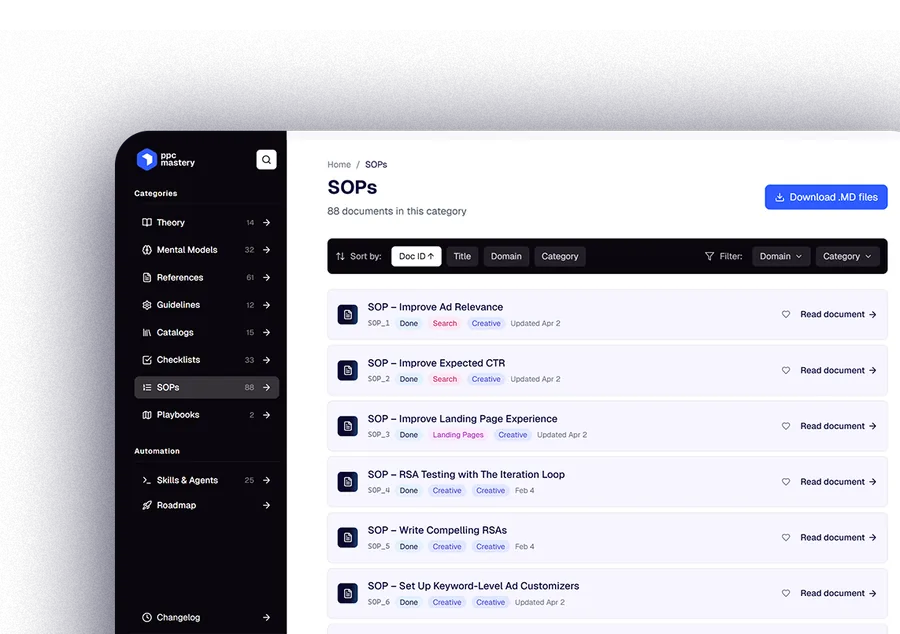
10:23dropping off?" And before, there was like a very manual process of going through all those individual recordings and trying to understand, you know, and take a take away some insights to to implement. And nowadays with AI, it's it's able to run through those those scans so quickly and so accurately that it's like literally fast forward that that whole data understanding process sixfold, so. Yeah. And and apart from that, like getting getting the insights, obviously you're connecting to different tools through through APIs. Are you using Claude Go for Claude Go for that, by the way, right now? Yes. Yeah. Pretty much everything I I had a meeting with with Alfred where I told him that I wanted to to build all these systems and build them out separately, and he's like, "Seth, why would you want to do that? Everything's in your company. You want everything to be aligned." And I was like, "You're absolutely right." And then that kind of changed the the whole philosophy about how we build on top of it. So, now we've got the OS as the base system, and then all the tools and stuff that we want, we pretty much connect to to your guys' system.
11:24Yeah, super cool, man. I love what you're doing with that, because that's ultimately how like how we envision PPC OS to be used, because well, there's a lot of skills in there and the knowledge base is is really good, but it also allows you to just build on top of it to to create your own solution that is fitting for you because, well, what you need might be different from what someone else needs who may not even be going so deep on the on the on the website stuff as you guys are. So, it's really cool to see how you're really like customizing that. That's like the ultimate goal what we had envisioned is is is coming is coming out with with you guys, for example. So, can you maybe talk us through a little bit what how you use AI AI on a daily basis? Like just maybe some examples and how that has changed how you work because I I remember in the round table that we did, you mentioned that your basically not looking into the account as much anymore as before and you're working much more from from the terminal with your agents. But, yeah, can you just talk us through what has changed and what what is maybe something that you tend to use AI for the most versus what you still do, etc., etc.
12:32Yeah, so it's changed quite drastically. I seldomly go into into the Google Ads dashboard besides actually checking that implementation has been made and yeah, always just good to have a a bird's-eye view over that, but pretty much everything's text-based in the in the AI agent or in the PPC OS where we go in and we'll see the state of the account, we'll see what needs to be improved, and then we'll go through renditions of what needs to be improved, what the recommendations are, and using our better judgment because, yeah, it's one thing that I've really noticed is that you can be very easily become a yes man with these systems. So, it's really important to always be the final call and it's actually, yeah, something I want to chat about a little bit later about how we've built our our team out and how it's how it's changed quite drastically because of that. But, yeah, in essence at the moment like everything's quite quite chat-based where we're seeing what needs to be changed in the Google Ads account. We've got connectors up with all of the different platforms, Shopify, WooCommerce, WordPress, and essentially we're connecting all the different elements. So, it will be Google Ads, for instance, we go in, we see conversion rates low, we then go and we'll run a Microsoft Clarity to understand what's going on with that traffic. Do we need to make changes or is this just a little blimp in the system or like a little blimp in data where it's actually better not to make changes because if you make too many changes, then you can just undo all of the things that you have done.
13:56And then it kind of dictates, okay, do we need to do an AB test? Do we need to make changes to copy? Do we need to do Yeah. That's kind of how we're using it at the moment. And then pretty much all action is done through the agent. So, we'll say, go and make this change to the Shopify site, and then it makes the change to the Shopify site in real time. And you can do that by connecting to the API, right? Very much so. And Shopify's been quite generous with their AI agent system. They've got a whole a whole methodology about how you connect safely and how you should do it. So, we've pretty much integrated that entire system into the into the system. System into system. Nice. Yeah, that that saves you so much hassle of going into the Shopify account and then finding the right buttons to click. And it it always took so much time, right? And now you can just do it through like on the on the background, it goes in automatically through through the agents.
14:49It's such an exciting time that we're living in. It's like anything I want like to build or or what is in front of me, like I can build it within a matter of seconds and then revise it in a matter of seconds as well. It's it's insane. Yeah, I was just uh working on some stuff as well before this before this call. And I was looking for some insights for one specific client, but I I didn't really know where to look. And then I was like, why am I even looking for this myself? So, I just opened a new chat and asked, can you pull up what we said about those insights for those clients? And then within 30 seconds, I got the the the folder the file and everything that I needed to know just presented to me in in that way. So, yeah, it's definitely crazy crazy times, man. Crazy. So, what is something that or maybe we can yeah, maybe we can pivot to what you just said around how your agency has changed cuz I think in the round table in the PPC Hub we didn't go too deep on this and we spoke to each other last year when when I was in Cape Town and yeah, you back then you were kind of like thinking should I grow the agency?
15:53Should I hire more people? Work with more freelancers? And then in the round table you said that now you're working with AI. So, you feel like you you have a lot more capacity for yourself to do more. Where do you currently stand and what's your vision in terms of how you look at your agency head count, hiring people or not? Yeah. Yeah, so before like we had a team of about six people all junior to to mid account managers and once we started implementing AI something that I did notice is the yes man effect because then people become over reliant on what the AI recommendations are and unfortunately we're still in a state where AI hallucinates. So, yeah, it's really really important to really sift out and be able to deduce what's going to be an impactful recommendation or what's really going to hurt your account or hurt the account as a whole. So, understanding the base theory and fundamentals has become more and more important nowadays than it ever has before. So, yeah, something that's changed at at Searchly we reduced all of those or we got rid of all the juniors in media media or they kind of were a little bit mediocre but we got rid of quite a few of the staff and essentially now all we do is we hire senior staff. So, we've got a see we've got two senior staff members who have been in the in the game with Google Ads so long that it was it wasn't even called Google Ads.
17:17It was Yeah, even before my time, truthfully. AdWords, yeah. AdWords, exactly. Exactly, sorry. Missed my moment there. But, yeah. In essence, this changed quite drastically. I only I really want people to push back on the AI, and that's like something that we really enforce at Searchly is not to be a yes-man and to really question, is this really going to assist the account or is it going to demolish the account? Man, such an important point. And I I I kind of feel for the juniors starting out now because, man, I I had the same, especially as the now it gets a little bit technical, but for people who haven't used agents before, but especially when the context window starts to to fill up and you're you're getting more you're using more tokens in one specific chat window, then the hallucinations really start to to pile up after after a certain point. And I had I had the same thing. I was working on something, and it it was just incorrect, and it it paraphrased me with something that I hadn't even said. And I was like, "Where did you get that?" And he's like, "Oh, sorry, my bad. I I totally put those words into your mouth." And then, yeah, you you really have to you need And then, if you're working with client budgets, then, yeah, man, that can be really dangerous.
18:29So, I kind of feel for the juniors who grow up now using these systems already and then maybe not having the right expertise to be able to judge when it is actually correct or when it's when it's not. So, you at Searchly Yeah, go ahead. Oh, I was going to say for the for the juniors, I'd almost recommend not using these agents until you've got a fundamental grasp on it because it's just it's too it's too fast-paced. I mean, you could make massive changes in the accounts, and yeah, especially cuz now API it can you can literally make changes. It's not just like, "Oh, we recommend you do this." Or maybe you have it on guardrails where you go down that route, but yeah, I'm really fearful for the the juniors at the moment. It's a really tough space to be in and it's just getting hotter and hotter. For sure. And then the read-only stuff becomes even more important so that they can probably just not in the beginning make changes directly through what like what you're doing now.
19:27Exactly. As an agency Sorry, I cut you off there. No, sorry. Yeah, go ahead. I was just saying as an agency owner, it doesn't make sense to have people that are are far less productive than you know, someone senior or someone that can make that decision and action thereafter. I mean, yeah. It's a hard one. As a smaller agency, for the bigger guys, I guess it makes more sense cuz they have to train up talent, but Exactly. Exactly. Yeah, that was that's what I was going to say as well. Like for you, what what's your head count now? Three. Yeah, exactly. So, there's always this thing in the agency world like the people are flexing with the head count, but it doesn't say anything. There's always different goals and yeah, just different operational models. But for you, you've chosen the the senior route, which I think a lot of agencies of your size are going to do because then you don't have to have all the overhead and all the extra time that you have to spend on training the juniors, but the seniors, they can just you can plug them in straight away and and and you can trust on their existing expertise.
20:27Exactly. Whereas indeed the the the the big agencies, they might have more resources and time to to to train those junior levels and then junior junior level specialists who are usually cheaper, but then it comes with the cost as well where you have to train them and well, potentially issues that can arise from that. Yeah, but then the problem is there's also the tasks. It's like the AI agencies nowadays like have replaced pretty much all the tasks that Not all, but there's some things that still need to be manually done, but it's pretty pretty much replaced like 90% of the manual tasks and the the labor intensive tasks that the juniors would normally work on. So, it's Yeah, it's it's going to be a very interesting time ahead for these bigger agencies and Yeah, for sure. Yeah, it requires a change of of the operating model, right? You You are doing that because you're not like sort of this legacy specialist or legacy agency where you only focus on growing the account. Like you take responsibility for growing the business, right? That's why you do those the the website stuff, the CRO stuff.
21:32I think that we're trying with clients now is I really want to come in as a a fractional CMO and take on that responsibility, which is something that we're playing with at Searchly and trying to like get into that phase with our clients because Yeah, when you see the growth that can happen from Google Ads and and really the CRO side of things because every channel becomes more efficient. It's just like not not not in a greedy way or any form, but like you really get invested in growing this company and you really want to not necessarily take more from it, but you want to grow with it. And doing that CMO role gives you that. Absolutely. And I at the BPC Summit in 1 month, we have Mike Rhodes. He's speaking. He's the last speaker on the on day one and he's going to be talking about when a lot of the execution is automated or commoditized, like how do you still charge for the value that you bring? Cuz I think a lot of specialists and agencies, they are stuck in the old way of charging, which is either hourly or for the Google Ads work. But they kind of Yeah. Well, if all of that is automated or or Yeah, done by agents, then you're kind of automating your own fee away. Have you made changes at Searchly? You don't have to get into specifics of what you actually charge, but have you made changes to your to your pricing model?
22:51No. We're just more efficient. Clients get I think if you can provide value, that's the the main thing on on costing and charging. Like clients are now getting results a lot faster and seeing changes like we've literally one we came for example like we had a client that came in with this really broken WordPress website on a on a WooCommerce site. Within two days we rebuilt their entire website to Shopify and we can increase the conversion rate by 40% just by having a a better system in place. Wow, that's crazy. And I mean for the traditional route I mean that would have taken a traditional agency or a non-AI equipped agency months to rebuild the website. They literally told us that their previous developer took six months to develop what that what we just rebuilt in in a weekend which is wild.
23:44Yeah. Do you have a certain philosophy on on what a good landing page looks like? I think I think that the one word that I can break it down is is clear call to actions and trust. Mhm. And that's that's pretty much our philosophy. If you can prove those three or prove trust and that you can show that there's a clear next step then it's it's pretty much not going to work if if the offer isn't right but but those are the the fundamentals we like to look at. Yeah. And you said you guys only work with e-com, is that correct? No, so we work with quite a lot of lead gen businesses as well and this is like been really impactful with the agent recently as well because what we've been doing is we've been building out like we've got our own subdomain so we've got so we pretty much have created full CRM systems for the clients and it like integrates directly with Google Ads so like offline conversions are sent directly which has been amazing. And not working with like legacy or like hard stops with like a HubSpot or a Zoho or a Pipedrive or any other CRM system like having custom CRM systems have been insane. So yeah, e-com, lead gen, I've I have veered away though from like the big B2B's just cuz yeah, it's not my favorite space.
24:59Yeah, it's different different game. Do you have any examples of when AI you already mentioned like the hallucinations of when AI is not perfect cuz I always try to balance these things out when we're when I'm talking about it on in my content because it's easy to really hype up AI and AI agents and because partly it is also true like you also said like it's super exciting to be working this way and most of the people who are using People COS have told me like I'm having so much more fun now doing the work than before. But there's also a a counterpoint to that where AI is not perfect, it hallucinates, it makes mistakes. Do you have some examples from your own experience where, well, AI was just not that great? Typically we keep our context windows and we keep those like quite small to try and avoid the hallucination and we've got like great systems in place that I haven't really found huge effects from it. Like the biggest stuff is like, oh, it said it went live with a campaign and then it it actually didn't and then you get a little bit maybe reliant on the fact that it said it did and then you didn't actually double-check that and then, you know, you're kind of stuffed because it was meant to go live like a week ago or 3 days ago or so or just on the Friday and then it ran the whole weekend without it being on. But I haven't really experienced any major hallucinations. Yeah, which I think is just an attribute or is is because of the amazing system that you guys have built that's got so many guardrails and so many things in place that just does eliminate quite a bit of the hallucination.
26:34All right, that's great. That's great to hear, man. All right, so lastly, for people who are interested in either two directions, people who are interested in finding out or learning more about CRO landing pages and how to integrate that into their into their stack of how what they offer to their clients, what what would your advice be to them? And for people who are interested in using AI AI agents in their daily work, but have maybe they're a little bit skeptical or they just don't know how to start, what would you say to them? So, let's start with the with the CRO landing page stuff. Yeah, so from a CRO landing page stuff, the the first thing I would go look at as a Google Ads specialist is I would go look at your quality score. Like that's going to be the main determiner of your sorry, your quality score and your conversion rate. If your conversion rate for lead gen is is fairly low or e-commerce is low, then you've got some serious work to do.
27:28And essentially where I would kind of start there is is actually I'd ask your your grandmother or I'd go onto the page and I just like understand why it's really difficult to go through. And then what you can do is you can pretty much get the the agent you can get Claude, you can get ChatGPT, you can get them to pretty much build brand new landing pages out. And then yeah, you don't necessarily have to take on that whole new skill set. You can pretty much build out what needs to be on the page and then you can work with a developer. Or you can send that to the client these are recommendations and the client will really appreciate that you're going beyond your previous scope to say that okay, this is affecting this and if we could do this, the sales will be or the the leads will be, you know, increased. So, I think just justifying that and working through that and what's really great is that there's so many great examples and skills built into the the Parrot OS system that it will pretty much guide you along the way.
28:23And yeah, feel free to reach out to me on and ask me to grade your your landing pages. I'd be happy to to assist there. Nice. Where can people do that? In LinkedIn? Yeah, on LinkedIn. Yeah, on LinkedIn or if you're in the hub, reach out to me on the hub directly. Either way. Yeah, cool. I'll I'll link to your LinkedIn in the in the descriptions. So, then maybe final question is just out of personal interest, when you draft your landing pages, do you create wireframes and then you send it to a developer to to create? Do you create wireframes and then build it out in Shopify directly? Do you create HTMLs and then in Shopify directly or anything else? Like what what what does that process look like for you? Yeah, so we pretty much don't use any wireframes whatsoever. We go straight to the hardcore implementation. And essentially we're always doing it like as a draft version, so it's never live to the the client or to to the public.
29:17And how we build those out is essentially we've got like a bit of a framework that you need to have a very very similar to the like all the information's there in the PPC Hub, like how things should be laid out. Like there's great fundamentals there. So, we pretty much use a lot of those fundamentals making sure that there's a clear offer, making sure that there's clear trust, and making sure that it's easy to go through. And essentially like we build pages out on those recommendations. We'll then look at the live visualization of it because it's built out in real time. And because it's so easy nowadays with with AI to to iterate so quickly, you could say I don't like this, I don't like this, I don't like this. And then because you've got like the the Chrome DevTools installed as well, it's like AI can look at it without you having to take screenshots or or correct itself. It can very easily self-correct itself. So, it's it's been really yeah, just having that iteration and then you can be you can do it so quickly that you've got like I did one where where we iterated so much that we were literally at like version 37 and we were literally like 30 minutes in.
30:21Not even. Dude, so it's so crazy because I sometimes forget how much in a bubble we are because for people who aren't using AI agents yet, they might be listening to this and thinking like, "Whoa, Chrome DevTools and then AI can look at your landing page? Like what?" So, because we're using it now for us and in the PPC Hub I see it as well like the way that people are having conversations is is changing because you're talking about these things like just connect from dev tools MCP servers connect API blah blah blah. But it's it's it's it is just mental like also when you have a draft for a landing page and then all of a sudden you see a screen pop up because the play right MCP has opened the the landing page itself just for you to look at for for itself to look at. It's just yeah it's it's it's so crazy man and we're living in such crazy times and this is this is not even the final form yet. I know. I I did want to ask you what are your thoughts on these new watermarks?
31:16Like I know that it's a new it's just come out on all the new models like what's what do you think the the impact of those are going to be like? Do you think clients are are going to ask why is this all AI? Do you think that there's going to be a huge effect? Do you do you mean watermarks in terms of like labels that this this was created with AI? Well essentially the the new stuff from Claude like that they've just come out in the EU is that essentially underneath each set of text that or anything that comes out of Claude is going to have a watermark and I think it's going to be the same with ChatGPT as well. So like I'm really like that's the only thing I'm worried about this AI bubble at the moment is like this this new watermark. Yeah. I don't know I haven't actually I see it's a few days old or maybe two weeks or so. I haven't actually looked at it yet but just thinking of it myself now I think it makes sense if it's in the EU because there's much stricter rules here than in in other I see it as well on on a lot of content now online both ads and organic with this like little badge created with AI. I think ultimately for the internet I think it's a good thing that it exists because my father he's 74 73 too and he sent me some some content and it was obviously AI but he didn't know you know. So, I think for the general internet and the the trust levels of the internet, I think it makes sense that we're going to see more regulation in that regard.
32:46I don't know if those watermarks are actually going to be harmful because the bots see them and then they automatically devalue it as being created by AI. But then, I think it's also going to be countered by how people actually use it. Cuz on LinkedIn, you have this you when someone posts something or leaves a comment, you can now mark it as AI slop. Like literally, you can hit the the three dots, yeah, and you can it's literally says, "This looks like AI slop." And then you can sort of report it as as AI slop. So, I think for those for those kinds of things, it's it's it's pretty good. But then, I think the systems like the algorithms of Google and whatever, they will also all I think they will also factor in actual user behavior and then see like if a website is has the watermark and it is and it's just badly performing, then I could foresee that it will would get flagged.
33:45But if it has a watermark, but people are still using it, clicking on things, going to the next steps, then I don't think it will be that harmful. But yeah, we'll see. That's just my take. What do you think? Yeah, I I don't know. It's really interesting cuz I feel like some clients are going to say, "We don't want you to use AI on our stuff anymore." And then you kind of hit them with okay, they will be six times less productive on your account. There's also going to be like an element of like from a ranking perspective, from an SEO perspective, I'm interested to see what that effect is. But yeah, ultimately, I think it's really going to affect the academic world, but in the professional world, I don't think it's going to it's like the next it's like when people were handwriting or or using or like had to write out books. And then they used the printing forge, you know, like or printing press, sorry. So, this is just the next evolution. So, it's kind of if you're if you're not using it, you'll you'll feel the effects of it and you are you'll deal with the consequences, but you're more productive, I guess.
34:43Yeah, and it is it is still so early. Like it is it's super super early and and the developments are going so fast. So, there's no way of knowing where we'll be in in one or two years. But I think what you said like for clients that may say don't use AI as much, then that is an objection, but they they don't really mean don't use AI, but there there's something else behind that objection that No, I had a client that came in and said, "We do not want you to use AI." And I said, "Well, I have to accordingly." And then I I I I literally hit them with a six times quote. Cuz I said we work six times less effectively and they were like, "No, you can actually just use AI. It's fine." [laughter] Yeah, exactly. So, for them it's not like, "Oh, oh, you said this is six times Okay, cheaper? Okay, fine. Just do it." No, I had, but they probably have seen a lot of AI slop and then they're like, "Oh, no, we don't want that type of cuz I something else like sidestep when I started before I started my career, I was trying to set up a Facebook ads agency with my brother. I was just fresh out of high school, didn't know anything. I found the Ty Lopez social media marketing agency course and I tried that and we went to a chiropractor in our in Amsterdam and we asked her like, "Hey, would you be interested in setting up ClickFunnels because we think we can get you more leads, blah blah blah." We didn't know anything. And she was like, "No, I don't want ClickFunnels." The we were probably like the third or fourth person who tried pitching that to her, but she got really fed up with the word ClickFunnels and it she had some sort of association with that. Whereas, it wasn't about the actual tool or the funnel, but it was
36:19more about the association that she had with the word and with the people that tried to to to pitch her the business constantly. And I think that's the same with a business owner like that who says don't use AI. They've probably seen too much AI slop so that they think no, you're going to create slop for me. I don't want that. But then they see how you actually work with AI. You can be six times more effective and the conversion rate increases by 40% and I think that objection is going to be totally gone. That's Yeah, I'm not willing to work with AI anymore. That That's my my take. No, no, yeah, for sure. Then if the client is really like regiment and they they say no, don't use it, then it's probably not a good match for you anyway. Exactly. Exactly. I can't You can't change your whole your whole business model and how you operate just for for one client. It's going to cost you I keep using the number six, but it's it's probably cost you like 36 times because you have to change your whole to be operationally efficient for this one client. So True.
37:20All right, Seth. That was a great talk, man. Yeah, people can follow you on LinkedIn. I'm going to drop your the link to your profile in the description. Thank you so much. Thanks everyone for listening, watching. Don't forget to subscribe and all that stuff and then we'll see you in the next episode of the PPC Mastery podcast. Thank you, Seth.