GM, Miles here!
When I look online, I still see a lot of skepticism around using AI for Google Ads.
A common sentiment I see is that you can’t trust AI with your account data.
Earlier this year, I shared that sentiment because AI fell short for me in 3 main areas:
- It doesn’t know what good or bad looks like.
- It can misinterpret context because it misses nuance about a task or project.
- It can produce bad output that could harm your results.
Bob and I understood the power of AI… But it just wasn’t working for us at the level that we wanted.
We realized it is because AI uses the generic knowledge from the web to give recommendations (which is often outdated, contradictory, or just wrong).
So we decided to build our own AI-first knowledge base (PPC OS), and it’s been the biggest “gamechanger” for us (I know that’s an AI buzzword but it’s absolutely true in this case).
So now, whenever we use AI, it doesn’t reference the general, outdated, and contradictory knowledge from the internet.
Instead, it references our own knowledge base.
And boy, does it make a difference.
Today, I want to dive deep into PPC OS, how we structured it, why it works so well, and what you can learn from that if you want to build your own AI-first knowledge base.
Let’s dive in!
Without a custom knowledge base, AI is averaging every opinion ever published about Google Ads. And that’s a big problem.
AI might seem smart, but by itself, AI doesn’t know anything.
Whenever you talk to it, it factors in whatever it can find online to give you a response back.
I see 3 major problems with that:
- We work in a fast-changing industry, and information online quickly becomes outdated.
- There is a lot of nuance in how tasks can be completed, with differences per vertical and business, or even per specialist.
- All of the information online was written for humans, not for AI. So whenever AI references it, it quickly skims through and only keeps the core and discards the rest (increasing the chances of dismissing important nuance which leads to making mistakes).
Just to give you a simple example: I’ve had AI recommend placing bid adjustments on my campaigns for devices and day of the week, not realizing that those don’t do anything when combined with Smart Bidding (which was active on my campaigns).
An AI-first knowledge base informs your AI what’s good and what’s bad.
With PPC OS, we tried to solve those 3 problems I listed above:
- Our knowledge base is always up to date (based on what works now in real accounts).
- We try to factor in nuance per vertical and business type into our knowledge base.
- And it’s written for AI, not for humans. This makes it hard to read for us, but easy to process for the robots.
An inside look at the AI-first knowledge base powering PPC OS.
Real quick: PPC OS is the AI-powered operating system that you plug into AI so it knows how to execute a certain task.
It’s powered by our AI-first knowledge base, consisting of 250+ docs:
- 30+ mental models (frameworks on what drives results today).
- 60+ references with technical specs on how Google Ads works.
- 10+ guidelines on how to think through certain decisions.
- 15+ catalogs with examples of what good looks like.
- 30+ checklists to validate quality of the output.
- 80+ SOPs on how to do certain tasks.
- … And more added every week.
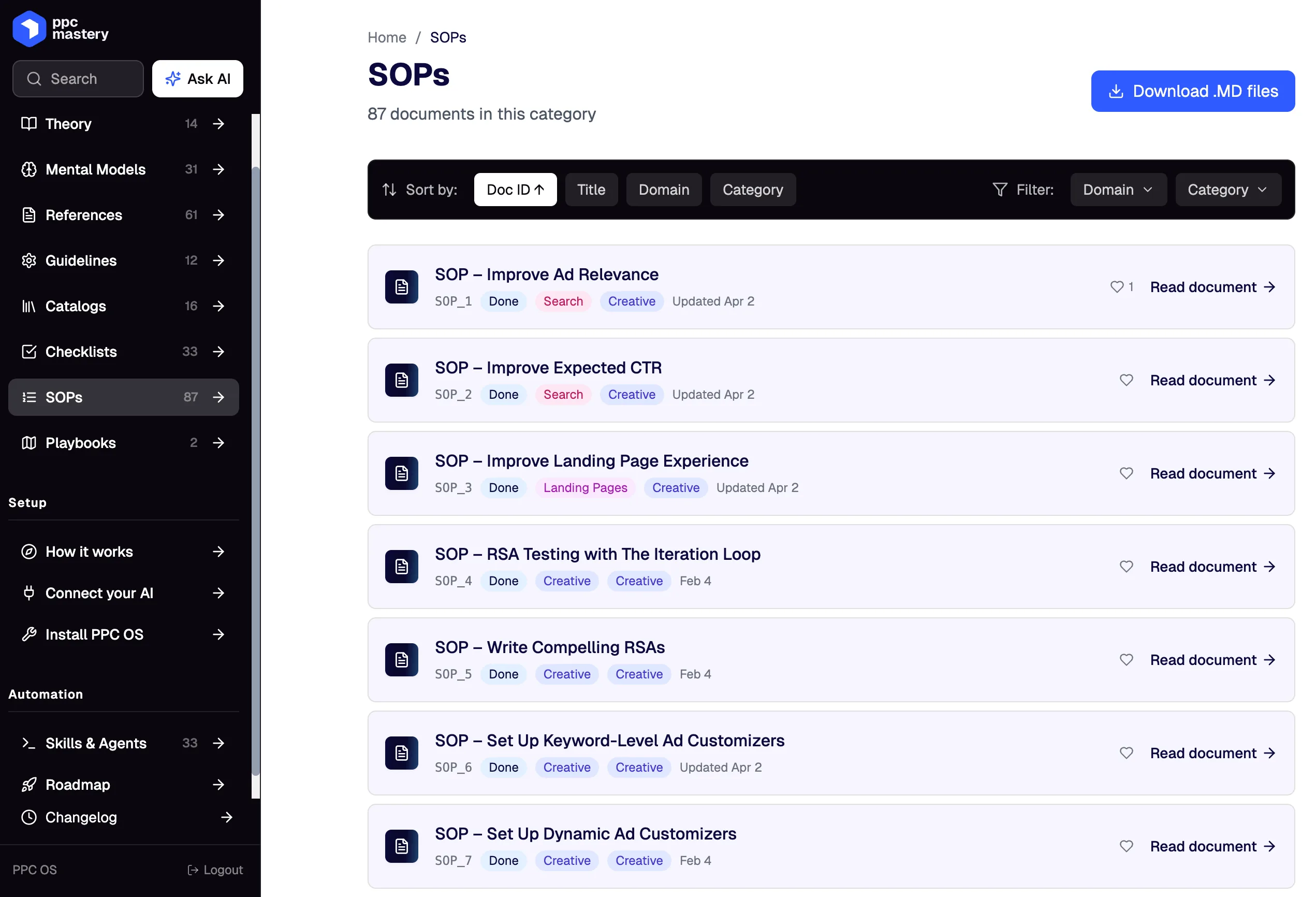
These are not simple docs.
Conservatively speaking, I think the average doc is about 20 pages long. So just imagine the depth that goes into it.
(If you’re interested, Bob showed a 10-min demo of the PPC OS knowledge base in this video)
Here’s a quick look at the “Write Compelling RSAs” SOP (Standard Operating Procedure).

It’s 20 pages long, with clear AI-first instructions so there is no room for error:
- Required inputs: what AI needs before it even starts.
- Reference docs: background info on the task.
- Decision gates: nuance for different situations.
- Execution framework: what it actually needs to produce and how.
- The phases of execution: step-by-step instructions.
- Checklist: double-check if all steps were actually followed.
- Validation & definition of done: explains when the task is done.
- Exit → entry bridge: what to do when issues pop up.
- FAQ: extra info for AI to process so the output is good.
- Common failures: so beginner mistakes don’t get made.
This is just for 1 SOP: writing compelling RSAs.
It might seem like overkill, but it’s actually essential to write high-converting RSAs.
Without all of these instructions, you give AI too much freedom to decide what to do and in what order, what good looks like, and when the task is actually finished.
Documents are cross-referenced so AI stays focused on executing the task in line with the knowledge base.
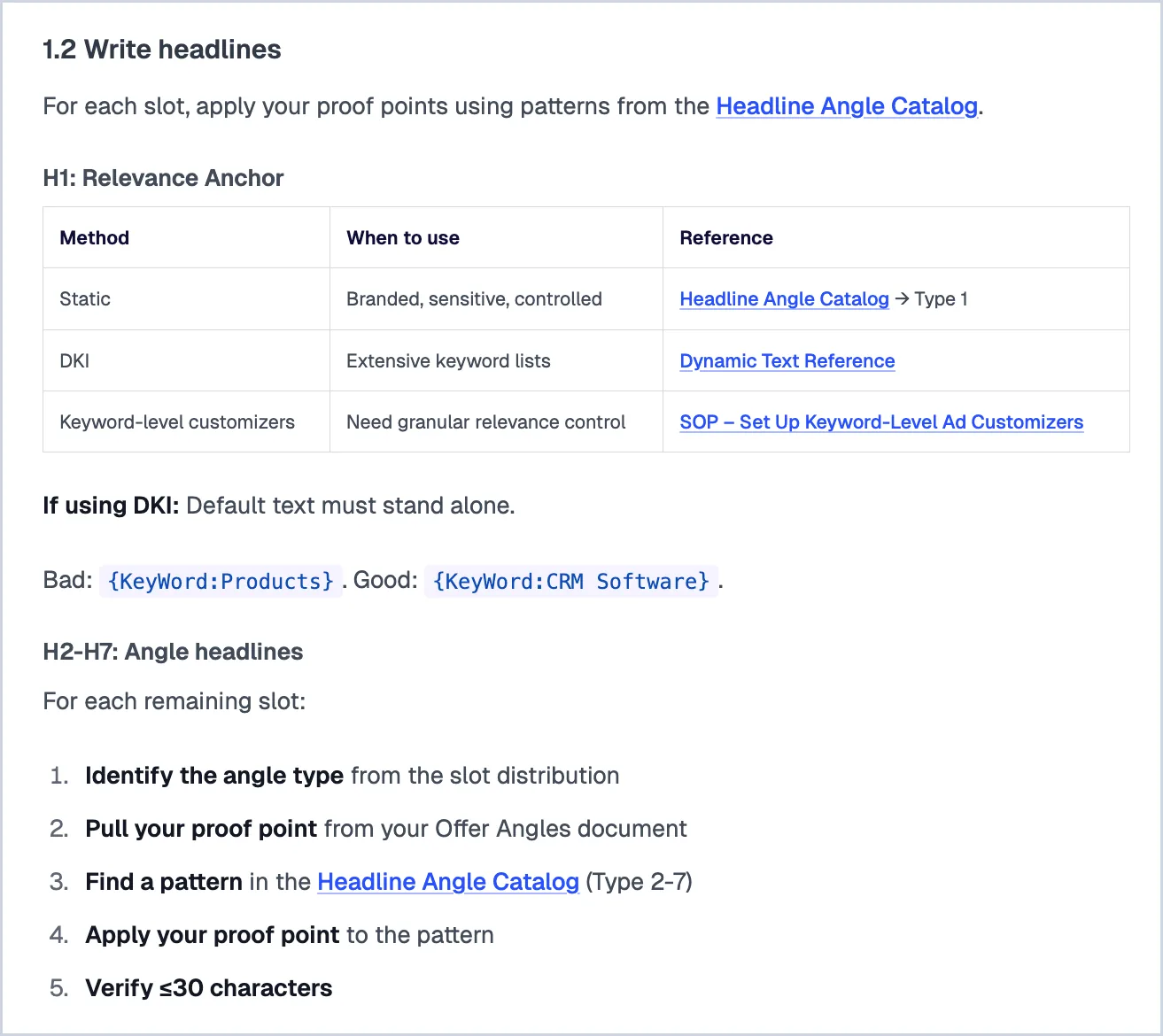
This entire database is then turned into skills, so AI can reliably execute real tasks without constantly repeating yourself.
This is where it becomes interesting.
In case you’re unfamiliar, skills are repeatable tasks that you can trigger automatically with a tool like Claude Code or OpenAI’s Codex. That way, you won’t have to repeat instructions or write endlessly long prompts every time you ask AI to do something.
A skill is basically a file with a long prompt.
Our “rsa-maker” skill generates Responsive Search Ads from offer angles and brand context, outputted in a CSV file ready to import into the Google Ads Editor.
It looks kinda scary, but it’s not. It’s just a bunch of text formatted in a way so that AI can process it easily. The instructions in the skill file are incredibly dry and hard to read for humans — but AI can process it very quickly.
And that’s exactly why it’s so powerful.
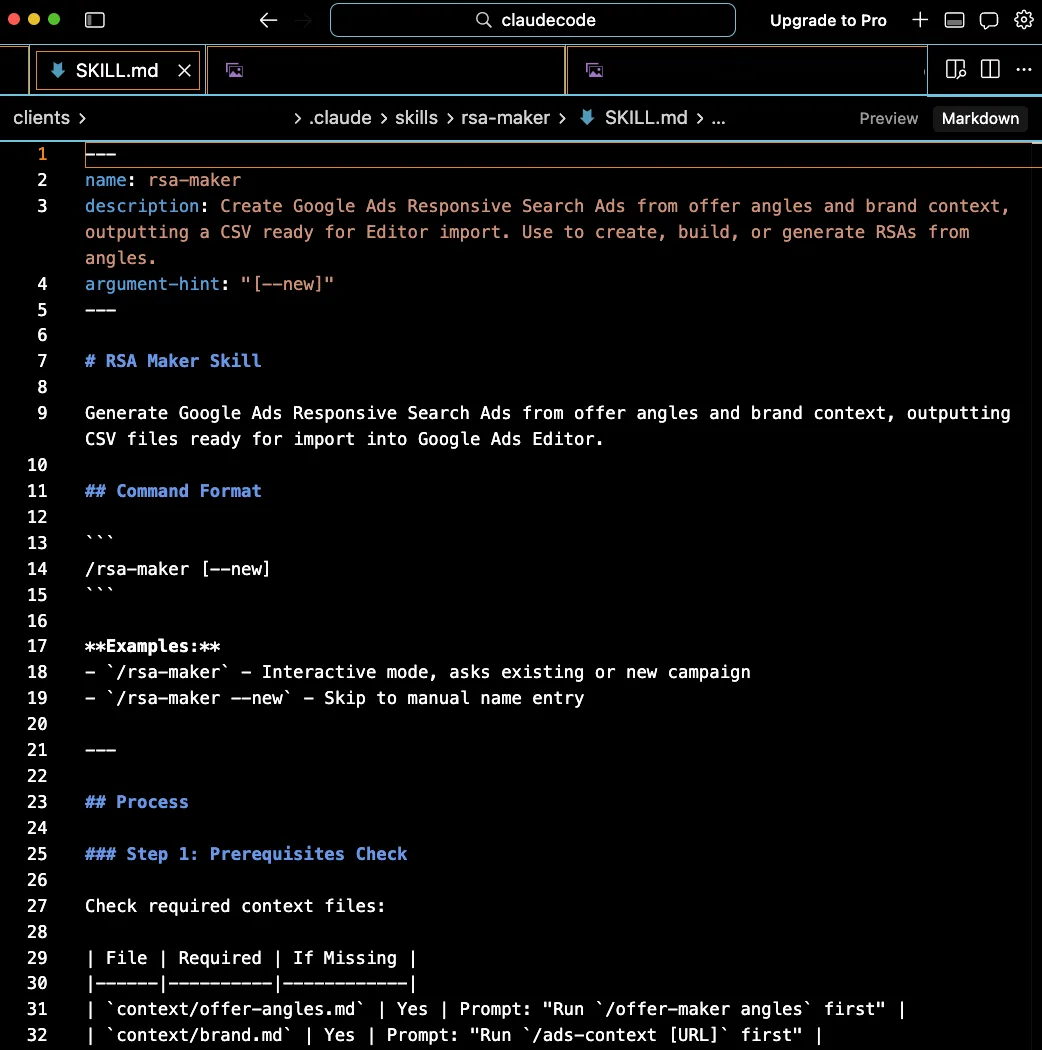
Our rsa-maker skill file is about 25 pages long.
Inside, we’ve integrated all the relevant knowledge docs I shared above so AI can reference the right materials without overwhelming itself with anything that’s not relevant.
All I have to do now, is type “/rsa-maker” in Claude Code, and my agents produce high-quality RSAs that factor in offer angles, keywords, USPs, the value proposition, benefits, social proof, risk removal, call to actions, and more.
And this process is repeated for every Google Ads task you can imagine.
Inside our knowledge base, we have 80+ SOPs that are turned into skills. For example:
- Typing /account-audit triggers a full account audit across pre-defined checks.
- Typing /pmax-auditor audits Performance Max results and cannibalization.
- Typing /bidding-optimizer audits your bid strategies and targets.
- Typing /feed-auditor audits your shopping feed.
- Typing /budget-optimizer audits your budgets.
- Typing /lp-audit triggers a landing page audit.
And we have many more skills for nearly all the nitty-gritty daily optimizations and checks like keywords, search terms, Quality Scores, placements, campaign structure, offers, RSAs, tracking audits, and more.
Essentially, we have:
- Auditors that find problems.
- Optimizers that fix them.
- Builders that make things (like ads).
- And context and research skills to give your agents more relevant business info.
We’re currently building skills to get deeper performance insights much faster — and we’re constantly adding others as well.
But all of this is only possible because we have spent time building out our own knowledge base.
Now over to you: how do you actually make this actionable for yourself?
Creating an AI-first knowledge base is incredibly boring, but so important.
It is THE difference between having AI that produces mediocre garbage and having AI that actually executes tasks like a top specialist.
The downside is that it takes time — and a lot of it too.
If you want to build your own Google Ads knowledge base, get ready to set aside hundreds of hours over the next year or so.
If you work at an agency, do NOT let your junior specialists do this.
The quality of your knowledge base directly impacts the quality of your work, so a senior should build it.
It’s a full-time job (we know this because we spent the last year building our own).
So if you are brave enough to try and build your own AI-first knowledge base, do this:
- Start small, one SOP at a time.
- Film yourself while you’re doing a certain task.
- Explain in plain words what you’re doing and why.
- Take the transcript and feed it to AI.
- Ask AI to turn the transcript into a step-by-step document.
- Iterate & finetune: fill the gaps, give more details, fix errors.
- Repeat for the next SOP.
Again, this is a tedious process and it takes a lot of time.
You’ll never one-shot an SOP: it takes a ton of iteration and finetuning to get right.
Want to save that time? We’ve already done all the hard work by creating our AI-first knowledge base for PPC OS. When you join The PPC Hub, you get instant access.
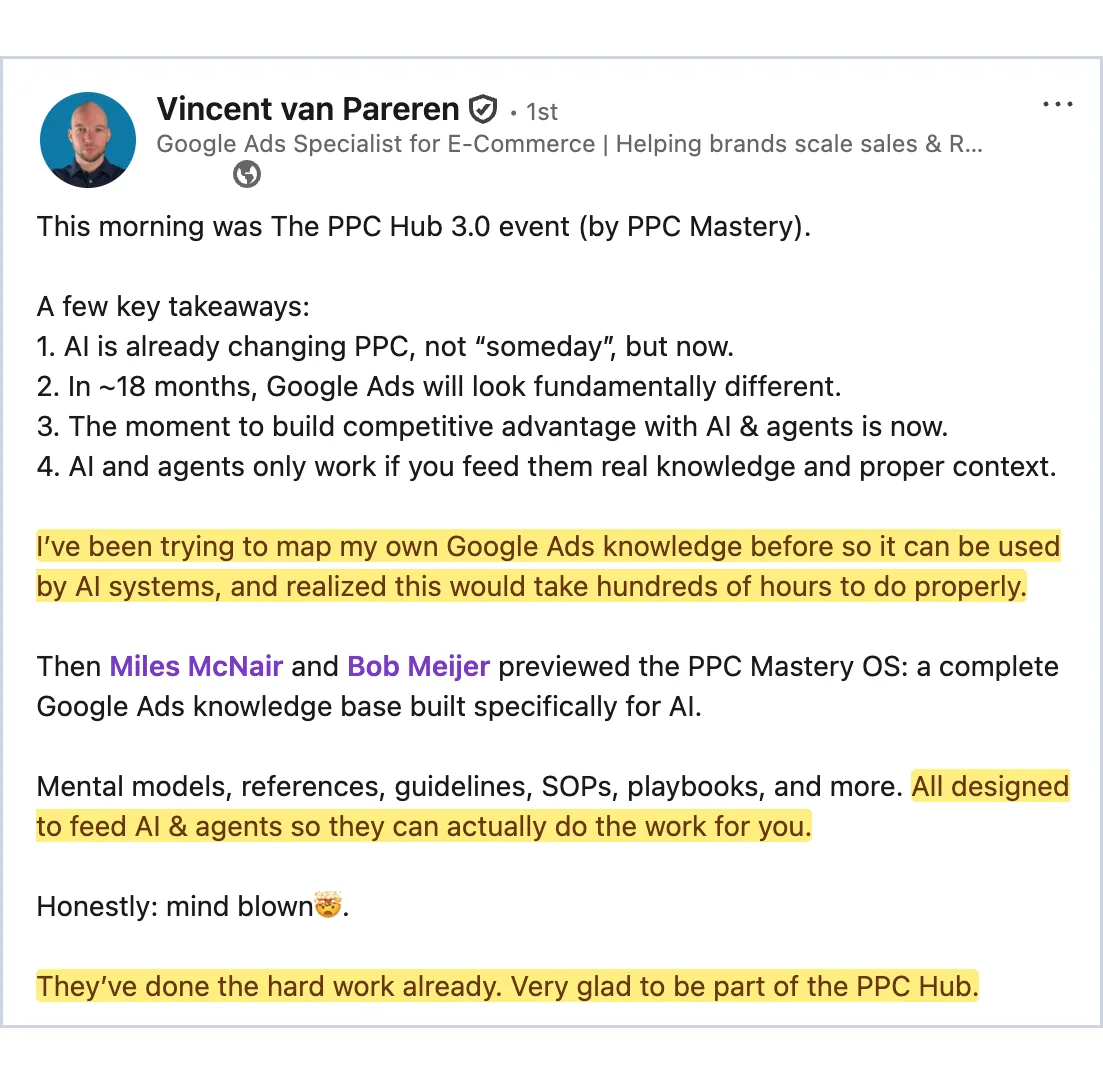
As a matter of fact, between Sep 14-18, we’re hosting The AI Agent Challenge 2.0.
In just 5 days, we’ll help you build an army of AI agents.
By plugging in PPC OS (our AI-powered operating system for Google Ads), you’ll turn AI from a chatbot that is often wrong into a reliable system that actually executes tasks at the highest level.
Join The AI Agent Challenge (exclusively inside The PPC Hub):
Existing member? This is already included in your membership!
- 🏃🏾♀️ Dates: September 14-18 (5-day implementation sprint)
- 🔒 Enrollment closes: September 11 (11:59 pm CEST)
- 🔥 You get: Working AI Agents running on PPC OS
- 🔗 Join The PPC Hub to get The AI Agent Challenge + PPC OS for free
The AI Agent Challenge doesn’t exist to give you more knowledge. It exists to give you a working system — so you can get more done, drive better results, and free up hours every single week.
Hope to see you at the live workshop on Monday, September 14th!
That’s all for today, thank you for reading.
See you next week!
Cheers,
Miles (& Bob)