
TPE #143: Optimizers vs Maximizers: Why Some Specialists 10x Results While Others Chase 10% Gains
Feb 09, 2026Read time: 4 minutes
GM, Miles here!
I watched a video from Alex Hormozi recently where he talked about the difference between “Optimizers” and “Maximizers.”
It’s a simple concept that explains why two people, who both have access to the same platforms, tools, and information, can have such different results.
It got me thinking about Google Ads Specialists:
How come some people drive 10X results, while others grind away making incremental improvements of 10% at a time, that never really compound into anything meaningful?
What’s the difference…?
After watching that Hormozi video, I realized it’s not about talent, experience, or some secret tactic (it never is).
It’s how you think about your role — and where you focus their attention.
So… Are you an Optimizer, or a Maximizer (and which one is best)?
Let’s dive in!
Optimizers: efficiency and incremental improvement-focused
Optimizers are always tweaking, refining, and looking for the next small win inside the platform.
Here's what they typically do:
- Adjusting bids and targets
- Adding negative keywords
- Testing new RSAs and sitelinks
- Restructuring campaigns and ad groups
- Tweaking audience signals
- And all kinds of other in-platform optimizations
Now let me be clear: all of these things are important. They're part of running a healthy Google Ads account.
Every good specialist should do them.
But the problem isn't the work itself — the problem is when this becomes all you do.
The trap that Optimizers fall into is that they spend most of their time on "busy work" — tasks that feel productive and keep them occupied, but don't actually impact results that much.
They're constantly doing something, but rarely focus on solving the #1 problem an account might have.
Their output is generally 10-15% performance improvements at a time.
Sometimes less. Sometimes nothing at all. And when results plateau, they just... do more of the same, hoping something will improve.
The Optimizer's attention split:
- 90% inside Google Ads
- 10% outside (if even that)
The Optimizer's mindset:
Optimizers tend to draw a hard line around “their responsibilities”.
- "The landing page? That's the developer’s job.”
- “The offer? That's a business decision.”
- The unit economics? That's finance. I just run the ads."
This isn't laziness — it's a genuine belief about what their role is and isn't. They were hired to manage Google Ads, so that's what they do. Everything else is someone else's problem.
And honestly, I understand it.
But here’s the biggest downside of this mindset: when results hit a ceiling, Optimizers generally get stuck.
They've already optimized everything inside their defined responsibilities — and they don't feel the need or don’t know how to look beyond it.
So they keep tweaking, and continue to do “busy work”…
And then wonder why nothing changes.
But Maximizers are different.
Maximizers: growth and leverage-focused
Maximizers, on the other hand, don’t ask: “how can I improve this by 10%?” — they’re asking “what would 10x this?”
That’s a fundamentally different question that leads to fundamentally different outcomes.
Maximizers understand that the highest-leverage opportunities usually aren’t inside the ad account.
They’re in the things that feed the ad account:
- The offer (is it actually compelling?)
- The landing page (does it convert?)
- The unit economics (can this scale profitably?)
- The creative (does it create intrigue and stop the scroll?)
- The data input (are we even measuring the right things, and pushing that back into Google Ads?)
The Maximizer’s attention split:
- 30% inside Google Ads (campaign setup and optimizations)
- 70% outside (offers, landing pages, tracking, creative, business fundamentals)
The Maximizer’s mindset:
“If it affects results, it’s my responsibility.”
Maximizers don’t hide behind “that’s not my job.”
They see the whole system and take accountability for the outcome — even the parts they don’t directly control…
Why? Because they know it impacts their results and take extreme ownership for it.
But this doesn’t mean they DO everything themselves — it means they get involved in a client’s business so they can drive the best possible results together.
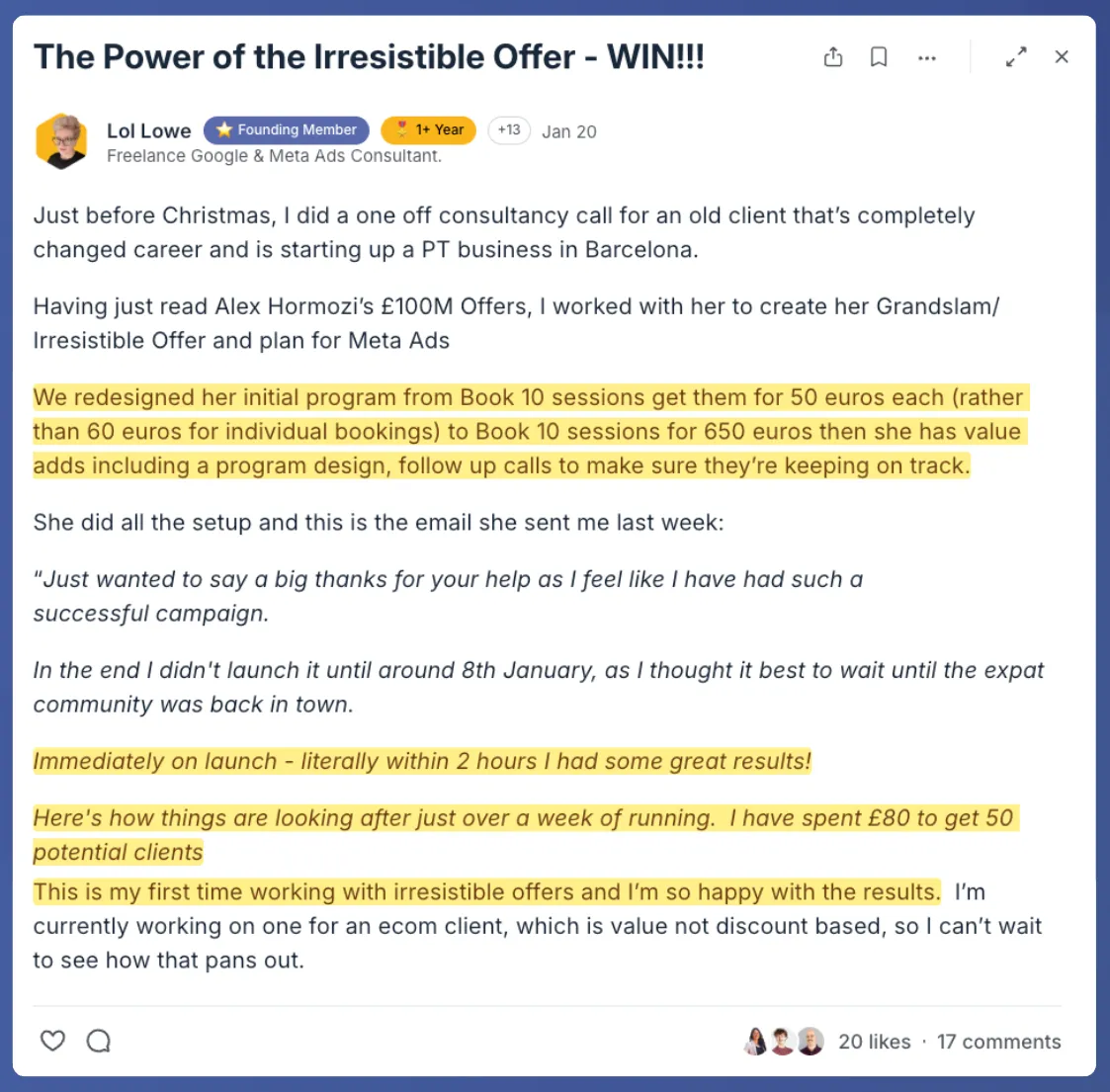
That’s exactly what Lol Lowe, a member of The PPC Hub did: one of her clients was struggling to advertise profitably.
Lol noticed the offer was not strong enough, so instead of tweaking the campaigns more, she decided to optimize her client’s offer.
As a result, she drove 50 qualified leads for only £80 ad spend!
That’s the power of being a Maximizer!
Why most specialists are Optimizers
Nobody teaches you how to be a Maximizer.
Most Google Ads education focuses on in-platform tactics: campaign setup, bid strategies, match types, audiences, ads, etc.
As specialists, we spend years getting really good at optimizing campaigns — but we never learn to zoom out.
Being an Optimizer also feels safer:
- It’s controllable (you can always find something to tweak)
- It’s measurable (you can report “50 optimizations this month”)
- It’s defensible (“I did everything I could inside the account”)
The problem is:
- You can’t out-optimize a weak offer.
- You can’t out-optimize a landing page that converts at 1%.
- You can’t out-optimize unit economics that don’t support profitable scaling.
You can have the most perfectly structured account in the world — and still hit a ceiling when the #1 bottleneck isn’t in Google Ads.
Lastly, the value of pure Optimizers is dropping fast because Google has automated many of the things they used to do to drive results.
The sweet spot: think like a Maximizer, but operate like an Optimizer
Here’s what I’ve learned after managing €100M+ in ad spend across 100+ clients:
The most important skill to have as a Google Ads Specialist, is being able to identify the #1 bottleneck that’s preventing a business from growing to the next level.
When results plateau, Optimizers dig deeper into the interface.
But Maximizers zoom out and ask: “What’s actually limiting growth here?”
- When Optimizers win: Sometimes it actually IS something inside your campaigns, and then you need to have an Optimizer’s eye for detail and understanding of campaign tactics to get unstuck.
- When Maximizers win: Sometimes it’s something outside of the account, like the offer, landing page, the tracking setup feeding garbage data to Smart Bidding, or poor unit economics that make profitable scaling impossible. That’s when you need a Maximizer’s big picture thinking to get unstuck.
Not all of these are Google Ads problems — but they’re problems that INFLUENCE Google Ads results massively.
The specialists who win aren’t just better at campaign optimizations. They’re also better at diagnosing and solving problems across the entire funnel (both inside AND outside Google Ads).
This is exactly why we built the T-Shaped Google Ads Specialist model
If you’ve been reading this newsletter for a while, you’ve heard me talk about the T-Shaped Google Ads Specialist.
This concept — Maximizers vs Optimizers — is exactly why that model exists.
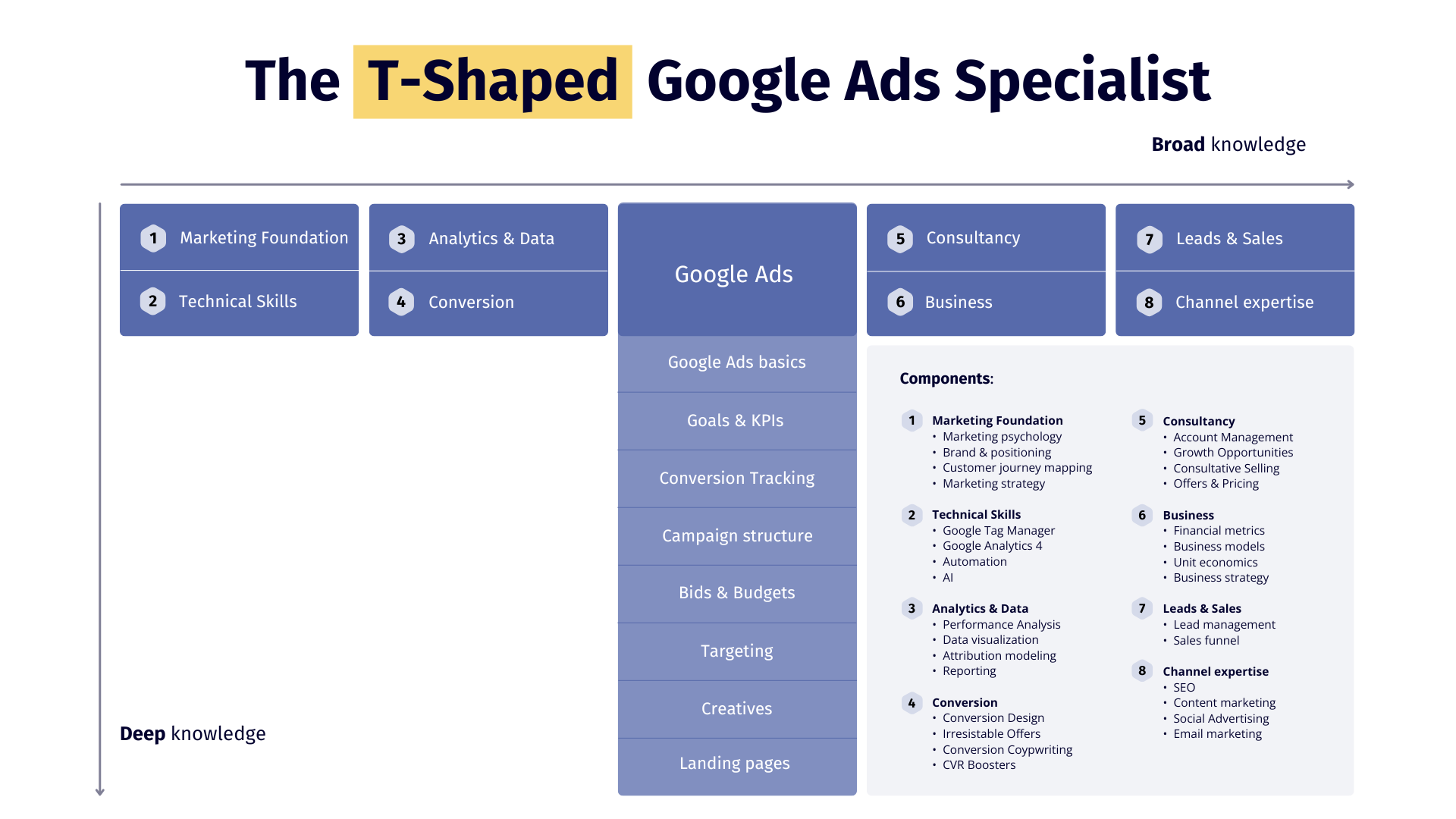
The “T” has two parts:
Vertical stroke = Deep Google Ads mastery
You still need to be excellent at the platform. Campaign types, bid strategies, tracking, structure, targeting, settings — all of it. This is the foundation that never goes away.
Horizontal stroke = Strategic breadth across related disciplines
This is what separates Maximizers from Optimizers:
- Landing pages and CRO
- Offer creation and positioning
- Analytics and business metrics
- Cross-channel thinking
- Creative strategy
T-Shaped specialists can diagnose constraints beyond “just the account.”
They see how Google Ads fits into the broader business system, and influence results across the entire funnel.
That’s why you see some people 10x results, while others chase 10% gains.
- Without strategic breadth, you hit ceilings you can’t explain, misdiagnose problems, and optimize low-impact things (“busy work”) instead of fixing what actually matters.
- Without deep platform mastery, your insights stay theoretical. You can’t translate strategy into execution, and you have no control over the results.
That’s why you need both.
T-Shaped Google Ads Specialists think big and spot opportunities like Maximizers, but they also make sure everything is set up and optimized correctly like Optimizers.
That’s the perfect balance that leads to the best results.
Last note: this is the philosophy behind The PPC Hub
Everything we teach inside The PPC Hub is built on this idea and gives you the best of both worlds:
- The Google Ads Success Path gives you deep platform mastery — the vertical stroke of the T (with 9+. advanced Google Ads courses)
- The T-Shaped Specialist Paths (Conversion Booster, Media Buyer, Automator, Search Specialist) give you strategic breadth — the horizontal stroke of the T.
Together, they help you become and think like a Maximizer, without losing the eye for detail of an Optimizer.
That’s why T-Shaped Google Ads Specialists win.
So if you’re tired of chasing incremental gains and want to become the kind of specialist who drives next-level results, consider joining The PPC Hub.
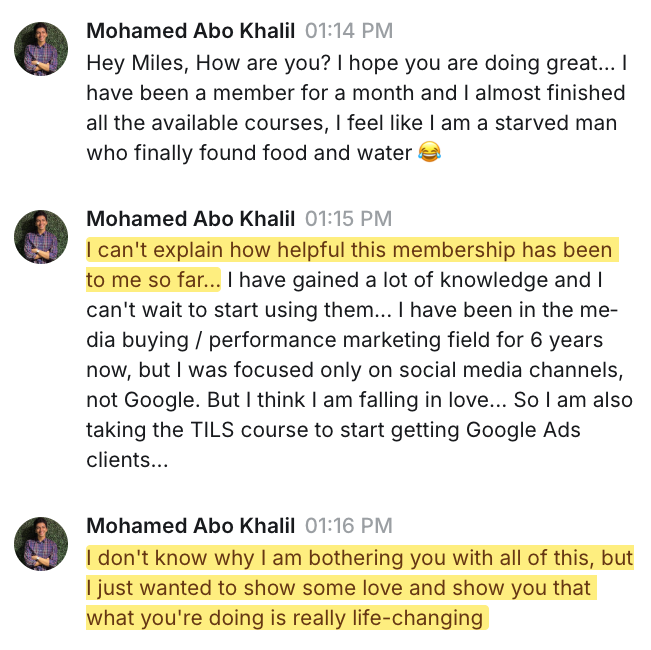
Inside, we’ll work together to upgrade your skillset and ability to drive results, so you can serve your clients at the highest level possible.
That’s all for today, thank you for reading.
I’m rooting for you — see you next week!
Cheers,
Miles (& Bob)

