
GM, Miles here!
Today’s issue is not sexy but extremely essential to understand.
I’ve noticed a pattern about something that’s harming specialists: clients with unrealistic expectations.
Have you ever experienced this? 👇
You take on a new client.
In the kickoff, you ask about their goals, and they say: “We want to double our revenue this year while increasing profit margins by 25%.”
You nod. Maybe you feel a hint of doubt and think “hmm, I don’t think that’s possible”…
But you don’t push back because you don’t want to upset your new client.
You’re a bit overwhelmed because the client seems confident. To them, the targets sound ambitious but achievable. So you get to work, because you got this and you’re ready to prove yourself.
Fast forward a few months.
You’ve been grinding: restructuring campaigns, optimizing bid strategies, testing ads. But something’s off.
- Every time you push for more volume, efficiency drops.
- Every time you try to protect efficiency, volume drops.
Super frustrating.
That’s when it hits you: these targets can’t both be hit at the same time.
So now you have to have “the conversation”.
But it’s already too late. The client expected results by now, and you look like you overpromised.
So the client relationship is already under pressure — not because the work was bad, but because the targets were never realistic in the first place.
This is the #1 horror scenario for PPC Experts. And it’s almost always avoidable.
But the fix isn’t better optimizations…
The fix is better conversations before the work begins: sitting down with your client, looking at the actual data, and setting realistic targets together — targets that are grounded in math, not wishful thinking.
That’s where the Profit-to-Acquisition Ratio comes in.
It’s a simple but effective data-driven framework to determine realistic targets with your client — based on their unit economics, growth ambitions, and how much of the profit they’re willing to reinvest in acquiring new customers.
It puts everything on the table upfront, so there are no surprises three months into the collaboration.
Here’s what you need to understand: it’s far better (and easier!) to adjust targets and set realistic expectations upfront than to start with impossible goals and spend the rest of the time adjusting or trying to justify why you’re behind.
I’ll explain everything below. Let’s dive in!
Why most targets are unrealistic (and whose job it is to fix that)
Let me be clear about something: setting targets is not your job as a specialist.
But it IS your job to help your clients get clear on their numbers, goals, and tradeoffs that go into setting realistic targets.
Then it is your client’s job is to make the decision*.*
The problem, though, is that most clients have no clue about their numbers (so they come up with unrealistic goals and expect us specialists to wave our magic wand to get results):
- They don’t know their breakeven ROAS.
- They’ve never thought about what percentage of profit should go back into acquisition.
- So they just say “grow more, spend less” — and expect you to figure it out.
That’s bad and sets you up for failure.
The Profit-to-Acquisition Ratio gives you a framework to set realistic targets based on real numbers — creating clarity for both you and your client.
Think of your Profit-to-Acquisition Ratio as a slider between two extremes (max growth or max efficiency)
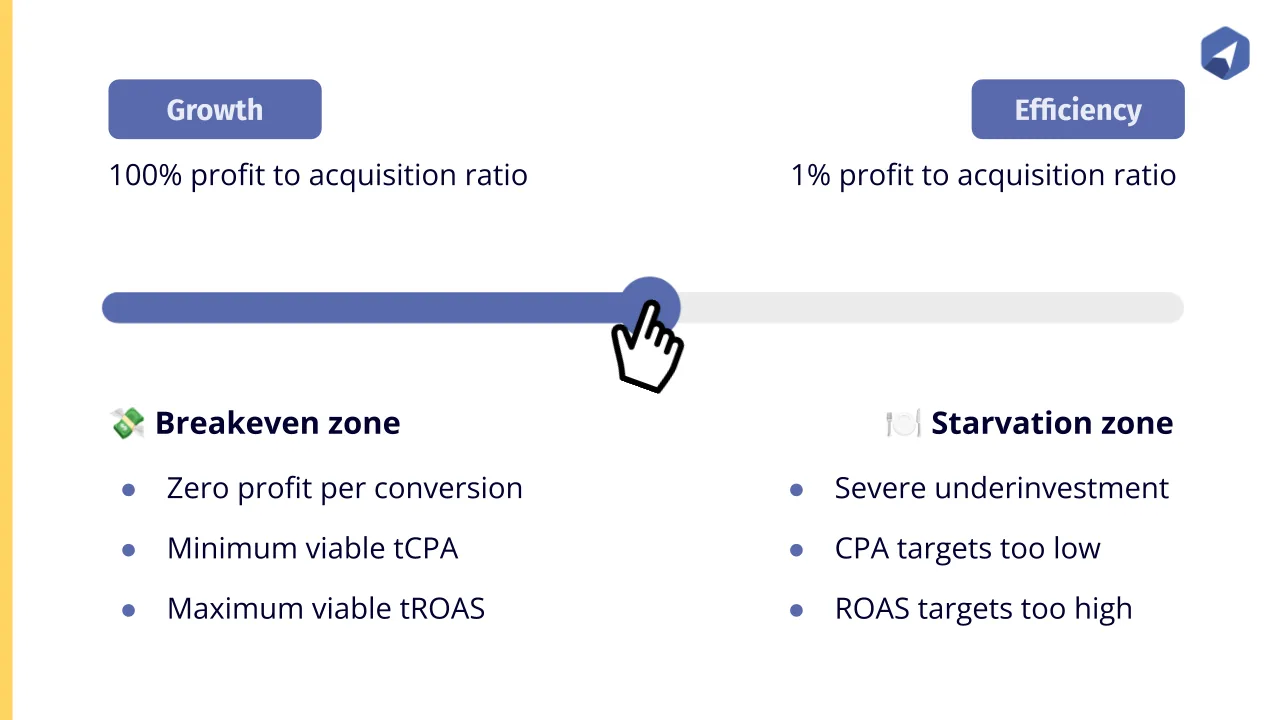
On the left: 100% Profit-to-Acquisition (the Breakeven Zone)
- You’re reinvesting all your profit back into Google Ads
- Zero profit per conversion
- This is your maximum sustainable bidding level (any further and you’re losing money)
- Use case: maximizing market share while not caring about short-term profitability
On the right: 1% Profit-to-Acquisition (the Starvation Zone)
- You’re keeping almost all profit
- But your CPA targets are so low (or ROAS targets so high) that you can barely win any auctions
- Volume dries up completely
- Use case: low-risk testing of new markets and tactics (in the short-term)
The sweet spot for most businesses is somewhere in the middle.
When clients see this, it usually clicks.
They realize they can’t have both extremes and must pick a spot on the slider.
That’s the start of the conversation that prevents unrealistic expectations.
The simple 3-step formula to set realistic targets together with your client
There’s a real science and art to setting the right targets:
- The science: calculating targets with a simple formula.
- The art: having the right conversations with your clients.
Combined, PPC magic starts to happen.
Here’s the simple 3-step formula to align on realistic targets with your clients:
Step 1: Calculate the breakeven point.
For Ecom:
Breakeven ROAS = 1 ÷ Profit Margin
- If the profit margin is 77%, breakeven ROAS is 130%.
- If the profit margin is 50%, breakeven ROAS is 200%.
Working with CPA instead?
Breakeven CPA = AOV × Profit Margin
- €50 AOV with 50% margin → Breakeven CPA = €25
- €100 AOV with 30% margin → Breakeven CPA = €30
For Lead Gen, work backwards from closed deal value through conversion rates to get your breakeven CPA at each stage.
Breakeven CPA = Average Deal Value × Profit Margin
Then work backwards through your conversion rates:
Breakeven CPL = Breakeven CPA × Lead-to-Sale Rate
Example:
€5,000 average deal value
- 50% profit margin
- 10% lead-to-sale rate
Here’s what your numbers would look like:
- Breakeven CPA = €5,000 × 0.50 = €2,500
- Breakeven CPL = €2,500 × 0.10 = €250
Step 2: Your client decides what percentage of profit goes back into acquisition.
This is the key question most clients have never been asked:
“What percentage of your profit are you willing to reinvest in Google Ads to acquire new customers?”
- <25% = Conservative. High efficiency, but potentially leaving volume on the table.
- 50% = Balanced. Half goes back into ads for safe, sustainable growth.
- 75% = Aggressive. Thinner margins, good for scaling phases.
- >75% = Hyper Aggressive. Pump it all back to maximize marketshare.
This is a business decision, not a Google Ads decision. That’s why it’s crucial to do this together with your client.
Keep in mind that most businesses like to play it safe, because they also have to reserve a % of profit for payroll, office space, and tons of other business expenses.
Step 3: Calculate the target.
Target ROAS = Breakeven ROAS ÷ Profit-to-Acquisition Ratio
Example:
- Breakeven ROAS: 130%
- Profit-to-Acquisition: 52%
- Target ROAS: 130% ÷ 0.52 = 250%
That 250% isn’t made up or what the specialist thinks is achievable.
It’s what your client has agreed to based on their own business inputs.
You provide the framework. Your client fills in the Profit-to-Acquisition Ratio. Then you get to work with aligned targets (agreed upon, validated, and realistic).
How this conversation would go in reality
Your client’s initial target: “We need €75K monthly revenue AND at least 300% ROAS.”
Instead of saying “yes, let’s do it”, you push back with questions (numbers are hypothetical to prove the point):
- “What’s your profit margin?” → Client says 77%
- “So your breakeven ROAS is 130%. You can’t go below that without losing money.”
- “What percentage of profit are you comfortable reinvesting in growth?” → Client says 40%
- *“That gives us a target ROAS of 384% — not 300%” *→ Big difference!
The outcome:
- The realistic ROAS target is 28% higher than the client’s initial target
- Your client understands the initial target was unrealistic because you went through the exercise together
- Your client agrees on the new target OR goes back to the drawing board to optimize their unit economics, so they have higher margins (or are willing to reinvest more into acquisition)
With this approach, you’ll have no more stress about unrealistic targets, and no more awkward conversations three months later about “why we are not on target.”
The expectation was set correctly from the start, which leads to a longer and happier client relationship.
Win-win!
When expectations are truly unrealistic
Sometimes you run the math, but it still doesn’t work out.
Can’t hit growth goals even when stretching toward 100% Profit-to-Acquisition? Then the targets may not be unrealistic, but simply impossible.
This is where the framework saves you from months of frustration.
You can show the client: “Listen, to hit your volume targets at your required efficiency, we’d need to bid above breakeven. We’d literally be paying to lose money.”
When that happens, the conversation shifts from “how do we optimize the campaigns?” to “how do we improve the business fundamentals and unit economics?”
That might mean:
- Increasing average order value and lifetime value with upsells and bundles
- Improving profit margins with better pricing or lower cost of goods sold
- Improving lead-to-sale conversion rates (for Lead Gen)
You could argue that these aren’t your problems as a Google Ads Specialist.
However… If you want to drive meaningful results, you’re gonna have to solve them anyway.
Because if you don’t, you’ll waste months banging your head against impossible targets before realizing the real constraint was never in the ad account…
You can’t optimize your way out of bad unit economics and unrealistic expectations.
When your client is unhappy, so are you. It’s a recipe for disaster.
Fixing it from the start is how you create long, healthy, and profitable client partnerships.
Take it to the next level in The PPC Hub
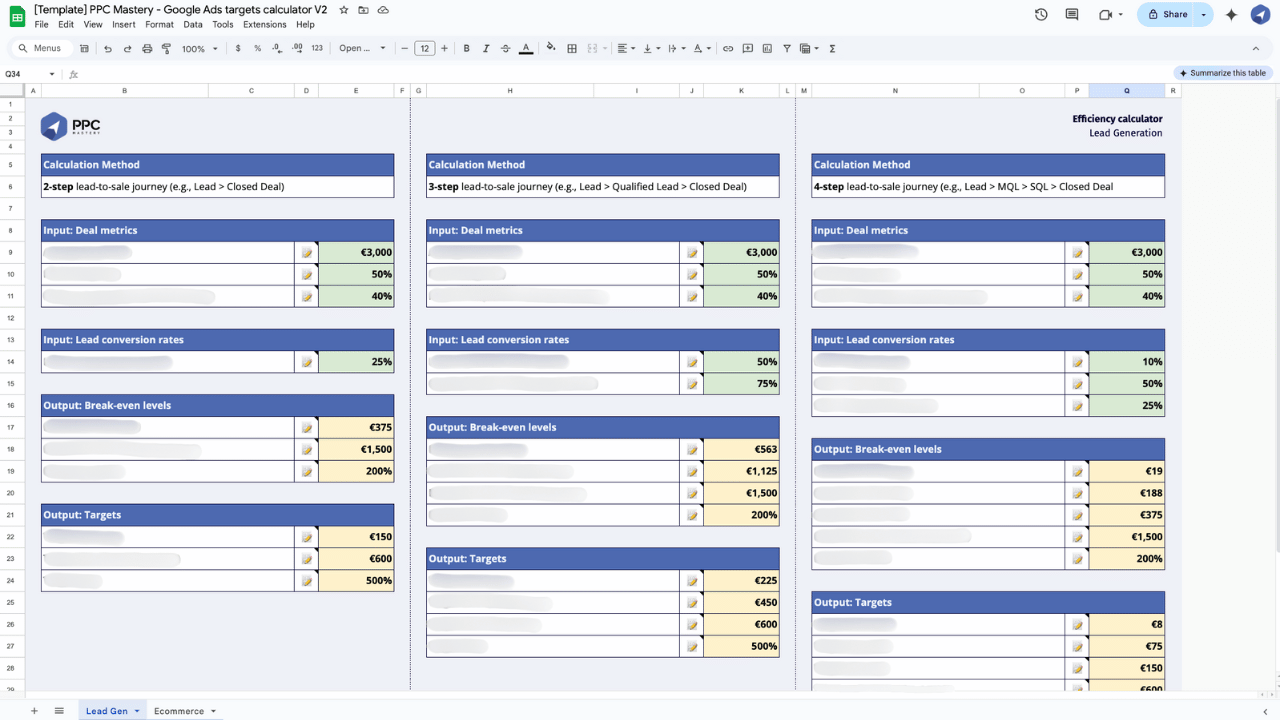
This framework is covered in detail inside our Bids & Budgets Mastery course that’s exclusively available In The PPC Hub, including calculator templates that walk you through this exercise automatically for Ecom, Lead Gen, and SaaS clients.
If you want to have long, healthy, and profitable client relationships that are built on realistic expectations, trust, and results, then **consider joining The PPC Hub.
**
Inside, we’ll help you take your skills to the next level, so you can drive the best possible results and stay ahead in our fast-changing industry.
That’s all for today, thank you for reading.
See you next week!
Cheers,
Miles (& Bob)

Bob Meijer & Miles McNair
The PPC Edge Newsletter
🎁 Free gift: subscribe to The PPC Edge Newsletter and get our Google Ads Audit Templates for FREE (€199 value).
And whenever you’re ready, here’s how we can help you further:
-
Join our global community of world-class Google Ads Specialists: Stay up to date with all developments, get trained by us all year round, and learn & grow together with like-minded PPCers. Become a member of The PPC Hub (2.000+ members) // enrollment is open, monthly plans available!
-
New free email course: Become a T-Shaped Google Ads Specialist in 5 steps. This free 5-day email course reveals the blueprint to stay ahead, drive better results, and thrive as automation & AI change the industry fast.
-
Scale your Google Ads campaigns with landing pages that are built to convert (even if you are not a webdesigner or CRO Expert): Get more conversions without increasing ad spend using our proven 5-step Conversion Amplifier Framework and Custom AI tools. Join Landing Page Mastery!
-
Learn how to launch, optimize & scale Performance Max campaigns. Get the exact framework we use to scale Ecom & Lead Gen clients. Join 3.000+ PPC Experts in Performance Max Mastery (fully updated).