
GM, Miles here!
Ever wondered why some Google Ads campaigns fail despite being “perfectly optimized”?
Have you ever had an account where:
- Campaigns are structured properly
- The tracking is solid
- Your targeting is on point
- Bid strategies are optimized
- All best practices are followed
But for some reason, you still can’t seem to scale?
Most specialists assume it’s a Google Ads problem, so they keep optimizing.
But often, the real reason why the campaigns fail has nothing to do with the campaigns at all.
It’s unit economics — the hidden foundation that determines whether your campaigns can succeed before you even log into the interface. And it’s one of the most overlooked reasons Google Ads campaigns fail.
Today I want to show you why this matters, what it looks like when unit economics are the problem (and the solution), and exactly which numbers you need to know before touching your campaigns.
It’s not rocket science, but absolutely essential to understand if you want to drive any meaningful results.
Let’s dive in!
Real quick: what are unit economics?
Unit economics is a way of measuring profitability on a per-unit basis.
- For Ecom, that’s per order.
- For Lead Gen, that’s per deal.
- For SaaS, that’s per customer.
Instead of looking at the business as a whole and asking “are we profitable?”, unit economics reveal if each transaction is profitable, and how much.
It’s the math that tells you whether acquiring one more customer makes you money or loses you money — and how much room you have to spend on acquisition.
It’s absolutely essential to understand, because it determines whether you can scale profitably or not.
But most Google Ads Specialists ignore it, and that’s why they run into problems.
Why even “perfectly optimized” campaigns fail without scalable unit economics
Unit economics are the hidden foundation of successful advertising.
Your unit economics determine:
- The maximum CPCs you can afford to set
- Whether your ROAS and CPA targets are realistic
- How competitive you can be in auctions
- Whether your campaigns can scale profitably
- How you should allocate budget (and if spending more will grow the business or harm it)
If your unit economics are poor, it doesn’t matter how perfect your campaign structure, bid strategy, and ads are.
It’s like trying to build a house on sand.
Without the right numbers, you can never scale profitably.
And yet, most specialists never look at unit economics. They think that’s “the client’s job” or “not my responsibility.”
That’s a mistake.
Before we get into the numbers, let me show you what this looks like in practice — one story where unit economics killed growth, and one where they unlocked it.
An example of when poor unit economics are the problem, not Google Ads tactics
I was recently talking to a frustrated business owner who runs a large Ecom store.
Their ROAS had been steadily declining for almost two years, and nothing they tried seemed to fix it.
He told me: “We’ve been tweaking our campaigns constantly, with new segmentations, bid strategies, lower targets, audience expansion, Broad Match, Performance Max — you name it, we tried it.”
They used to hit 1,000% ROAS consistently. But over the past couple of years, competition in their space had increased dramatically.
As a result, CPCs kept rising.
What was once a blue ocean had turned into a red ocean with aggressive competitors putting pressure on the auctions.
First, their ROAS dropped to 800%. Then 700%. Still profitable, but a lot less than before.
And every optimization they made didn’t bring them back to their original levels.
So I asked him a different question: “What do your unit economics look like?”
He told me his numbers:
- Average order value.
- Cost of goods sold.
- Cost to acquire a customer.
- Profit margins.
- Customer lifetime value.
- Repeat purchase rates.
- All of it.
And that’s when it clicked:
The problem wasn’t their campaigns (they were actually well-optimized).
The problem was that their unit economics hadn’t evolved with the market.
When competition was low, they could easily hit a 1,000% ROAS target because their margins supported it and they were winning cheap clicks.
But the market changed. CPCs increased, CVR dropped. And suddenly, their margins were under pressure.
The solution wasn’t another campaign tweak. It was fixing the foundation:
- Increasing AOV with bundles and upsells
- Improving LTV with better retention
- Revisiting margins where possible (negotiating better logistics and purchasing deals)
These changes would lower their breakeven ROAS, which would make their targets achievable again — even with higher CPCs.
They spent two years asking the wrong question.
- It’s not: “what can we tweak inside the campaigns?”
- The real question is: “what needs to change in the business economics to make these campaigns more profitable again?”
That’s the trap many business owners and Google Ads Specialists fall into.
When you’re a Google Ads Specialist, campaign optimization is what you know.
So that’s where you look…
But sometimes the answer isn’t in the ad account at all. Perfectly optimized campaigns can still fail if the unit economics aren’t scalable.
And on the flip side — if you fix the unit economics, you can set yourself up for success again, even in a more competitive market.
That’s exactly what Ramial did for his client. Let’s look at his success case.
How Ramial scaled a struggling supplements brand by focusing on the client’s unit economics
Now let me show you what happens when you actually apply this.
Ramial Aqeel, a member of The PPC Hub, took on a supplements brand that was struggling to scale.
Before he got involved, the account was fragmented, tracking was a mess, and spend was minimal because they couldn’t find a way to scale profitably.
Ramial realized his client had no understanding of their unit economics.
So before touching the campaigns, he dug into the numbers:
- AOV: £65
- Avg customer lifetime: 6 months (subscriptions)
- Churn after month 1: 25%
Then he did the math:
- If 100 people sign up at £65, that’s £6,500 in initial revenue.
- 25 of them churn after month one
- But the remaining 75 customers continue for an average of 5 more months: 75 × £65 × 5 = £24,375.
- Total revenue: £30,875, divided by total 100 customers = £309 LTV per customer.
This changed everything.
The client wanted scale, so Ramial recommended a £200 target CPA.
Sounds aggressive for a £65 AOV product, right? But when you know each customer is worth £309 over their lifetime, £200 CPA is actually profitable.
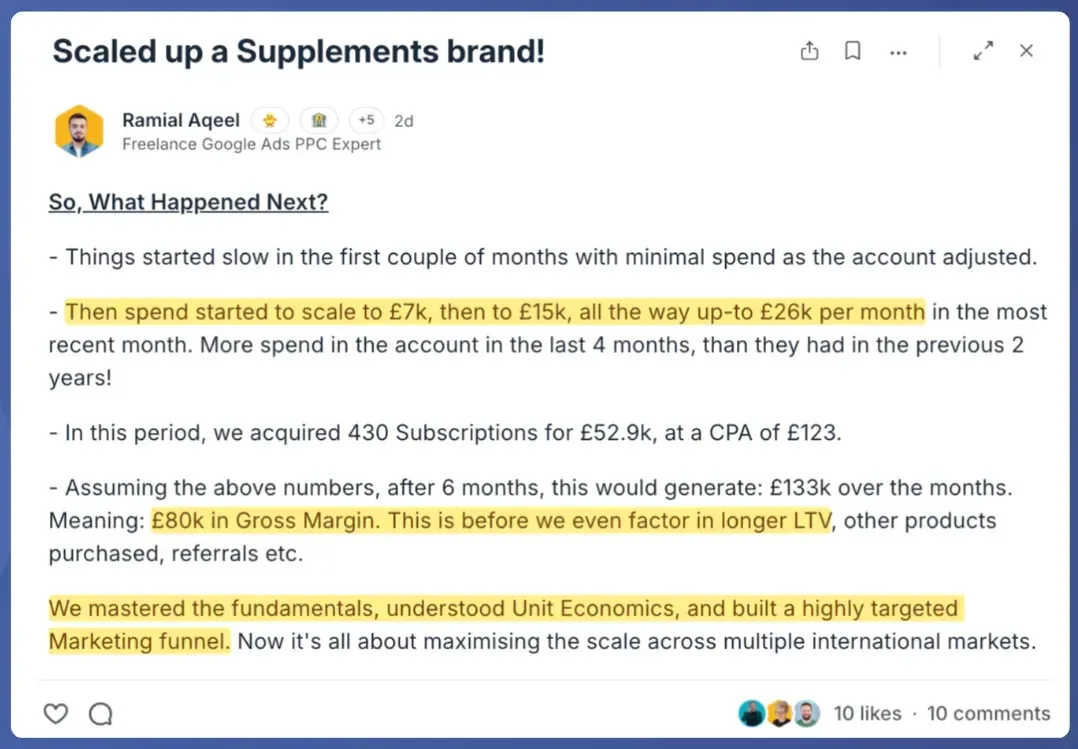
The results speak for themselves:
- Spend scaled from almost nothing to £26K/month (profitably!)
- 430 subscriptions acquired at an average CPA of £123 (even below target)
- Projected revenue over 6 months: £133K
- Estimated gross profit: £80K
By incorporating unit economics into the Google Ads strategy, they were able to spend more in 4 months than the previous 2 years combined.
The campaign setup mattered, of course (it’s why the CPA was 39% below target)… Ramial restructured the account, fixed tracking, and built a proper full-funnel setup.
But none of that would have worked without first understanding the unit economics.
Knowing the LTV allowed them to bid aggressively upfront, confident they’d make it back over the customer lifetime.
That’s the power of this stuff.
The essential numbers you need to know
Now let me walk you through the core unit economics metrics for each major vertical. These are the numbers you should know for every account you manage, but they are just examples to get you started.
Ultimately, you want to know as much as possible about your clients’ economics on a per-unit basis, but also on the wider business level.
Those numbers influence everything, and whether you can scale profitably or not.
Before we dive in, here’s the simple version. You’re trying to answer three main questions:
- How much profit do you make per sale? (Gross Margin)
- How much does it cost to acquire a customer? (CAC)
- How much is that customer worth over their lifetime? (LTV)
Everything else supports those three.
For all business types
Customer Acquisition Cost (CAC)
- Formula: Total acquisition spend ÷ Number of (new) customers
- What it tells you: How much you’re paying to acquire one customer
- Why it matters: Must be lower than the value that customer brings — otherwise you’re losing money on every acquisition
Customer Lifetime Value (LTV)
- Formula: Average revenue per customer × Customer lifetime × Profit margin
- What it tells you: The total average value (profit!) a customer generates over their entire lifetime
- Why it matters: Sets the maximum you can afford to spend on acquisition — and determines whether you can bid aggressively upfront (like Ramial did)
For Ecom
Average Order Value (AOV)
- Formula: Revenue ÷ Number of orders
- What it tells you: How much a customer spends per order
- Why it matters: Directly impacts your bidding power
Go next level: exchange revenue for average gross profit per order
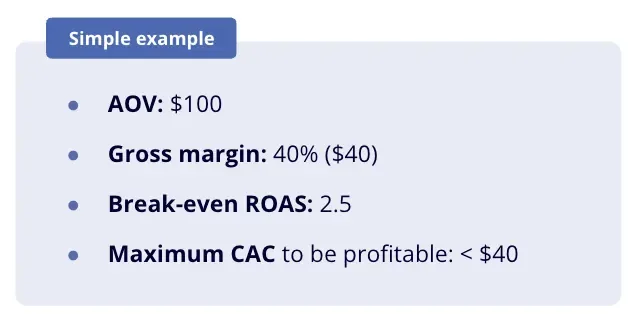
Gross Margin
- Formula: (Revenue - COGS) ÷ Revenue
- Example: 40% margin means €40 profit on a €100 sale
- Why it matters: Determines how much you can spend on ads
Breakeven ROAS
- Formula: 1 ÷ Gross Margin
- Example: 40% margin = 2.5x breakeven ROAS
- Why it matters: The minimum ROAS needed to cover costs
If you can’t hit 2.5x ROAS, you’re losing money on every sale. Simple as that.
For Lead Gen
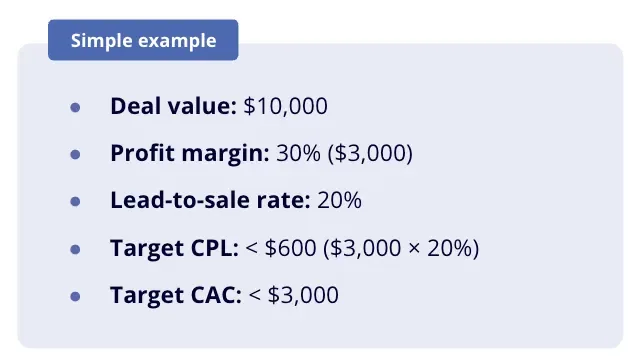
Average Deal Value
- Formula: Revenue ÷ Number of closed deals
- Example: €200K revenue from 20 deals = €10K per deal
- Why it matters: Sets the ceiling for what you can spend on acquisition
Lead-to-Sale Rate
- Formula: Closed deals ÷ Total leads
- Example: 40 deals from 200 leads = 20% conversion rate
- Why it matters: Determines how many leads you need per sale
Target Cost per Lead (CPL)
- Formula: Profit margin × Lead-to-sale rate
- This gives you your breakeven CPL
- Why it matters: Anything above this number and you’re losing money on acquisition — even if the CPL looks “cheap” in isolation
For SaaS
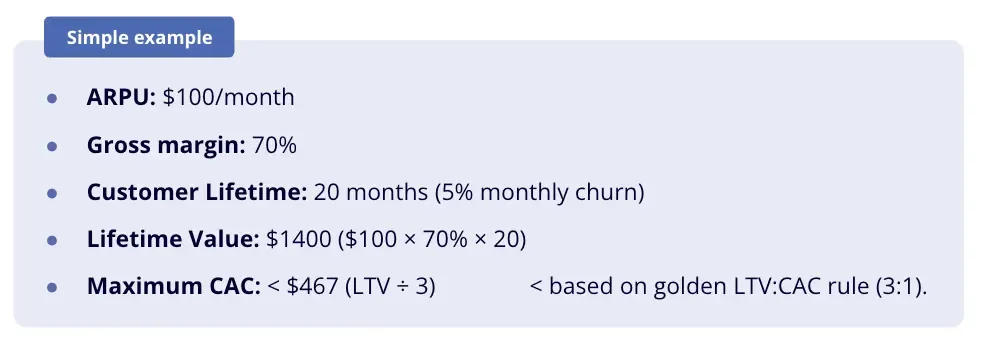
ARPU (Average Revenue Per User)
- Formula: MRR ÷ Number of active customers
- Example: €100K MRR with 1,000 customers = €100 ARPU (per month)
- Why it matters: Determines how much each customer contributes and sets the baseline for LTV
Customer Lifetime
- Formula: 1 ÷ Monthly churn rate
- Example: 5% monthly churn = 20 months average lifetime
- Why it matters: Directly multiplies your revenue per customer — low churn dramatically increases what you can afford to spend on acquisition
LTV (Lifetime Value)
- Formula: ARPU × Customer lifetime × Margin
- Example: €100 × 20 months × 70% margin = €1,400 LTV
- Why it matters: Sets the ceiling for acquisition spend — this is the maximum a customer is worth, which determines how aggressively you can bid
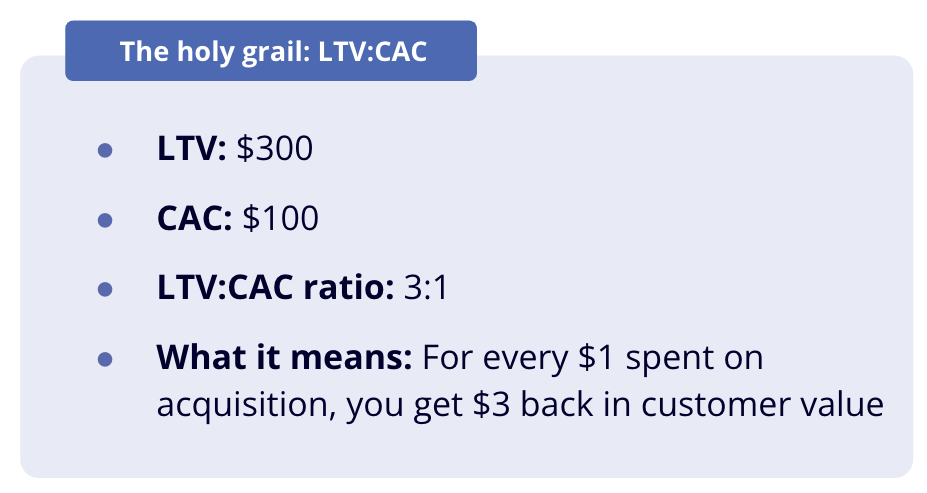
The Golden Rule: LTV:CAC Ratio
- Healthy ratio: 3:1 or better
- Example: €1,400 LTV means maximum CAC should be ~€467
- Why it matters: The ultimate health check for sustainable growth — below 3:1 usually means you’re spending too much to acquire customers relative to their value
If your CAC exceeds LTV, you’re burning money. You need to either increase LTV, or decrease CAC.
Warning signs you have a unit economics problem
Here’s how to spot unit economics issues before you waste months optimizing the wrong things:
- You’re unable to bid competitively in your industry. Your targets force such low bids that you barely win any auctions. As a result, volumes dry up, and your competitors beat you on every level.
- You’re forced to target only bottom-funnel keywords. Upper-funnel and mid-funnel campaigns are “too expensive” — but in reality, the economics just don’t support scaling.
- You find yourself over-optimizing for efficiency instead of growth. Every conversation is about cutting costs rather than scaling volume.
- Growing feels like a giant struggle. Hitting targets requires perfect conditions, and even small fluctuations throw everything off. You just can’t seem to scale beyond a certain point and are forced to play small.
If you’re experiencing these symptoms, the problem probably isn’t your campaign setup. It’s the underlying unit economics.
Put it into action: how to start leveraging unit economics as part of your Google Ads strategy (this week)
To summarize: you can have the most perfectly structured account in the world, nailing every best practice in the book…
But if your unit economics are poor, you’re never going to scale.
This is why you need to have different conversations with your clients:
- Instead of asking: ❌ “How do we optimize the campaigns so we can start scaling?”
- The question becomes: ✅ ”How do we improve the business model, so that we can start scaling?”
My recommendation for you this week: start talking to your clients about their unit economics. Ask about their numbers and calculate whether your targets are realistic or not.
Then, I suggest you talk to your clients about:
- Can we increase AOV with bundles or upsells?
- Can we improve margins with better supplier negotiations?
- Can we increase deal values with premium positioning?
- Can we improve lead-to-sale rates through better qualification?
- Can we reduce churn or increase repeat purchases to increase lifetime value?
These aren’t Google Ads questions — they’re business questions.
But they’re the questions that actually determine whether Google Ads can scale or not.
Here’s what you must realize: better unit economics create an upward spiral:
Better margins → lower breakeven points → more competitive bids → more auction wins → more volume → more data for Smart Bidding → better performance.
Everything gets easier when the foundation is solid.
It’s in your best interest to start leveraging, because it will allow you to drive better results for your clients (which leads to better opportunities for yourself, like a raise, promotion, or just a better client relationship).
Why most specialists skip this (and why understanding unit economics gives you a big competitive edge)
Most Google Ads Specialists will say “this is not my job.”
They’ll continue to only focus on in-platform tactics and completely ignore the business side of PPC.
But understanding unit economics is what separates the elite from the average.
The specialist who can look at an account and say “your campaigns are fine, but your margins don’t support profitable scaling — here’s what we need to fix” is infinitely more valuable than the one who just keeps tweaking campaigns, trying to scale when the numbers don’t allow it.
This is how you become a trusted growth partner that’s impossible to replace.
This is exactly what we teach in The PPC Hub
Understanding unit economics is just one piece of thinking beyond the platform — seeing Google Ads as part of a broader business system rather than an isolated channel.
Inside The PPC Hub, we teach specialists to master not just in-platform tactics, but also the strategic skills that take results to the next level: unit economics, offer creation, landing pages, goal setting, target validation, full-funnel thinking, diagnosing if the constraint is inside versus outside the account, etc.
If you want to stop guessing why campaigns won’t scale and start breaking through ceilings because you know exactly what to do, consider joining The PPC Hub.
It’s how we can help you the best.
That’s all for today, thank you for reading.
See you next week!
Cheers,
Miles (& Bob)

Bob Meijer & Miles McNair
The PPC Edge Newsletter
🎁 Free gift: subscribe to The PPC Edge Newsletter and get our Google Ads Audit Templates for FREE (€199 value).
And whenever you’re ready, here’s how we can help you further:
-
Join our global community of world-class Google Ads Specialists: Stay up to date with all developments, get trained by us all year round, and learn & grow together with like-minded PPCers. Become a member of The PPC Hub (2.000+ members) // enrollment is open, monthly plans available!
-
New free email course: Become a T-Shaped Google Ads Specialist in 5 steps. This free 5-day email course reveals the blueprint to stay ahead, drive better results, and thrive as automation & AI change the industry fast.
-
Scale your Google Ads campaigns with landing pages that are built to convert (even if you are not a webdesigner or CRO Expert): Get more conversions without increasing ad spend using our proven 5-step Conversion Amplifier Framework and Custom AI tools. Join Landing Page Mastery!
-
Learn how to launch, optimize & scale Performance Max campaigns. Get the exact framework we use to scale Ecom & Lead Gen clients. Join 3.000+ PPC Experts in Performance Max Mastery (fully updated).