What you'll learn
Freelance Google Ads Specialist Mark van der Eng gets paid per lead. So when his lead gen client's cost per lead was €90 against a €40 target, he wasn't getting paid, and the client was sure the competitors were outbidding them.
In this episode, he shows how PPC OS helped him find what was really holding the account back, what he changed inside the account without touching the landing page, and why a higher CPC wasn't a problem. Plus how his conversion rate went from about 3% to 13.5% in the first full week after his changes.
- Check if the competitors are really to blameIn September, the results got worse while impression share went up, and Mark's client was sure the competitors were outbidding them. See the first thing he checked, and why it ruled the competitors out.
- Find what's really holding a lead gen account backMark's city ad groups brought in leads at €52 each, his generic ad group at about €130. See how he used PPC OS to find the real problem before he changed anything.
- Raise bids without confusing Smart BiddingMark used to change his targets in steps of 30 to 50%, and the learning took too long and his volume dropped. Hear how big his steps are now, and when he moves from manual CPC to Max Conversions.
- Know when a higher CPC is a good signAfter his changes, Mark's CPC went from about €3 to €5, and his best week ran at €7.70 per click. See why that wasn't a problem, and what happened to his conversion rate.
- Price your work on performanceMark gets a fixed fee per lead at a €40 cost per lead, a lower fee up to €60, and nothing above that. Hear why he didn't ask for a base fee, and what it meant when the first few weeks didn't go to plan.
Chapters
Mentioned in this episode
Full transcript
Read the full transcript (3,764 words)
Auto-generated from the video, so expect the odd typo. Click a timestamp to watch from that moment.
0:00My next guest is Mark van der Eng, a freelance Google Ads Specialist from the Netherlands. And this summer, he took over a lead gen account for a home valuation firm. And in September, the results kind of got worse while impression share went up. And the client was sure that the competitors were just bidding them out or outbidding them. So before changing anything, Mark checked the numbers, metric tree, and diagnosed his account with PPC OS. And he found the real problem, which was traffic quality.
0:31So without touching the landing page or the tracking, his cost per lead went from 90 euros to 36 euros within the target of around 40 euros. And that's exactly what we preach in the PPC Hub. Find the constraint first and then fix it. And so I wanted to bring him on because I think it's just super inspiring on how specialists are identifying the number one constraints. And especially in this case with PPC OS.
0:59Yeah. And it just helps you find out why an account is underperforming and also how to fix it. So without any further ado, let me bring on Mark. Mark, welcome. Hey, Miles. Hey, man. Good morning. And for everyone here, can you just briefly introduce yourself? What do you do? What type of clients do you work with? And how do you serve them? Yeah. Yeah. So I'm Mark. I've been working in the Google Ads environment for over 10 years now. I think I started in around 2015. Um,
1:34the most, mostly I've worked, uh, in the beginning on the agency side, uh, to, uh, yeah, learn a lot about, uh, Google Ads, uh, world. And since 2023, I've been fully freelance. Um, and now basically running, uh, yeah, freelance company by myself, uh, with, uh, yeah, different set of type of clients, I would say, uh, mostly, uh, I run e-com and lead gen, but also a bit of SaaS and, uh, yeah, B2B, mostly B2C, but, uh, also a few B2B clients. Um, and I work from, uh, Amsterdam, uh, I rent an office with, uh, another digital marketing agency.
2:21So we have a nice collaboration, uh, uh, going on where, uh, if one of my clients needs an extra service, uh, uh, I introduced them to them and the other way around.
2:33Uh, that's always so nice to have that, uh, those types of partners. I know Geert also does it, uh, in a different, in a similar way with the developer agency. So it's always, always smart to, to do that. So, um, Hey, let's talk about how you use PPC OS to optimize this account. And you had a, a great case study that you shared in the PPC Hub. So I think this is going to be super interesting to hear how you have been able to drive the cost per lead down from 90 euros to 36 euros. But let's just, just talk about the case first.
3:05Can you just talk about what, what type of business is it? Um, and then from the end, the, the big result. And then from there we can just backtrack and see what you did and, uh, yeah, each individual step. Yeah. Yeah. So it's a home valuation, uh, clients of an appraiser. Um, uh, so it's Legion. Uh, they, uh, yeah, they were, they had been running Google Ads in the past, uh, few years back, uh, by another agency. Uh, then they stopped because they, they, they had enough work basically. And because they have partnerships with, uh, all type of other businesses like, uh, real estate agents, uh, uh, bigger corporations.
3:47Um, but that dried up a little bit. So they wanted to get back in the Google Ads game. So they approached me, uh, to see, yeah, uh, what we could do. Uh, I made them a proposal and I decided to do it performance based because I saw a lot of potential on the account from, uh, uh, uh, after auditing it, um, the only thing I forgot was that it was about three years ago. So the whole landscape changed quite a bit. Um, so when I initially relaunched the campaigns, uh, the performance was not as I expected.
4:27So, uh, uh, yeah, after a few weeks of analysis, uh, I knew I had to change something. Actually, I got inspired, uh, during the PPC summit, um, by some presentations I saw there and talking to other specialists to really dive deep into the account again, because yeah, in the, I think earlier this year with, uh,
4:55um, yeah, the rise of AI and, uh, all the efficiency gains. And basically that, uh, nowadays you don't really need developers or designers anymore for your PPC work, uh, to, yeah, to create a landing page. Like I think Bob showed it pretty well, maybe for e-com it's a bit different. Um, but for lead gen now it's really, yeah, simple to, uh, launch landing pages. I, I started off with Lovable, uh, uh, last year and now I switched more to, um, a setup that I create, uh, uh, uh, yeah, landing pages with cloudflare pages and a lot of the PPC OS skills.
5:36Um, so that's what I've been doing, uh, um, yeah, for this client as well. But the issue is that, um, when I launched the landing pages, uh, this was before, uh, I started really going into the account. So the landing page were already really good. Um, and then only after I started diving more into, uh, the account itself and, and using the PPC OS skills to, uh, yeah, basically determine what the constraints were. However, I was able to scale it. Um, so I only did it through in account changes basically.
6:19All right, real quick. If you haven't already, can you please subscribe? I'm trying to grow the channel and it would help me a lot. All right, back to the video. Yeah. So yeah, let's, let's definitely dive into that. You said you do performance based. What does that mean for this client specifically? Yeah. Um, so I, I analyzed the account and I, uh, saw that there was a lot of opportunity. So I said, okay, if, uh, I take on all the paid, uh, search work and organic and in the mix, uh, we reach a target of, uh, 40 euros, uh, CPA.
6:55Uh, so 40 euros, uh, for a lead, um, I get a certain, uh, uh, fixed fee basically per lead. Um, and if it's up to 40 to 60 euros, uh, the fee will be a little bit lower and above 60 euros, I would not get paid anything. So I, I, I decided to, yeah, not, uh, uh, uh, as for like a baseline fee, uh, just performance based because I, I, I, yeah, I thought that would be a huge potential, which, uh, there is, but I was not able to achieve that in the first few weeks. So I was not getting paid for all the valuable time I put in.
7:38Yeah. That's the, that's the balance, right? Uh, sometimes it works, sometimes it doesn't, but I can also assume that it, um, made you dive into your account even deeper because you were like, okay, I'm above the target now. I'm not getting paid. How are we going to fix that? Yeah, exactly. Um, so that's what I, yeah, after the PPC summit, I got really inspired, um, by people that were diving really deep into the accounts and running PPC OS, uh, uh, through clouds, uh, uh, kind of ways. I also did a quick check on how often I now use PPC OS.
8:19Um, and I think I used it, uh, uh, about 200 times in 11 days, uh, with 280 knowledge base calls. Um, so, um, yeah, it shows that, uh, uh, uh, it's really valuable, uh, for me. Um, so for this specific client, what I did first is, uh, I, I started analyzing, okay. Um, what exactly happened because the client itself thought, uh, we were being outbid by competitors. Well, that's the first thing I checked and basically found that that was not the case. Um, cause when we raised the pids, uh, the impression share went up, but the CPC stayed flat.
9:04So yeah, that, that, that couldn't be it. Um,
9:11um, um, um, um, so what's PPC OS told me is okay. The, uh, uh, constraint is not the, uh, is basically the, the type of, uh, traffic that you are getting in. Um, so we had a few different ad groups. Uh, we had a location based, uh, so, because this is a highly location based, uh, client that only runs in, uh, the, uh, the North of North Holland. Uh, it's a province, uh, in the Netherlands where for example, Amsterdam is also, uh, uh, located. Um, but we also had a generic ad group, uh, and, and two other ad groups that were more focused on urgency.
9:53Um,
9:55and basically the PPC OS found, okay. You are doing quite well on the location based keywords. Um, but the other keywords that, uh, are, yeah, running more, uh, uh, more for, yeah, generic valuation keywords, like how's appraisal, uh, these kinds of, uh, queries are not generating, uh, the traffic that you want. And at this time it was still running on max CPC, uh, because it was, we launched a new campaign. Um, and the conversion rate for the city ad groups was quite good. Uh, like I said, the landing page was quite decent.
10:36Uh, just like Bob showed before, we also had dynamic, uh, keyword and search and on the landing pages itself. So every time someone search a location based, uh, keyword, uh, it would insert that on the landing page. Um,
10:52but the generic, uh, yeah, uh, basically PPC OS found, okay. The generic campaign cannot run at, uh, this, uh, goal because the, yeah, the conversion rate is too low for the max CPC that you said. So I think it was generating about 130 euros per lead while at the same time, the city ad groups, uh, did 52 euros per lead. So it found that those ad groups had much more room, uh, to scale. Um, so just real quick, uh, just to, um, uh, explain a little bit because, you know, PPC OS, the, the AI system that we've built for the PPC Hub.
11:37And it basically has two parts, the, the scale, the, the skills, which, uh, allow you to do certain tasks repeatedly. And we have the, the knowledge base that you can interact with through the MCP. Um, so you can have it do things for you, or you can just use it to analyze or ask questions and run, uh, um, challenge your, your thinking or get explanations for what's going on. Right. And in this case you, I guess you use the skills, but you also mostly use the MCP. Is that correct? Yeah. Yeah. Uh, that's correct.
12:11I actually looked this up before the call. Um, so, uh, in May, um, June, for example, like 90% of my, uh, uh, interactions with Claude, uh, were typed, uh, slash commands from PPC OS. Yeah. And then from around July on it switched the other way around. Now I just prompt. And basically in my prompts, I say, according to PPC OS, what is the best thing to do here? And this is my thinking. Uh, yeah. Okay. Yeah. That's all it is. And it works really well. Yeah. Yeah. I think, uh, that's also, uh, still a, a question mark for some of the users.
12:53Like when you use the skills, when do you use MCPs? Uh, some people don't even know that you can also talk to it like, like the way that you're doing. Um, so you're using it primarily, I guess, to just, uh, uh, challenge your thinking and make sense of what you see in the data or, uh, or in a different way. Um, yeah, challenge my thinking. So yeah, from my experience, uh, of course I have a certain understanding and like some ideas about how I should optimize the account. Um, but I like to verify it with, uh, the PPC OS.
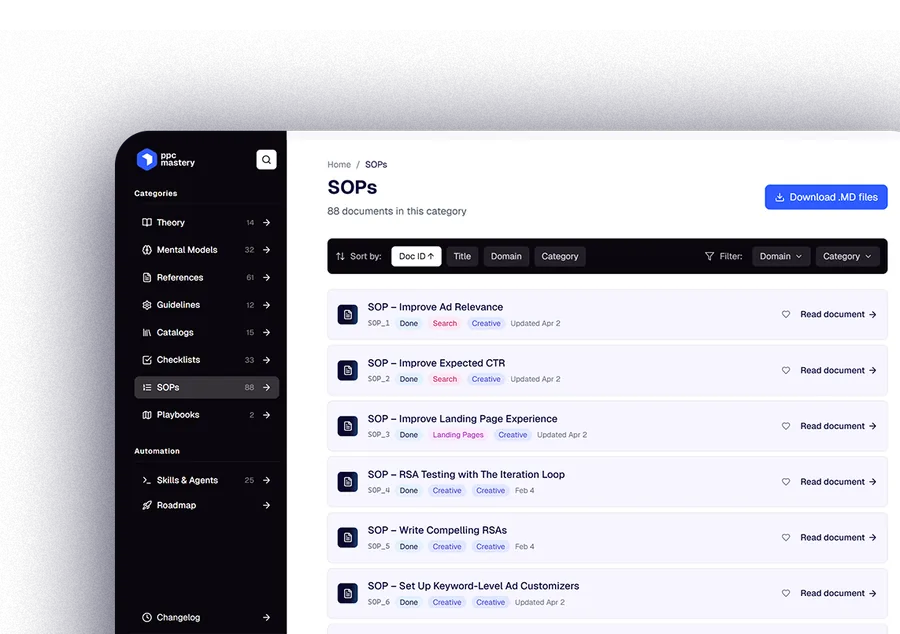
13:31Yeah. Uh, yeah. But basically the mental models, SOPs, uh, just to see if we are aligned, uh, and to get new ideas or some, uh, feedback on, uh, if my thinking is correct. Um, and I learned a lot like this because before I was, for example, I set targets, uh, steps of 30, 40, 50% sometimes. And then I noticed I was, yeah, the, the, the learning would take too long or, uh, would get confused and, uh,
14:11um, yeah, volume would drop. Um, and now that, or especially with this account, I learned taking these gradual steps. So basically I started with manual CPC, then started racing CPCs, uh, by 10 to 15%. Uh, then when it had enough monthly volume, uh, I switched to, uh, max, uh, conversions. Uh, then when it had enough volume, I added a target. Um, and it, it kept scaling up basically. Uh, and before I would probably have done it differently and not waited to have enough conversion switches to max conversions right away.
14:52Uh, with a target CPA, just to be able to get my fee, uh, uh, in the spot where I wanted it. Um, and I learned in the past now that, that usually does not generate the results that you want. And, uh, by applying people's COS in this way, I feel much more comfortable now as well to scale up, uh, accounts. And yeah, after, like I said, after the PPC summit, I have applied this to many other accounts. Uh, and yeah, in, in, I would say a hundred percent of the cases, uh, this it works. Yeah. Hmm. Nice.
15:32So, um, you started with a way too high, uh, cost per lead around 90 euros. You, you were able to bring it down to your sweet spot where you, um, have been able to get the maximum fee back because you hit the target. Um, what did you do in between? Like, well, I know you, you mentioned that you, um, use the bidding reviews, SOPs and things in, in, um, in PPC OS to use the metric tree that I also just was talking to Bob about to really diagnose the, where the number one constraint really was. Um, what did you find there?
16:10And, uh, from there, how, what did you do to, to fix it, to bring down the cost per lead? Because a drop from 90 to 36, that's like 66% drop or something like that. So that's insane. Uh, so it's really, I'm really curious to see like what happened in between those steps.
16:29Yeah. Uh, I think I explained it a bit, uh, already now, but, um, it, uh, it helped me to find keywords that were not working. Uh, uh, uh, I did an Ngram analysis as well, uh, that helped me find that like basically a bit of waste, uh, uh, to exclude, um, but I found that at that moment it was best to just pass the generic ad group and only continue with the location specific ones. Um, and then. I use, because then it started to change something in the account and, uh, it started generating leads in, uh, yeah, uh, against the cost per lead that was within the target.
17:24So just to give you an illustration I have now in front of me, um, uh, yeah, the CPAs per week, uh, over that period of time. Um, so in, in July, August, we were. Uh, on average on 90, but, um, most of the weeks above a hundred euros, um, after, uh, the review of the Ngrams, uh, and, uh, gradually passing. So the passing generic ad group and gradually scaling up, um, the city bits. So I did it in steps of 10 to 15% are manual CPC first until we hit the. Uh, yeah, the required number of leads in early October, uh, to switch to max conversions.
18:16Um, so I basically followed this. Yeah. Model of, uh, um, first finding the main constraint, what, which was traffic quality, um, cutting out the bed traffic quality, focusing on the, uh, uh, yeah, the traffic quality that was generating results. Um, and then, uh, what followed was just a huge increase in conversion rate. Um, not only. Um, uh, by cutting generic ad group, uh, um, traffic, uh, fully, uh, but also saw the result of Google being more efficient with the location specific, uh, keywords.
19:02So I think we went from around three, three percent overall to, well, in the first week of all these changes, like the first full week to 13.5% conversion rate. Uh, which made us able to, yeah, also be more, uh, competitive in the options. So we also saw the CPC went up from around three euros to five euros. Um, but because of the higher conversion rate, uh, like, yeah, the overall CPA was still within the target. Um, and then even when switching to max conversions, uh, it improved even more. And our best week, uh, was early November and we hit 18.9% conversion rate.
19:54With a seven year or 70 CPC, um, just on these, uh, yeah, location keywords that were not, uh, working before. Wow. So yeah. Um, and that's only with the in account changes. So I already knew the landing page was good enough. Uh, I just needed a PPC OS to, uh, scale the account. Yeah, no, but that's, that's nice because you, it also proves the point of, you know, diagnose, really doing your best to diagnose the constraint because you, you also said like, Oh no, the, the landing page is solid. So that's not the issue.
20:31If we can just improve the traffic quality, then that is going to convert because we know the landing page is, is already good. And I think it shows in your, in your case. And also the fact that your, uh, CPC went up so much is not even, it's not necessarily an issue. Um, because some people are, you know, it's a thing in the PPC world to complain about high CPCs, which I understand, but to some degree it is about the quality of the click first. And you were able to increase the quality of your traffic, which was more expensive traffic, but the conversion rate was higher.
21:05So you're, you're, you're, you're happy with that. Right. So it doesn't really matter. No. Yeah. And this, I think I've also gained more confidence in the Google algorithm. Basically, uh, we, we, sometimes we think Google is this evil, uh, uh, uh, company that wants to, uh, get all our money, which still are many cases is, uh, true. Um, but yeah, I now I've, uh, got more confident in that. They are able to find the right type of audience. It's what, when you give the right inputs and, uh, optimize towards your goals.
21:47Yeah. So, yeah. Yeah. Um, so what did you learn from this personally? Because you said that, uh, at the PPC summit, you were really inspired by the people that you were talking to and the things that you heard from the, from the talks. Then you started to implement this for yourself. Uh, and you said you're also doing that on other clients. What is it that you take away from this for yourself?
22:09Um,
22:12well, first of all, that, uh, uh, asking for other opinions and, uh, um, using more sources of, uh, yeah, uh, yeah, of opinions basically is, is really something that can help you. Um, because before I, I like to work by myself, uh, I knew, okay. I, I know a lot about Google Ads. I can do this. Um, and then like last year, uh, well, with our, uh, mastermind group, uh, in December, I think we, uh, did a session where we were writing down all our, uh, goals for 2026. Uh, and one of the things I put in there is to attend a live event, uh, at least one in the, uh, in the year of 2026.
23:08So we, which for me was at the moment, uh, a huge, uh, step because I was not someone who would frequent, uh, these events or like in person, uh, meetups. Um, well, thanks for coming to PPC summit. Well, thanks for organizing it. It was super cool. Uh, and I'm happy I joined in, but what I want to say as main takeaway is that, uh, asking for help or different opinions or, um, yeah, going deeper in things without trying to figure out everything yourself is, uh, uh, one of the, well, maybe higher level takeaways I got from this, uh, uh, exercise.
23:50Yeah. Yeah. Nice. I love that, man. And, uh, how are you, um, are you using a similar system to, uh, diagnose the root cause in, in, in your other accounts and using a similar approach to finding and fixing those? Yeah, for sure. Um, and in many cases I used to start more with, uh, well, the, the main constraint is often something outside of the account. Um, and I always used to focus on that for some great, really good landing pages, uh, uh, get to a lot of good content on the pages, uh, uh, optimizing the conversion, uh, uh, set up and of course this, this impacts it quite a bit.
24:37Um, I think setting the basics is really important. Um, but I, yeah, the in account, uh, changes are sometimes, uh, um, I think, uh, underestimated. I realized that. Okay. Real quick. Do you want to deeply master Google Ads and drive better results faster with AI powered systems? Then join the PPC Hub inside. You'll get the training or Google ad success path, the systems PPC OS and a community of over 2,500 specialists from all around the world to build deep expertise, deliver the best possible results and stay ahead.
25:15No matter how fast the industry changes, just click the link below and then I'll see you inside.