
The Google Ads Success Formula is the nine pillars that decide whether Google Ads works, in the order you build an account, where a broken pillar caps every pillar after it. Google’s auction rewards the same chain: Ad Rank weighs your bid together with the quality of your ad and landing page.
It’s the first lesson of my Google Ads Success Formula course:
Miles and I have identified nine key areas that make your Google Ads campaign a success.
Here is what a broken pillar looks like in a real account. This year I audited a Dutch security camera webshop, about EUR 50k a month on Google Ads, that lost 35% of its self-serve orders in one month. Orders went from 28.8 to 18.8 a week, on stable clicks and stable search demand.
The landing page audit came back clean: fast, stable, technically sound. Nothing on the page explained the drop.
The offer did. On 1 August prices on the common systems went up 20 to 25%, and 13 of 18 responsive search ads still promised the old “from EUR 698”.
The page was fine. The pillar at the top of the formula broke, and everything below it lost its job. (The fix hasn’t been re-measured yet.)
This guide runs through the formula in three steps: what it is, where your account is capped right now, and what each of the nine pillars needs. Every pillar has a short lesson clip from the course, one example and the framework that goes deeper.
Chapter 1 of 4
Chapter 1: The formula
The nine pillars in build order, and why the order matters.
The nine pillars of Google Ads success
Google Ads success comes down to nine pillars, and you build them in this order:
Measurement
In Google Ads
Success
- Irresistible offer: A package your ideal customer wants more than the alternatives.
- High-converting landing page: One page per search that converts on that offer.
- Unit economics: Margins that leave room to bid competitively.
- Goals and KPIs: One target, tied to your break-even, with a guardrail.
- Conversion tracking: Data Smart Bidding can trust.
- Campaign structure: Consolidated, so Google’s AI has enough data per campaign.
- Targeting: Your ads reach the people who can buy.
- Creatives: Ads that win the click in the auction.
- Bids and budgets: Set from your goal, so you don’t overpay or cap your growth.
The first three are your business. The next two are measurement. Only the last four live inside Google Ads.
The guides that rank for “google ads guide” start with keywords, campaign types and bidding (the last four pillars) and never get to the first five. That’s a shame, because the first five decide whether the last four can work at all.
Why the order matters
Google Ads is an amplifier, not a creator. It takes what you have and puts more people in front of it.
A strong offer on a page that converts gets amplified into growth. A weak offer gets amplified into wasted spend.
That’s why every pillar depends on the ones above it. Your landing page builds around your offer, your goals depend on your unit economics, and Smart Bidding depends on your tracking. Your bids depend on all of it.
It works the other way round as well. When an early pillar improves, everything after it gets better. I call it the upward spiral:
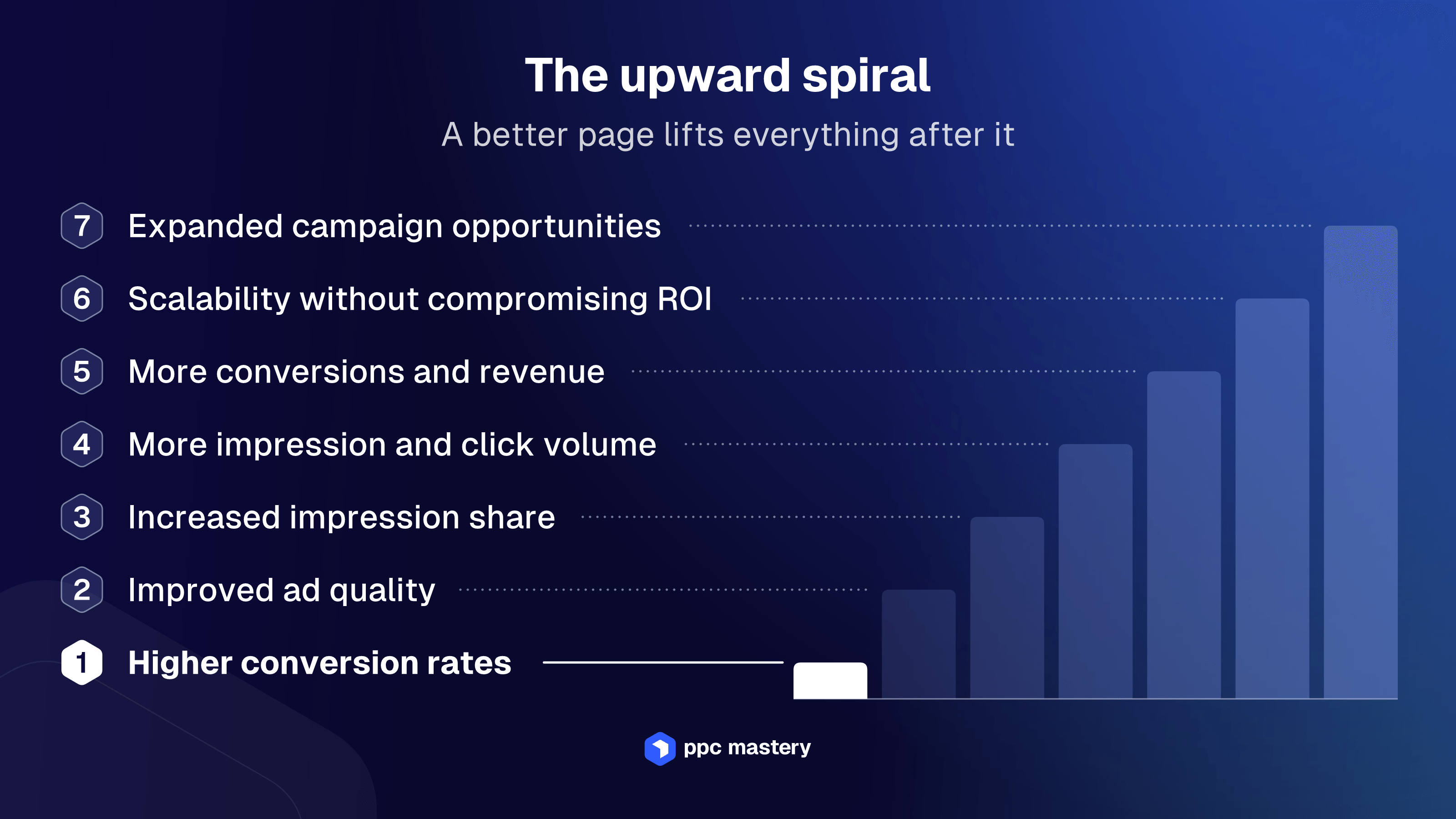
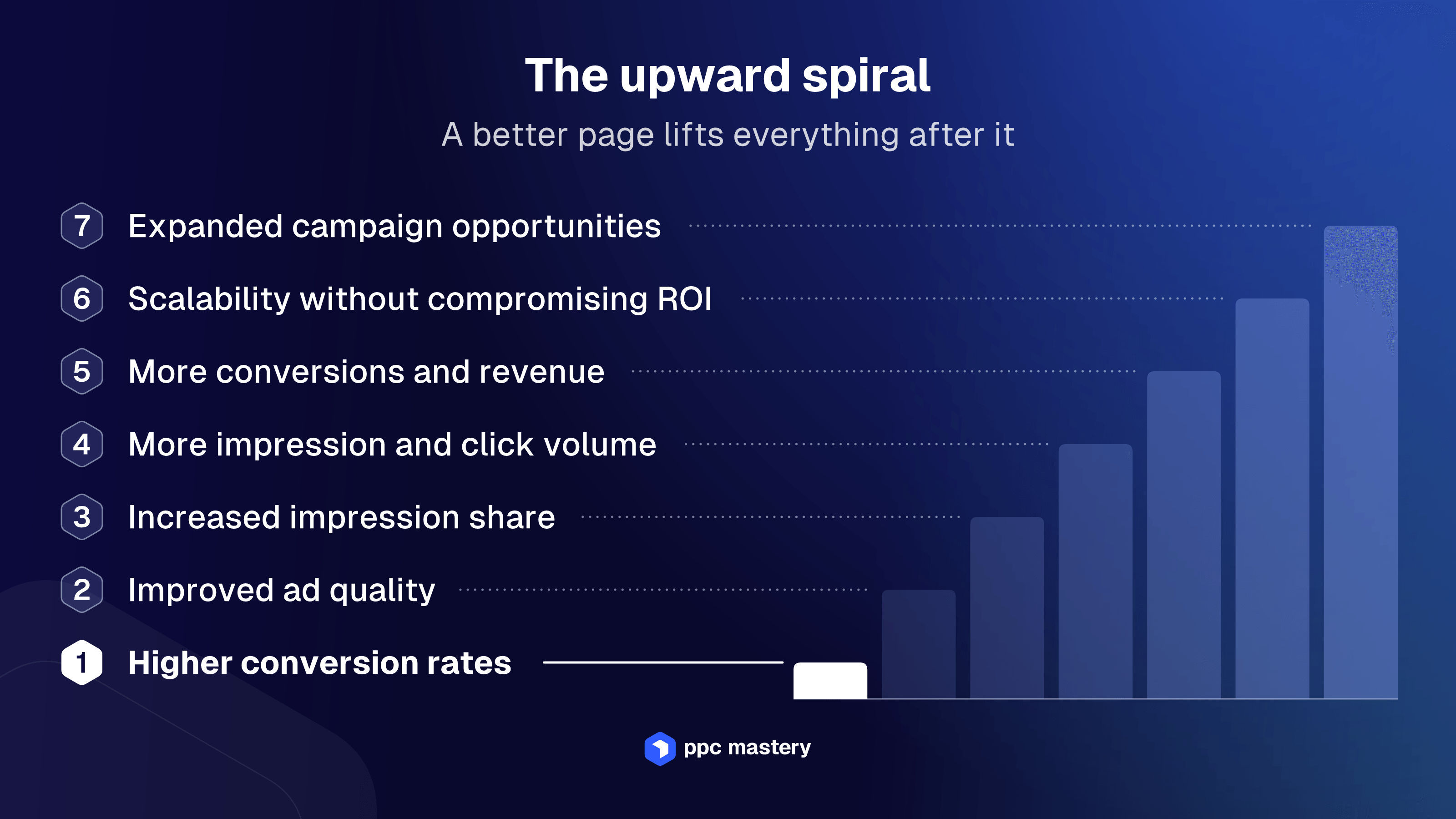
A higher conversion rate makes each click worth more, so Smart Bidding can bid more at the same target. A higher bid with better ad quality raises your Ad Rank, which wins more impression share, more clicks and more conversions. Eventually there’s room left over for campaigns you couldn’t afford before.
Make sure to start with the high impact foundation, because over there lies the scalability and over there you will find the money.
That’s why I’m not a huge fan of starting with search term reports and ad copy tests. They’re fine work, for a 1 or 2% gain. Fix the foundation first.
Bottom line: Build Google Ads top down: offer, page, economics, goals and tracking before anything inside the platform.
Chapter 2 of 4
Chapter 2: Where is your account capped?
Break a pillar and see what your account becomes, then find the first broken pillar in your own account.
What happens when one pillar breaks
Every pillar has its own way of failing. Break one, and the whole account turns into one word:
Break a pillar
Success
| Irresistible offer | Landing pages | Unit economics | Goals and KPIs | Conversion tracking | Campaign structure | Targeting | Creatives | Bids and budgets | Result |
|---|---|---|---|---|---|---|---|---|---|
| In place | In place | In place | In place | In place | In place | In place | In place | In place | Success |
| Missing | In place | In place | In place | In place | In place | In place | In place | In place | Useless |
| In place | Missing | In place | In place | In place | In place | In place | In place | In place | Leak |
| In place | In place | Missing | In place | In place | In place | In place | In place | In place | Unscalable |
| In place | In place | In place | Missing | In place | In place | In place | In place | In place | Aimless |
| In place | In place | In place | In place | Missing | In place | In place | In place | In place | Blind |
| In place | In place | In place | In place | In place | Missing | In place | In place | In place | Fragmented |
| In place | In place | In place | In place | In place | In place | Missing | In place | In place | Inaccurate |
| In place | In place | In place | In place | In place | In place | In place | Missing | In place | Unremarkable |
| In place | In place | In place | In place | In place | In place | In place | In place | Missing | Inefficient |
- 1 Irresistible offer
- 2 Landing pages
- 3 Unit economics
- 4 Goals and KPIs
- 5 Conversion tracking
- 6 Campaign structure
- 7 Targeting
- 8 Creatives
- 9 Bids and budgets
Text versionThe failure words as a table
| Pillar | Failure word | Because |
|---|---|---|
| Irresistible offer | Useless | Nobody converts on an offer they don’t want |
| Landing page | Leak | The click arrives and the page lets it go |
| Unit economics | Unscalable | You can’t bid competitively on thin margins |
| Goals and KPIs | Aimless | You can’t tell good results from bad ones |
| Conversion tracking | Blind | You and Smart Bidding can’t see what converts |
| Campaign structure | Fragmented | Data is split too thin for Google’s AI to learn from |
| Targeting | Inaccurate | Your ads reach the wrong people, or too few of the right ones |
| Creatives | Unremarkable | Competitors win the click in the same auction |
| Bids and budgets | Inefficient | You overpay, or you cap the growth you could have had |
The words come from the course. Name the word that fits your account, and you know which pillar to look at.
Find the pillar that caps your account
The rule: fix the first broken pillar before anything after it. Effort below a broken pillar is wasted, because the broken one sets the ceiling.
On a new account, check the pillars in build order. On a running account, start with tracking and unit economics.
If your conversion data is wrong, every other check reads wrong numbers. And if the account can’t get above break-even, no fix below it will change that.
Constraint check
What kind of business runs the account?
Your business type
Question 1 of 9
Offer
Would your ideal customer pick your offer over the top three results for your main search, on value, proof and risk?
Your constraint
Find out first: that is your constraint.
Your answers stay in this browser. Nothing is sent.
- Offer: Would your ideal customer pick your offer over the top three results for your main search, on value, proof and risk?
- Landing page: Does every ad lead to a page made for that search, with one goal, that converts at least as well as your other pages?
- Unit economics:
- Ecommerce: Do you know your break-even ROAS (1 / margin after product cost, shipping and payment fees), and is the account above it?
- Lead gen: Do you know your maximum cost per lead (deal profit x lead-to-sale rate), and is the account below it?
- SaaS: Do you know your LTV and your maximum CAC (LTV / 3), and is the account below it?
- Goals and KPIs:
- Ecommerce: Is there one ROAS or profit target, tied to break-even, with a revenue guardrail?
- Lead gen: Is there one cost per qualified lead target, tied to your maximum, with a lead volume guardrail?
- SaaS: Is there one cost per trial or demo target, tied to your maximum CAC, with a volume guardrail?
- Conversion tracking:
- Ecommerce: Do purchases and revenue in Google Ads match your shop backend within about 10%, with transaction IDs?
- Lead gen: Do qualified leads and closed deals from your CRM flow back into Google Ads?
- SaaS: Do trials, activations and paid accounts flow back into Google Ads?
- Campaign structure: Does each campaign get enough conversions for its bid strategy (as a rule of thumb about 50 a month)?
- Targeting: Is most of your spend on searches or audiences that can buy?
- Creatives: Is expected CTR average or better on the keywords that carry your spend?
- Bids and budgets:
- Ecommerce: Is bidding on conversion value with a ROAS target, and are profitable campaigns losing under 10% impression share to budget?
- Lead gen: Is bidding on qualified leads with a CPA target, and are profitable campaigns losing under 10% impression share to budget?
- SaaS: Is bidding on the conversion that predicts revenue (activation or paid), and are profitable campaigns losing under 10% impression share to budget?
The first no is your constraint.
Pick your business type first, because the tests differ: an ecommerce account is judged on break-even ROAS and revenue, a lead gen account on cost per qualified lead and closed deals, a SaaS account on LTV and CAC. Then answer nine questions with yes or no. Your first “no” is your constraint. “Not sure” counts as a no: finding out is your first job.
Bottom line: Your account runs at the level of its first broken pillar. Find that one, fix it, then look for the next.
Chapter 3 of 4
Chapter 3: The nine pillars
What each pillar needs, how it breaks, a real example and where to go deeper.
Pillar 1 of 9Fails as: Useless
Without an irresistible offer, every campaign is useless
An irresistible offer is the package that makes your ideal customer choose you. It says what they get, why it beats the alternatives, why now and why it’s safe to say yes. Your product or service on its own isn’t the offer. Google Ads can’t scale a broken offer, as Miles likes to say.
Your offer is the foundation for everything you do.

Offers fail for four reasons:
- Generic value proposition: “High-quality service” says nothing a competitor can’t say.
- No urgency: “Request a demo” gives nobody a reason to act today.
- Weak proof: No reviews, cases or testimonials that back the claim.
- No risk removal: No guarantee, trial or money-back promise.
Compare a software trial. “Sign up for our software and see how it works” against “Try our software free for 30 days, no credit card required”. Same product, but the second one removes the risk and gives a reason to start now.
The offer can also change without the ads changing with it. In the camera webshop from the start of this guide, the price step went live on the site while 13 of 18 ads kept selling the old price. Those ads carried EUR 78,187, 39.2% of the audited cost.
The test: would your ideal customer pick your offer over the top three results for your main search, on value, proof and risk? If not, nothing below this pillar will save the account.
The framework for this pillar is the Irresistible Offer Formula: a clear value proposition, unique selling points, value boosters, social proof and risk removal.
Bottom line: Start with an offer that’s too good to ignore, and only then think about traffic.
Pillar 2 of 9Fails as: Leak
Without a landing page that converts, your traffic leaks
A landing page is the first page someone sees after the click: one page, one goal, built for the search that brought them. Your ad wins the click from the small space it gets on the results page. Your page has to do the rest.
Your ad sets the stage, but your landing page closes the deal.
Most leaks have nothing to do with design. Someone in Atlanta searches “dental implants near me” and gets this:
Search: dental implants near me
2 of 4 in the first screenThe ad
- Dental implants✓H1 “Save 20% off dental implants”.
- Dental implants cost & pricing✕No price anywhere. “Implant pricing” is a menu link.
- Affordable dental implants↓“We make implants affordable”, with financing, lower down.
- Near me (searched in Atlanta)✓Schedule and call buttons up top.
The page

- In the first screen
- Below the first screen
- Nowhere on the page
The fix: Put a starting price for implants in the first screen, with the 20% off applied to it, or drop "Cost & Pricing" from the headline.

 “Cost & Pricing” in the ad. No price on the page.Open the roast
The ad promises cost and pricing, and the page has a clean design, a discount and two buttons, but no price. Someone who wants to know what implants cost goes back to the results and clicks the next ad.
What a working page does looks like this. My highest conversion rate ever came from a gardening company I worked for in the Netherlands (B2C lead gen): 20.2% on quotation requests, one in five clicks, at EUR 4.53 per lead. That’s crazy high.
The most common way a page breaks is the broken promise: the ad says one thing, the page says another.
The framework for this pillar is the Conversion Amplifier, and the full method is in the guide to Google Ads landing pages.
Bottom line: A page built for one search and one goal turns paid clicks into customers. A homepage turns them into bounces.
Pillar 3 of 9Fails as: Unscalable
Without solid unit economics, your campaigns can’t scale
Unit economics are your profit per sale, per lead or per customer. They decide your maximum cost per click, whether a target is realistic and how far you can bid before you lose money. This is the pillar most Google Ads guides skip, and the one that explains why a competitor can outbid you on every search.
The formula differs per business type:
Unit economics
What can you afford to pay for a customer?
Pre-filled with the course example. Change any number to yours.
After product cost, shipping, fulfilment and payment fees, ex VAT
Leave at 0 if your conversion values are net of returns
Type 300% or 3x
Count only Google Ads leads older than your sales cycle
- Room to scale (5:1 or more)
- Healthy (3:1 to 5:1)
- Warning (2:1 to 3:1)
- Danger (1:1 to 2:1)
- Losing money (under 1:1)
| Business type | Course example | What you can pay |
|---|---|---|
| Ecommerce | Average order value $100, Margin 40% | Break-even ROAS: 2.5 (250%) (1 / margin / (1 - return rate))Max CAC per first order: $40 (Average order value x margin x (1 - return rate)) |
| Lead gen | Deal value $10,000, Margin 30%, Lead-to-sale rate 20% | Deal profit: $3,000 (Deal value x margin)Max CPL: $600 (Max CAC x lead-to-sale rate)Max CAC: $3,000 (Deal profit) |
| SaaS | ARPU per month $100, Monthly churn 5%, Margin 70% | Lifetime: 20 months (1 / monthly churn)LTV: $1,400 (ARPU x lifetime x margin)Max CAC at 3:1: $467 (LTV / 3)Payback at max CAC: 6.7 months (CAC / (ARPU x margin)) |
Text versionThe formulas per business type
| Business type | Break-even metric | Formula | Course example |
|---|---|---|---|
| Ecommerce | Break-even ROAS | 1 / margin (after product cost, shipping and payment fees) | 40% margin on a $100 order: 2.5 (250%), max $40 per first order |
| Lead gen | Max cost per lead | Deal profit x lead-to-sale rate | $3,000 profit per deal at 20% lead-to-sale: max $600 per lead |
| SaaS | Break-even CAC = LTV | LTV = ARPU x lifetime x margin; stay under LTV / 3 | $100 a month, 20 months, 70% margin: LTV $1,400, max CAC $467 |
Two years ago I worked for a supplements webshop. Its ROAS looked great. Its margin didn’t:
Case, from my own accounts
A ROAS of 12.18 on a 4% margin
Supplements webshop, October 2024
- Revenue
- EUR 40,254 on EUR 3,306 Google Ads cost
- Blended ROAS
- 12.18
- Gross profit
- 12%
- Contribution margin after ads
- Problem: 4%
- One order
- Problem: EUR 4.64 gross profit on EUR 32.28: break-even ROAS near 700%
Getting traction with numbers like that is nearly impossible.
It happens with healthy margins too, as in this year’s audit for the camera webshop from the start of this guide:
Case, from my own accounts
A healthy margin, still below break-even
The camera webshop, non-brand Generic Search, April to July 2026
- Gross margin
- 65%, before shipping and payment fees
- Break-even ROAS
- 1.54x (1 / 65%), and higher once those fees count
- Actual ROAS
- Problem: 1.16x
No landing page fix closes a gap that sits in the margin.
I’m not going to work for any e-com player with really poor gross margins ever again.
Poor unit economics can’t be solved with Google Ads optimizations. You fix them at the source: price, margin, order value, shipping and returns, lead quality, the sales team, or churn and price per customer.
Bottom line: Know your break-even before you set a single target. It’s the ceiling on every bid you’ll ever make.
Pillar 4 of 9Fails as: Aimless
Without goals and KPIs, you’re aimless
A goal tells you, and Google Ads, what good looks like. Without one, you can’t tell whether a campaign works, so you can’t optimize it either.
Goal setting runs in three steps: start from the business goal, pick the KPIs that measure it, then translate it into a Google Ads goal.
And you choose: growth or efficiency. You can’t maximize both at the same time. Pick one as your primary KPI and keep the other as a guardrail (a minimum ROAS while you grow volume, or a minimum volume while you push efficiency).
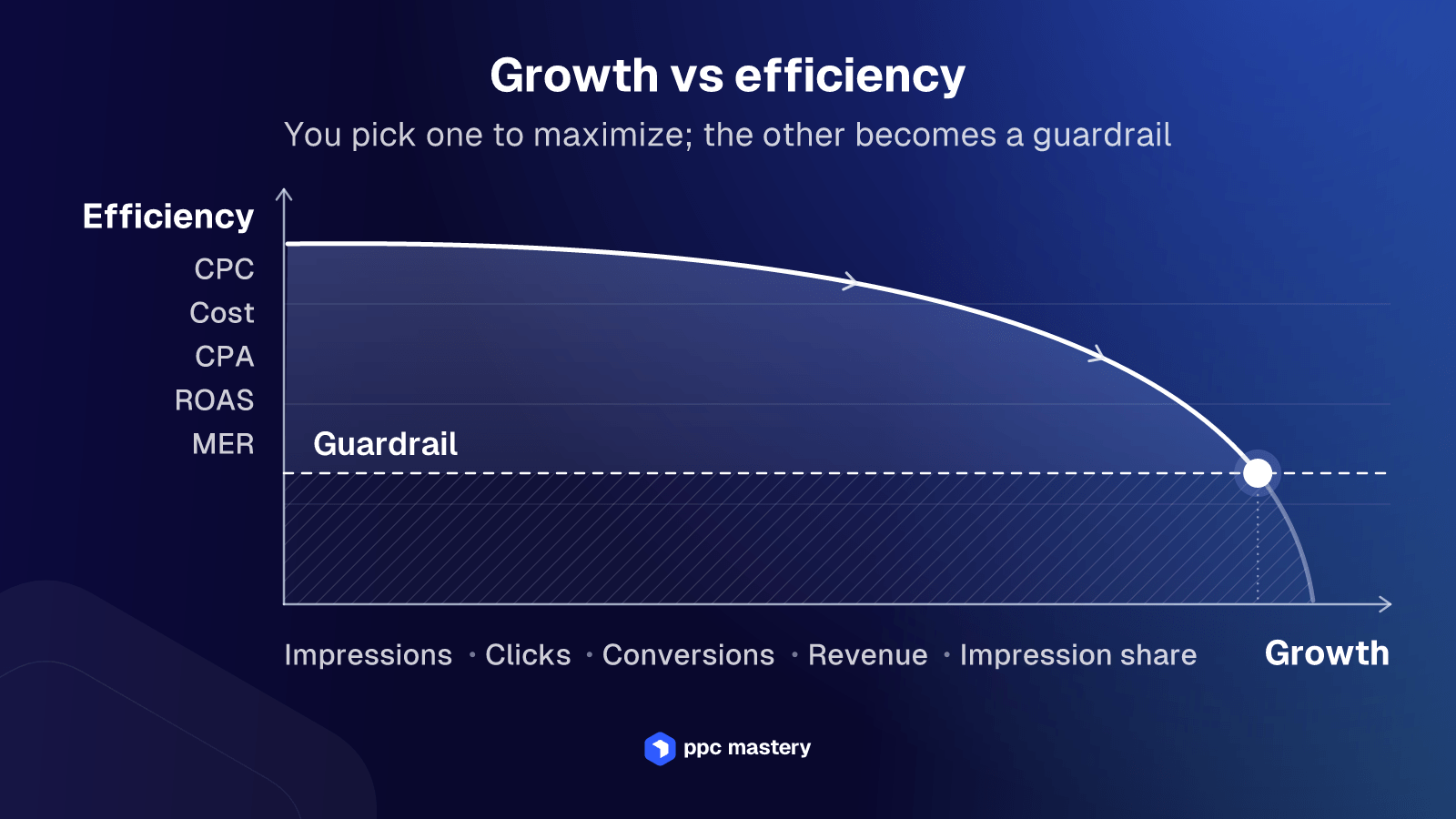
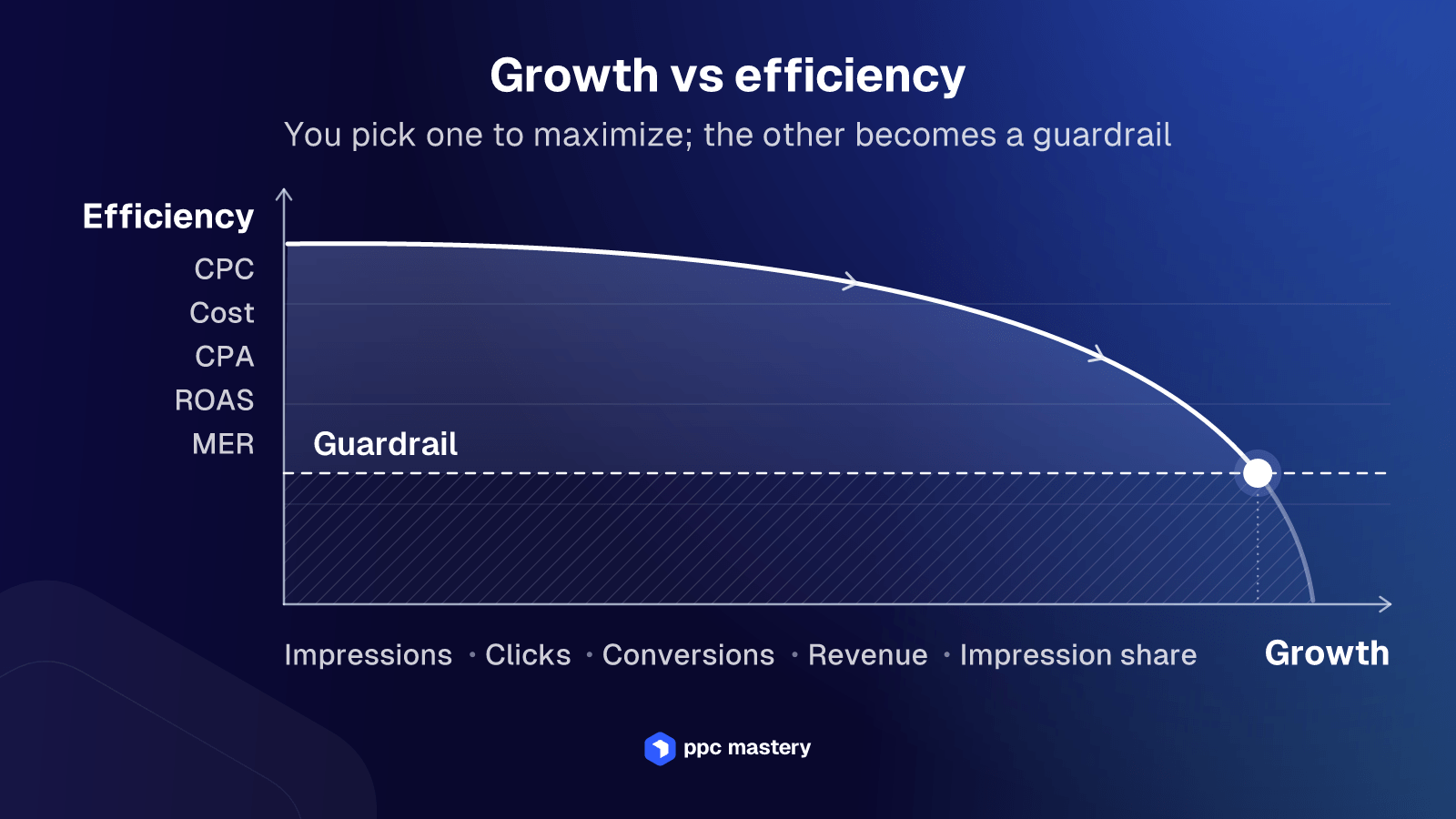
The trap is step three. The same camera retailer also has a German shop, and when I audited it this year, it had a clear business goal: at least 4.0x revenue on ad spend, on a 1.54x break-even.
None of it reached the account. Generic Search and pMax ran Maximize conversion value with no target ROAS, and a hard monthly budget was the only control.
The result, over 90 days to October 2026 (the last three weeks still filling in, so read the direction): an account ROAS of 1.98x, above break-even and half the business floor. Branded Search at 42.23x carried the account, while non-brand Generic Search ran at 0.84x and lost money on every euro before overhead. The goal existed in the boardroom, not in the bidding.
(There was a reason. An earlier Target ROAS test had throttled spend until the sales team ran out of leads. Fair enough, but the fix is a realistic target, not no target.)
And stay away from vanity metrics. You can’t put vanity metrics in the bank., said  Bob A high click-through rate says nothing if the clicks don’t buy. I only use CTR to judge ad copy.
Bottom line: One target, tied to your break-even, set in the account, with a guardrail on the other side.
Pillar 5 of 9Fails as: Blind
Without conversion tracking, you’re blind
Conversion tracking tells you and Google’s AI which clicks turn into sales or leads. Every Smart Bidding strategy runs on it: Google describes Smart Bidding as bid strategies that use Google AI to optimize for conversions or conversion value in every auction.
Running Google Ads without conversion tracking is like driving a Ferrari blindfolded.
If the data going in is wrong, it’s just bidding, not Smart Bidding. And wrong data is as dangerous as missing data. This year I audited eight accounts for their landing pages, and in three of them the measurement was broken or contaminated:
- A German retailer’s Generic Search had 4,508 clicks in one week, with one begin_checkout event and one purchase.
- The same retailer’s checkout hung on German phone numbers with slashes in them, for almost four weeks. Real orders were lost, invisible in every data source.
- A podcast SaaS logged 11 straight days of zero conversions on 148 clicks.
That’s why a running account starts here. In three of eight accounts, every other number I would have judged was wrong.
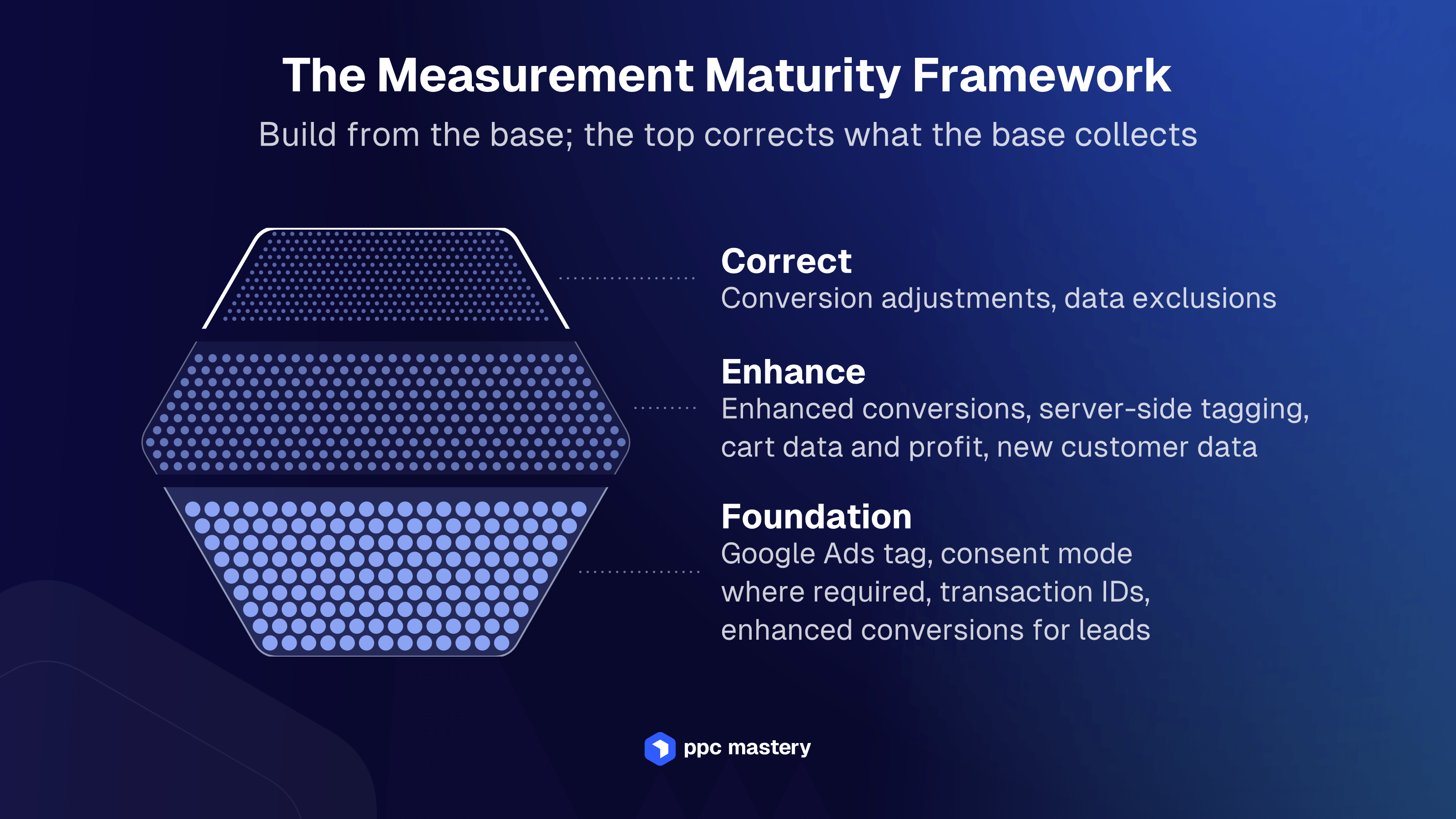
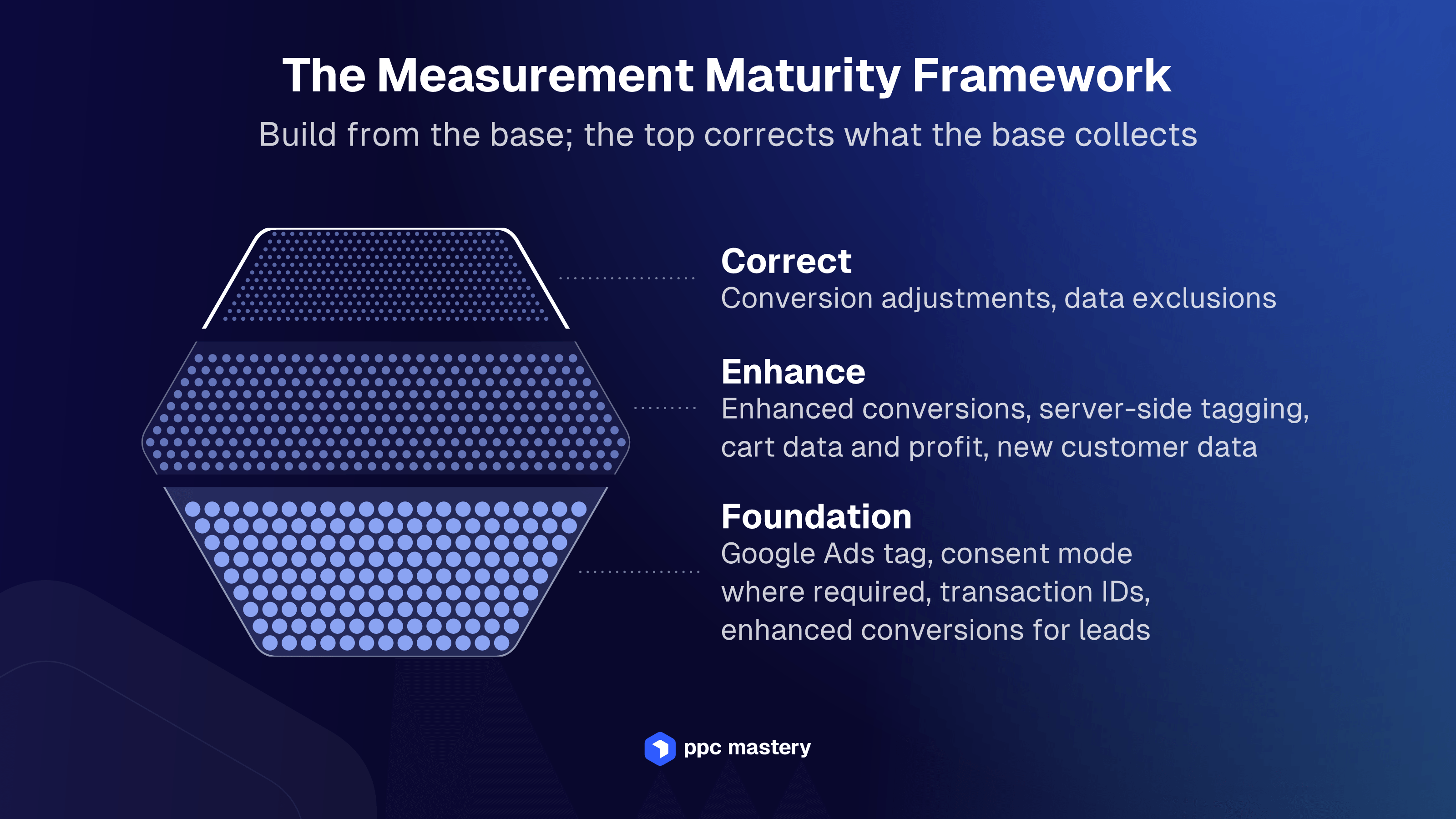
The framework for this pillar is the Measurement Maturity Framework, in three levels:
Measurement Maturity FrameworkThe three levels in detail
- Foundation: The Google Ads tag on every website conversion, consent mode where the law requires it, transaction IDs so no sale counts twice, and for lead gen and SaaS enhanced conversions for leads (the upgraded offline conversion import) for sales that close offline.
- Enhance: Enhanced conversions, server-side tagging once you spend about EUR 5,000 a month, conversions with cart data, profit and new customer data.
- Correct: Conversion adjustments for returns and cancellations, and data exclusions for days your tracking broke.
Bottom line: Check that Google Ads matches your real sales before you trust a single number in the account.
Pillar 6 of 9Fails as: Fragmented
Without a solid campaign structure, your data is fragmented
Campaign structure is how you split your account into campaigns and ad groups. Every split divides your conversion data. Smart Bidding can borrow signals across campaigns, but each campaign’s bidding still leans mostly on its own conversions. Split too far, and none of them has enough. In the age of AI, I always say that less is often more., said Bob
The golden rule of consolidation: always consolidate as much traffic as possible. Only segment when there is a good reason to do so. Good reasons are a different bid strategy or target, a budget per product or service, or a different conversion goal. Different settings such as location count too, and so do an insight Google doesn’t have, reporting needs and experiments.
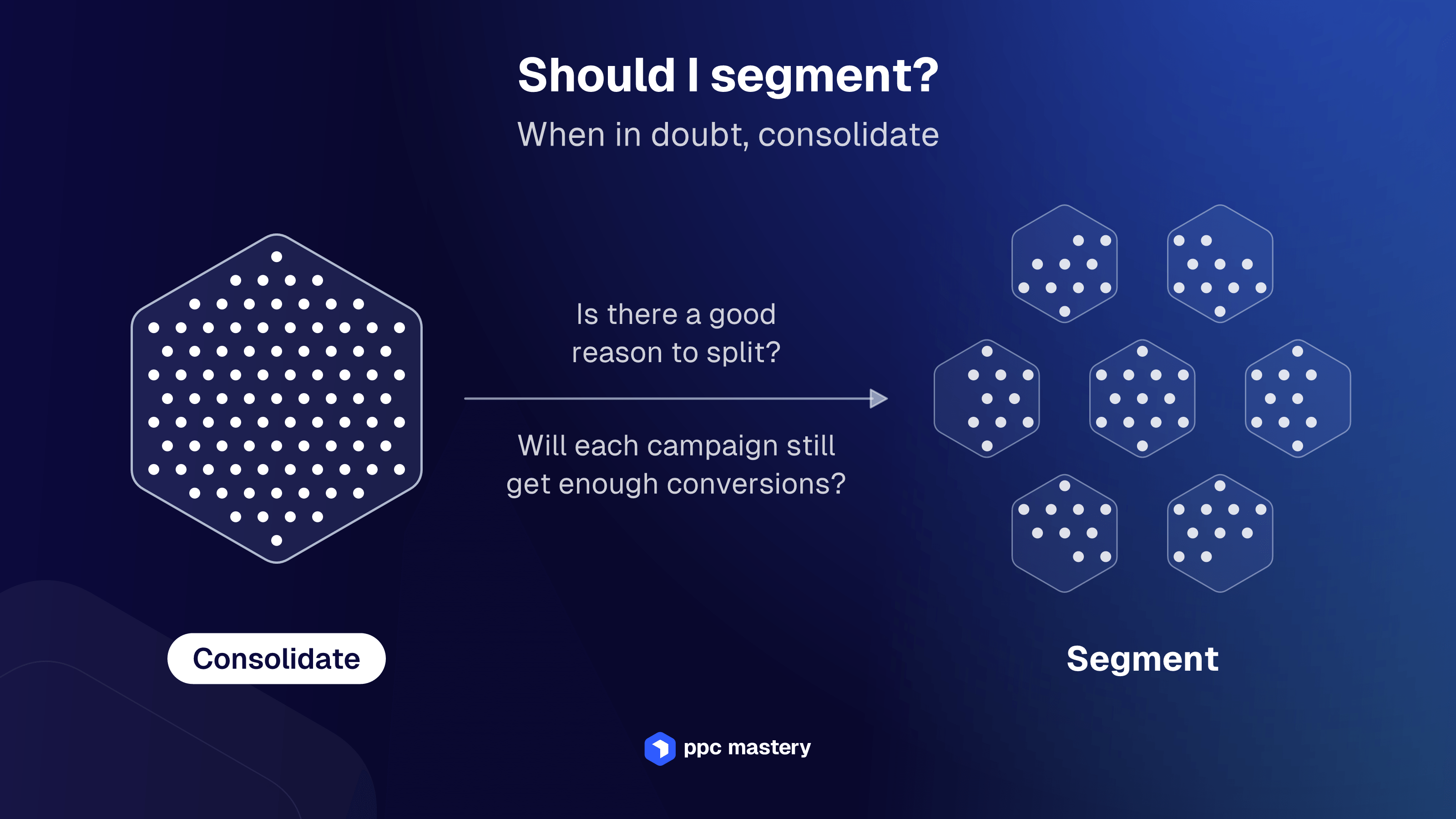
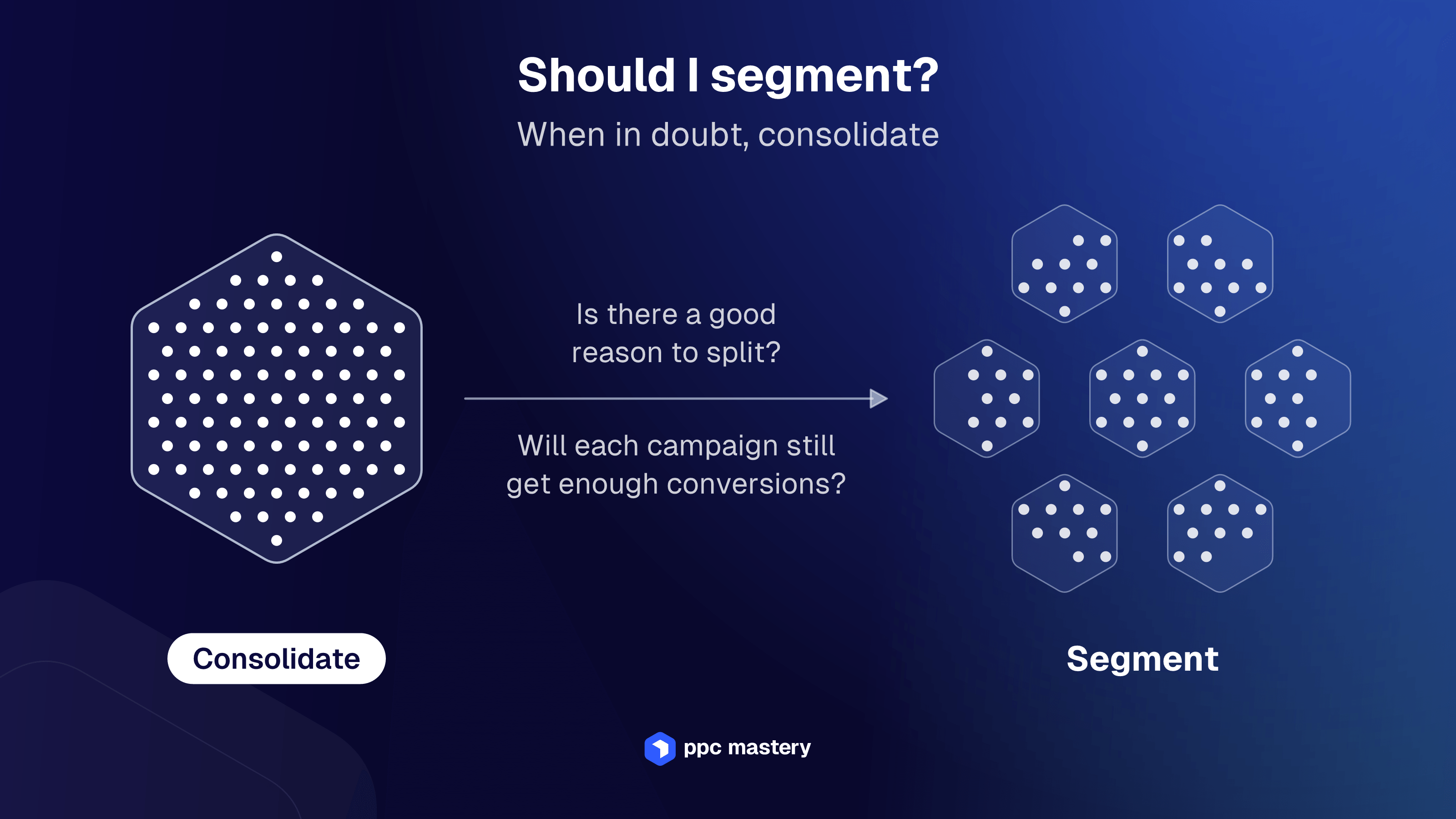
How much data is enough? My rule of thumb is about 50 conversions per campaign per month.
Google saysWhat Google itself asks for
It’s not Google’s rule. Maximize conversions only needs conversion tracking, Target CPA can start with no conversion history, and Target ROAS asks for 15 conversions in 30 days on Search and Shopping. Fewer can work, but in my accounts 20 to 30 a month often comes with inconsistent results.
What consolidation does in practice: three years ago I took over a lead gen account. The owner had run it for a year and a half after the in-house specialist left.
Case, from my own accounts
From 19 campaigns to 4
Lead gen account, taken over three years ago
- Campaigns
- 19 to 4
- Ad groups
- 89 to 21
- Setup
- Target CPA everywhere, broad match and offline conversions
- Non-brand conversions
- +253% year on year
- Average CPA
- -60% year on year
Bottom line: Consolidate by default. Split a campaign only when you can name the reason, and only if both halves keep enough data.
Pillar 7 of 9Fails as: Inaccurate
Without the right targeting, you reach the wrong people
Targeting decides who sees your ads: the searches you match and the audiences you reach. In my opinion it’s also the pillar that changed most in the last few years. Your job shifted from picking exact keywords and segments to feeding Google’s AI the right signals. I think broad match plus smart bidding is going to be the new normal., said Bob
Google agrees: Smart Bidding works best with broad match, and broad match also reads your landing pages, your assets and the other keywords in the ad group. The flip side: broad match without Smart Bidding is a money pit. In 2023 I ran broad match experiments in three accounts. Against the original, conversions went up 28%, 64% and 18%, at the same or a lower CPA.
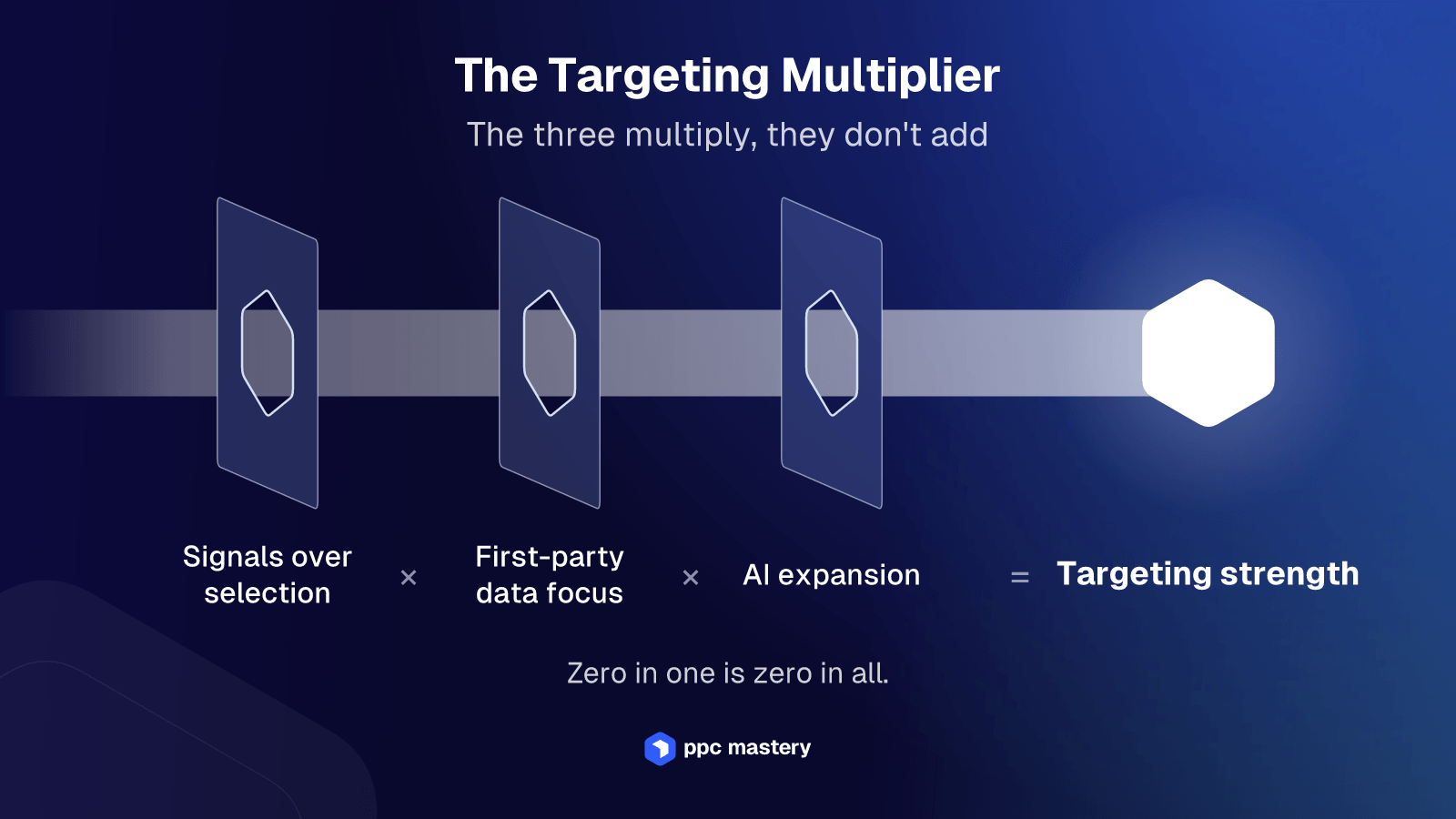
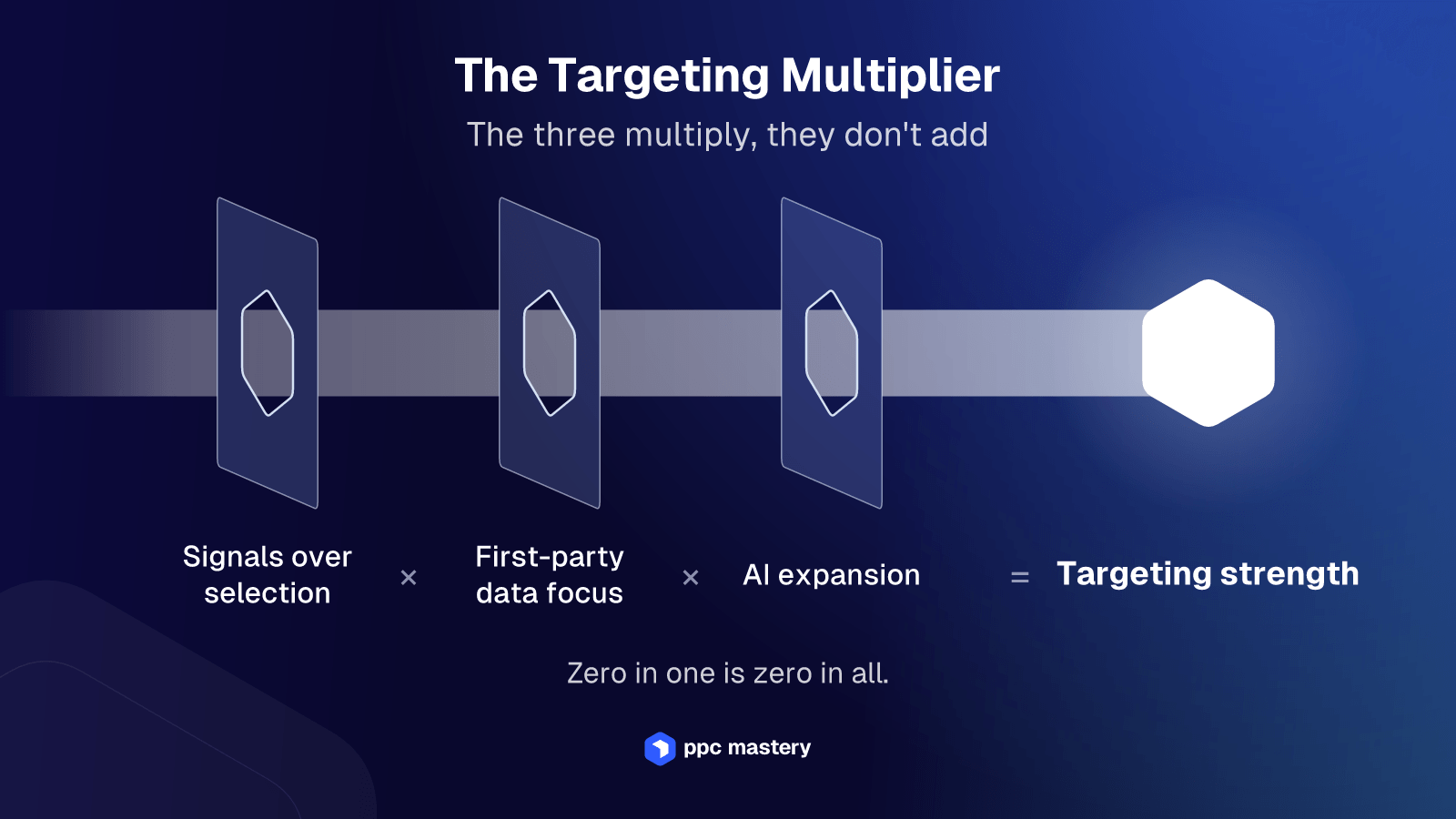
The framework for this pillar is the Targeting Multiplier: signals over selection, times first-party data focus, times AI expansion. They multiply rather than add, so if one is zero, so is the result.
Signals still have to be the right ones, and that starts with words. Back to the camera webshop: the owner calls the product “camera systems” because it sounds more professional. Buyers search for “security camera”: about 14 times the search volume.
Your keywords, ads and pages should speak the buyer’s word.
Changed since 2023Three things older guides still get wrong
Some things in the older playbooks no longer hold. Similar audiences were removed from all campaigns in August 2023. Video action campaigns have moved to Demand Gen. And third-party cookies didn’t disappear: Google kept them in Chrome in April 2025. First-party data is still your best signal, just not for the reason everyone expected.
Bottom line: Give Google’s AI room with broad match and Smart Bidding, and steer it with first-party data and your buyers’ own words.
Pillar 8 of 9Fails as: Unremarkable
Without compelling creatives, your ads are unremarkable
Creatives are your ads: headlines, descriptions, images and video. Searchers don’t see your targeting, your structure or your bid strategy. They only see your ad, next to your competitors’ ads.
Perfect targeting with poor creatives is like having the world’s best storefront, but completely in the dark.
The framework for this pillar is the Creative Excellence Framework, in four steps where every step builds on the one before:
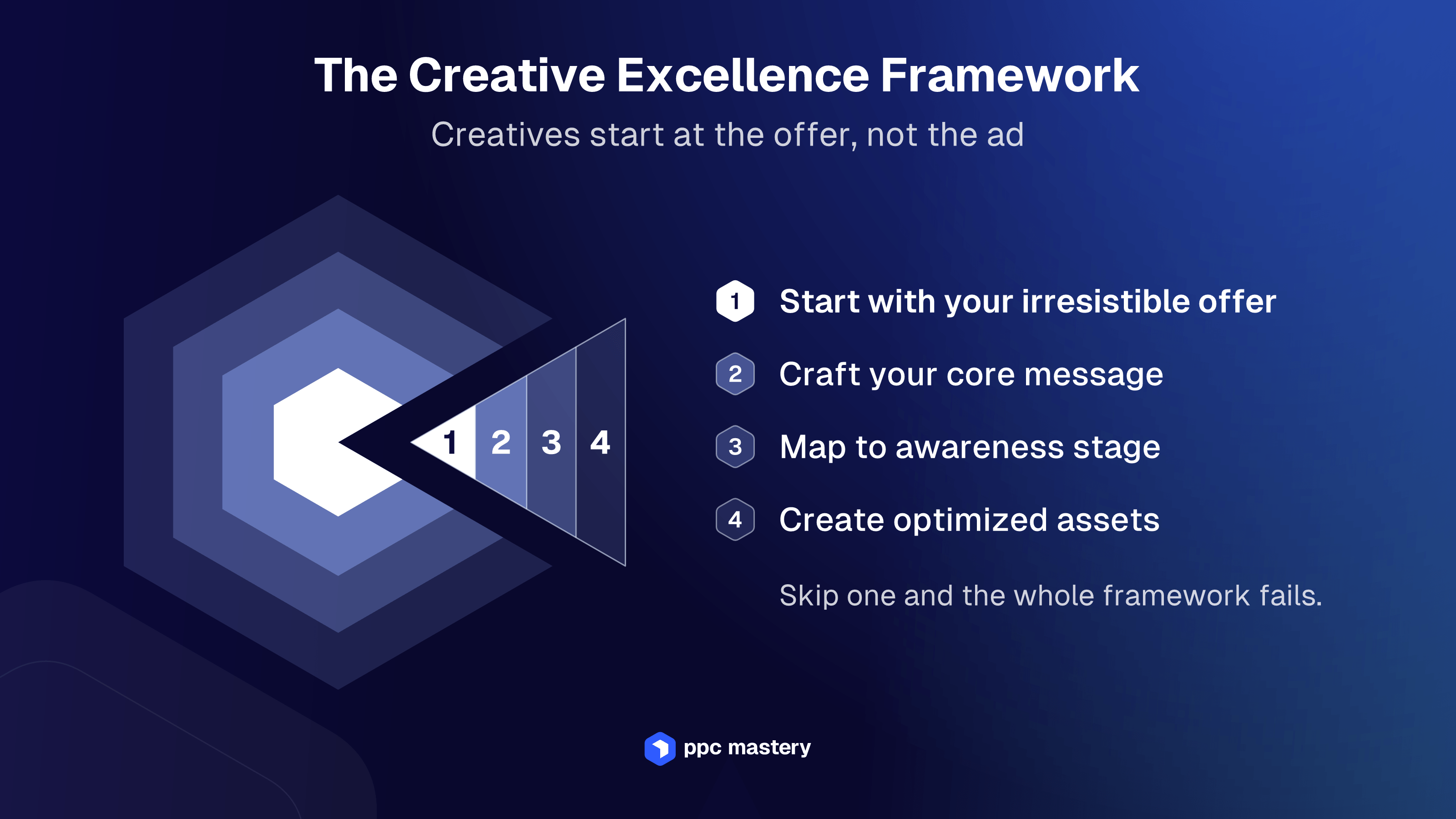
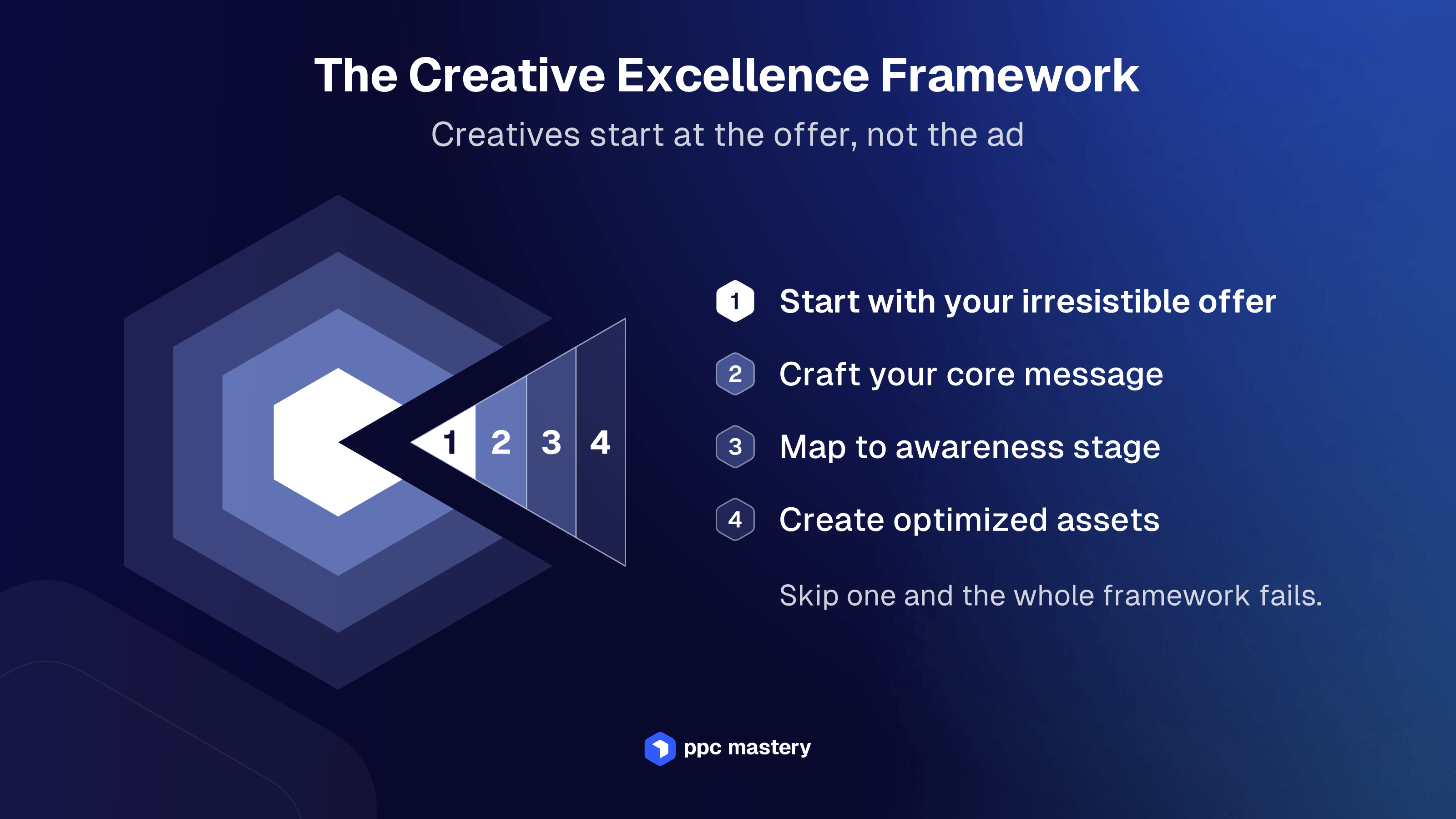
- Start with your irresistible offer: The facts of what you sell.
- Craft your core message: How you sell it. Your offer is what you sell, your message is how you sell it.
- Map to awareness stage: A cold searcher who doesn’t know the problem needs a different ad from one who’s ready to buy.
- Create optimized assets: Turn the message into responsive search ads (up to 15 headlines and 4 descriptions), images and video.
The Iteration Loop is how you then test those assets, one hypothesis at a time.
A creative also has to be true. In an audit for a repair manual subscription this year, the ads claimed “78,000 Reviews”. The site showed 398.
An ad that oversells wins the click and loses the sale on the page (and it can break Google’s misrepresentation policy).
Bottom line: Build ads from the offer down, write for the searcher’s awareness stage, and only claim what the page can show.
Pillar 9 of 9Fails as: Inefficient
Without the right bids and budgets, your campaigns are inefficient
Bids and budgets decide how much you pay per click and how much you spend. They only work together:
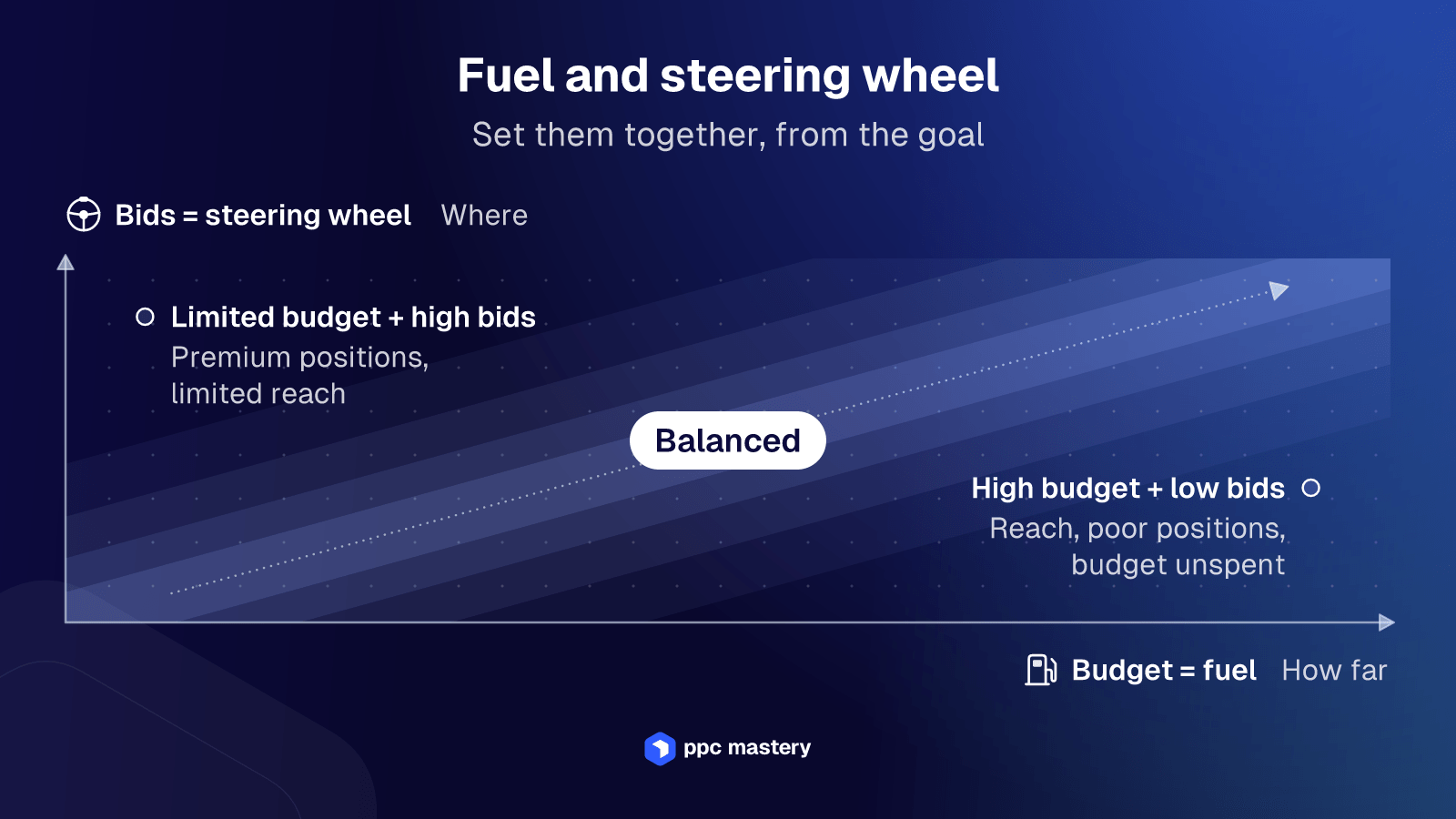
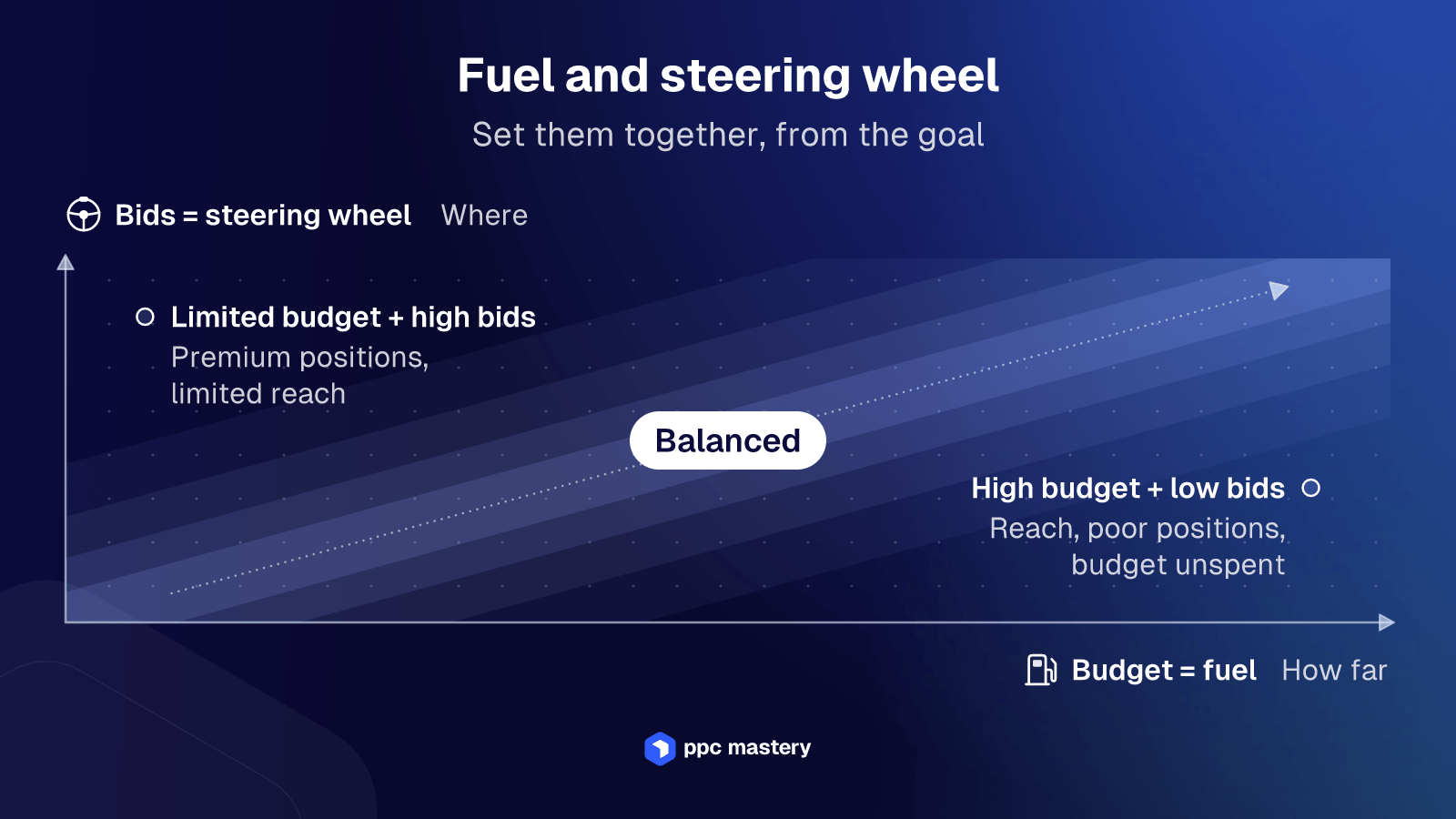
Set both from your goal, not the other way round:
- Budget for conversions: Target monthly conversions x target CPA.
- Budget for revenue: Target monthly revenue / target ROAS.
- Daily budget: Monthly budget / 30.4, Google’s average month. A campaign can spend up to twice its daily budget on a single day, but for most campaigns never more than 30.4 times it in a month.
Your budget is the fuel and your bids are your steering wheel.
Then pick the bid strategy that matches the goal. Google maps Maximize conversions and Target CPA to sales or leads, and Maximize conversion value and Target ROAS to profit. You simply can’t outwork Smart Bidding, said Bob by hand: it sets a bid for every single auction, from signals you can’t see in the interface.
A budget cap isn’t always a mistake. The gardening company from the landing pages pillar ran at EUR 4.53 per lead, and I still had to limit the daily budgets: the company couldn’t follow up more leads.
That’s a cap set by the business, on purpose. A cap on a campaign that’s above break-even and could take more budget is the inefficient kind.
Bottom line: Set your budget from the goal and your bid strategy from the KPI, and lift caps on campaigns that make money.
Chapter 4 of 4
Chapter 4: How to use it
The loop for a running account, and where to start reading.
How to use the Success Formula on your account
On a new account, build the pillars in order. Don’t launch campaigns before the offer, the page, your break-even, a goal and tracking are in place.
On a running account, work in a loop:
- Check tracking and unit economics first: If the data is wrong or the account can’t get above break-even, start there.
- Find the first broken pillar: Use the nine questions in the constraint check. The first “no” is your constraint.
- Fix that one pillar: Not the easier one further down.
- Measure: Give it at least two weeks, or twice your conversion delay, whichever is longer.
- Find the next one: Fixing one pillar often exposes the next.
If your account is running but not delivering, start with why Google Ads isn’t working: every symptom traced back to its pillar. For the full list of checks per pillar, with how often to run them, use the Google Ads optimization checklist.
Where to start reading
- Business owners: Read the first five pillars. They decide whether Google Ads can work for you at all, before anyone touches a campaign.
- Google Ads specialists: Start with the pillar your constraint check pointed to, then go to its guide.
- The nerds: Each pillar guide has the mechanics in fold-outs: the auction maths, the bidding thresholds, the scripts.
Google Ads myths to drop
- “More budget will fix it.” Budget amplifies what’s there. On a broken offer or a leaking page, more budget buys more waste.
- “The algorithm will figure it out.” Smart Bidding optimizes toward the data you give it and the target you set. Wrong data or no target, and it optimizes toward the wrong thing.
- “Quality Score is the problem.” Quality Score is a diagnostic, not an input in the auction. It points at your ads and page, the pillars above it.
The full course is ten lessons, one per pillar, about five hours of me walking through every pillar with real accounts.
Remember the camera webshop: a clean page, and 35% fewer orders because the offer broke. That’s the whole formula in one account. Find your first broken pillar and fix that one before anything else.
