GM, Miles here!
Google Ads has officially entered the next phase in the “Age of AI” — and this might be the biggest shift I’ve seen in my entire PPC career.
Enter: the Agentic Era.
At Google Marketing Live, Google called it the shift “from chat to act.”
For the last couple of years, using AI in our work meant typing into ChatGPT or Claude and getting back ideas. Helpful, but it was still just a chatbot. That era is over.
AI has evolved and can now do actual work. From research, analysis, building campaigns, reporting, actually implementing changes… Alongside you, following your instructions — all while you grab your coffee.
Seriously. I know that sounds hypey but it’s true. There’s no reason anymore to be doing most of the manual work yourself when you can have an army of AI Agents do it for you.
I’ll be honest: I spent a long time calling AI a shiny object. But this year, I changed my mind completely. Not in the “replace your entire marketing department with agents” type of way you see all over LinkedIn…
But in a more serious and constructive way, where AI Agents work under your direction, 24/7 — giving you time back to focus on what truly matters: growing businesses, not just ad accounts.
Winning in this new Agentic Era requires you to master a new mindset, a new skillset, and a new tool stack. I’ll share it all today so you are prepared for the biggest shift of your career.
Get ahead of it now, and you’ll be part of the small group of specialists who will take 10x more opportunities over the next 18-24 months (before everyone else catches up).
Let’s dive in!
The Agentic Era: “from chat to act”.
To see why this matters, it helps to look at how we got here:
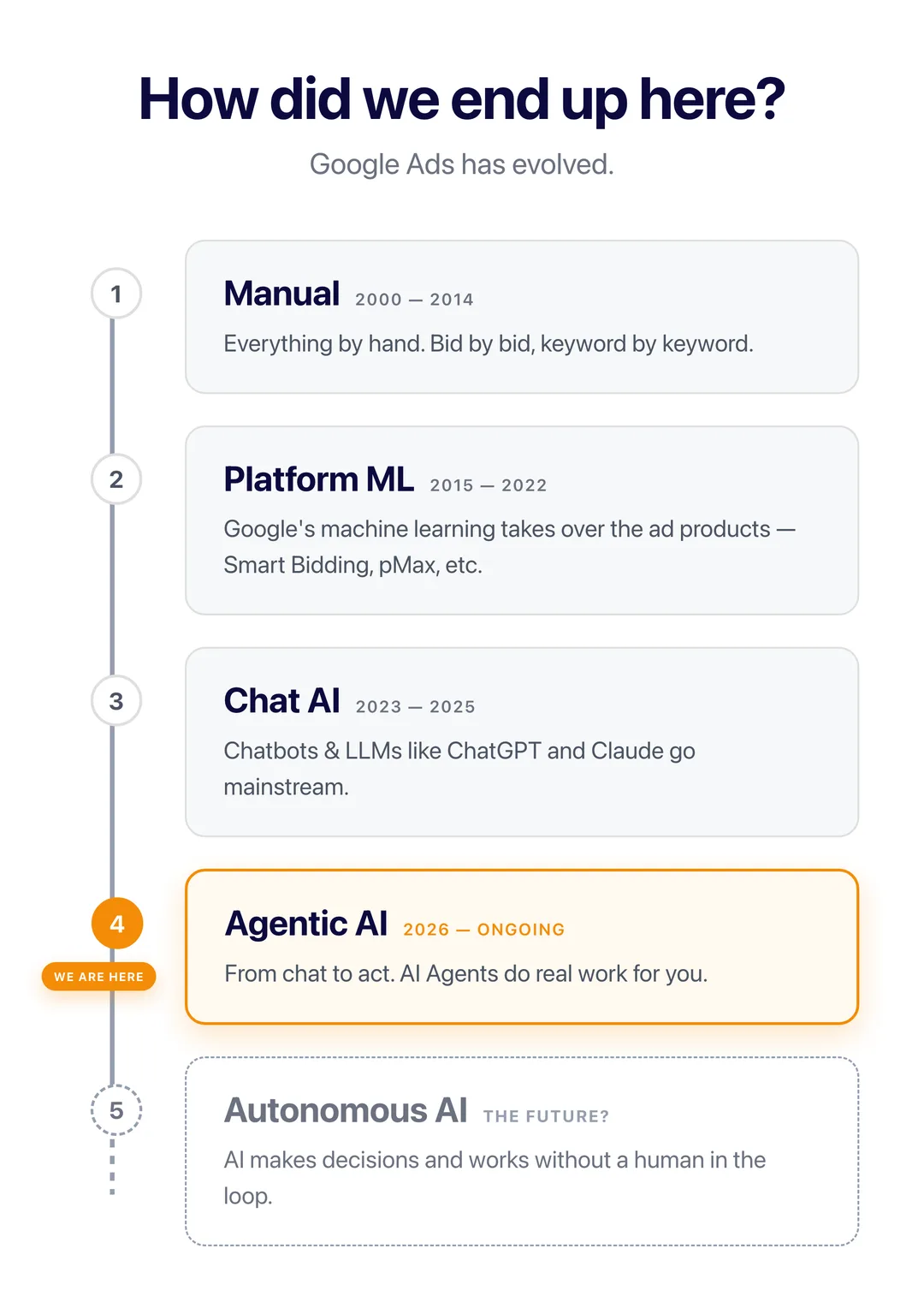
From 2000 to 2014, Google Ads was purely manual — you did everything by hand.
Around 2015, Google started embedding machine learning into the platform, starting with the fully automated Universal App Campaigns, followed later by Smart Bidding, Performance Max and everything else they launched lol.
Around 2023, chatbot AI tools like ChatGPT & Claude started to pop off: brilliant text engines you could talk to and pull ideas from and brainstorm with.
Now, in 2026, we are in the Agentic Era. The difference is big: an AI Agent doesn’t just answer your questions — it does real work for you. AI goes from reactive to proactive. You give it the inputs and the instructions, and it completes the task, exactly the way you want it done.
To me, that’s the sweet spot of automation and control. You stay in charge of the direction, and the agent handles the work behind the scenes, references what it knows from your instructions, and corrects itself as it goes.
You stay the human in the loop and either implement everything yourself through Editor-ready CSV files that your agents make for you, or you let your agents make changes in Google Ads directly (I don’t recommend this though, especially early on).
There is another phase people love to talk about: fully autonomous AI that not only executes but also makes decisions on its own.
Those tools do exist already, but I think it’s a bad idea to hand over the keys to your Google Ads accounts to AI fully, without your oversight. Working with real budgets, a small mistake can be disastrous. So I think we’re currently in the best place we can be, with the right balance of automation and control.
The opportunity of a lifetime is here, but the window to seize it is closing.
What makes this such a big opportunity: most specialists haven’t started using AI agents yet. They’re still at the “let me talk to ChatGPT” stage. That’s not bad, but it’s nowhere near as effective as having agents do the work for you.
I believe that in 18-24 months, almost everyone will be using AI Agents. But until then, I think there’s a massive opportunity that can be seized for those who act now.
I’m not just making this up… It comes from the Innovation Adoption Lifecycle — the predictable path in which every new technology gets adopted by the masses.
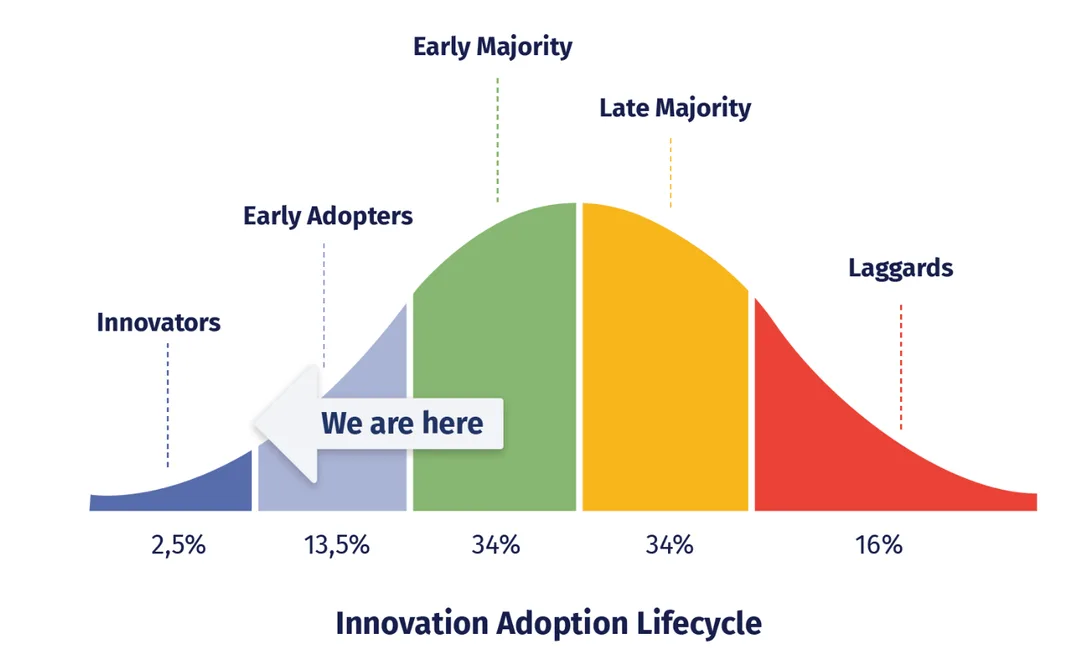
With AI agents, we’ve only just left the innovators stage, and the early adopters are picking it up now. Most Google Ads Specialists haven’t used AI agents yet.
So if you act now, you get a real edge and first-movers advantage over everyone who waits.
You won’t just save time — you’ll operate at a level that wasn’t possible before. And you get to decide what to do with that leverage: take on more clients, go deeper with the clients you have (increasing your value in the marketplace), or work less without sacrificing income.
This is the opportunity of a lifetime, but it’s not around forever. It’s at its biggest right now, and it shrinks a little every month as more people catch on.
In 18-24 months, using AI agents will be the new baseline, and we’re gonna have to look for another edge.
Winning in the Agentic Era requires a new mindset, skillset, and tool stack.
It starts with the new mindset: how you look at and position yourself as a specialist.
The specialists who win in the Agentic Era are evolved T-Shaped Google Ads Specialists who combine deep Google Ads expertise with broad business knowledge.
They automate most of the execution with AI agents so they can focus on what truly matters to impact results (which is usually the business stuff).
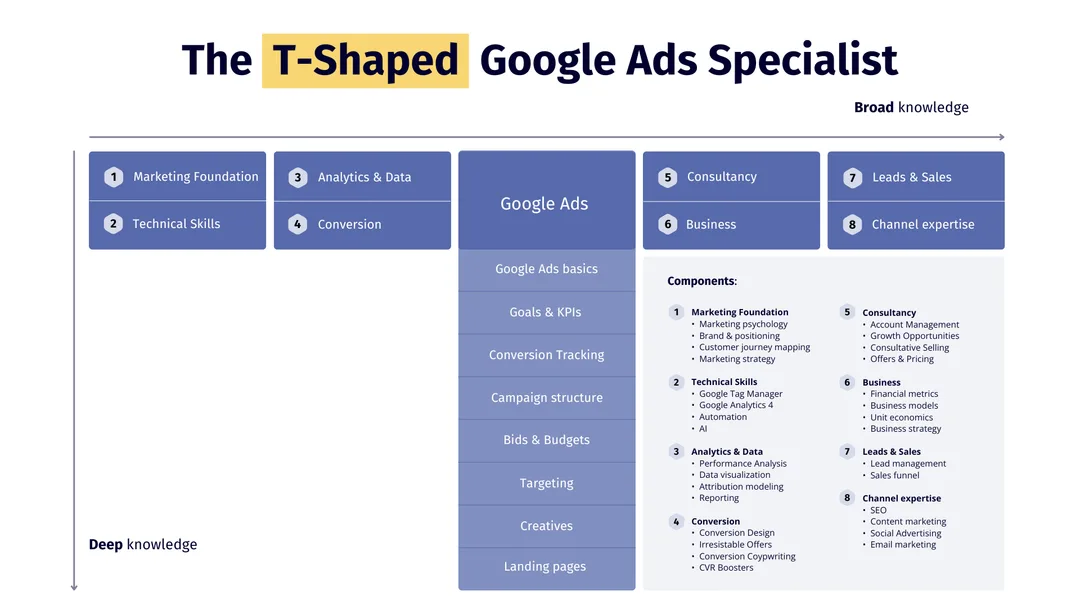
The foundation of your skillset remains deep Google Ads expertise — that’s your base, and it never goes away.
But on top of that, you stack broad business skills that allow you to grow businesses, not just ad accounts: marketing foundations, analytics, CRO, sales funnels, offers, unit economics, finance, and everything else that goes into business growth. You don’t need to be an expert in all of it — you just need to know enough to spot the opportunities and bottlenecks others don’t see.
Without AI agents, most specialists stay “vertical”: deep in execution, but with no time for or know-how of the things that actually impact business growth. AI agents change that. When they take on most of your execution work, you free up time for the high-level strategy that enables real growth.
The biggest mindset shift is this: you stop thinking of yourself as the person who optimizes the account, and start thinking of yourself as the person who grows businesses, not just ad accounts. Google Ads simply becomes the vehicle to allow you to do that.
And that’s a good thing.
The new toolstack: the tech, a custom OS, and context.
Succeeding in the Agentic Era also requires a new toolstack. Here’s what you need:
- The tech stack: Claude Code (inside Cursor) + Google Ads API is basically all you need to get started. Claude Code starts at $20 per month and allows you to operate AI agents that connect to and pull data directly from your Google Ads account. Cursor is needed to run Claude Code as a plugin, and the free plan is enough. If you’re wondering, we have a full setup guide in The PPC Hub that will help you set it all up in no time.
- An operating system: the structured knowledge docs, SOPs, and AI-ready skills that instruct your agents how to do any task well. This includes guardrails and built-in quality checks to ensure your agents stick to the task and don’t hallucinate.
- Context: the background information you provide to your AI agents so the output is relevant to a specific client/situation (like performance targets, unit economics, strategy, known constraints, business goals, strategic priorities, past test results, etc.).
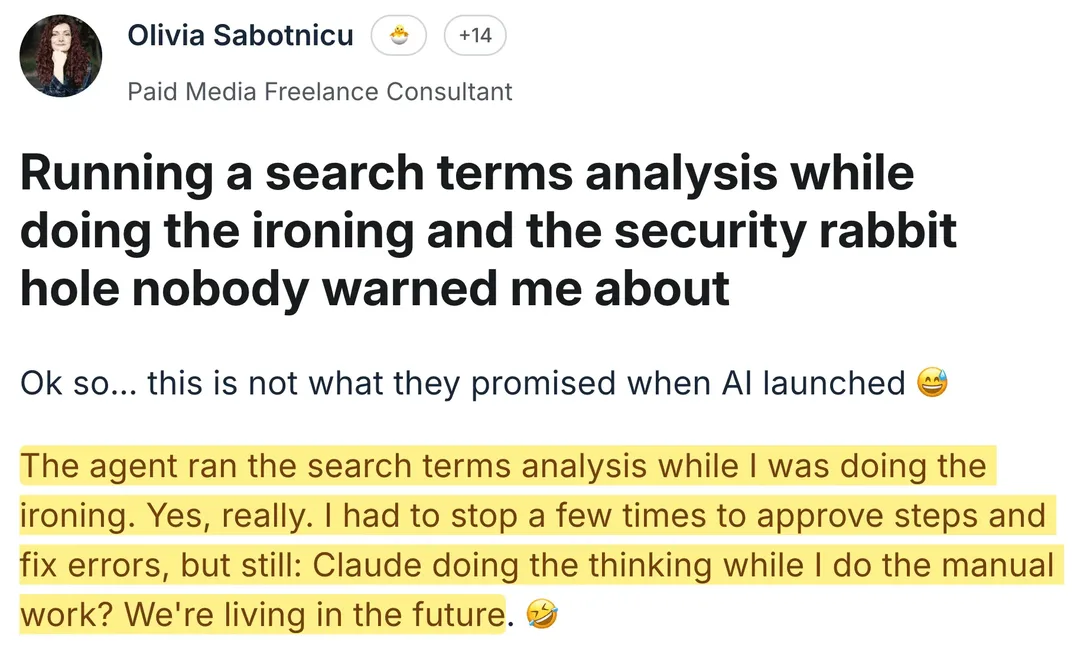
This new toolstack honestly gives you the feeling you have superpowers — Olivia, a member of The PPC Hub, also experienced that haha (once you experience the magic of agents you can never go back):
But… Your edge is not the agent. Everyone has it. Your edge is the operating system you build to steer it.
Setting up AI agents with a tool like Claude Code is easy. You’ll be up and running in an hour. Anyone can do it, so the agents themselves aren’t your edge. Your edge comes from what you put inside your operating system.
Think of it like an iPhone: amazing technology, but without the iOS software, it’s just hardware that does absolutely nothing (it looks cool though…)
The cool thing about your operating system is that you can (and should) build it to be 100% in line with YOUR approach to Google Ads.
We built PPC OS, our own AI-powered Google Ads Operating System available in The PPC Hub, using 3 layers:
- Knowledge base: everything we know about Google Ads (250+ extremely detailed docs with mental models, frameworks, reference guides, guidelines, catalogs, checklists, and more).
- SOPs: that knowledge base is then used to fuel the step-by-step SOPs (Standard Operating Procedures) that explain how to do certain tasks (like creating RSAs, auditing accounts, building landing pages, etc).
- AI-ready skills: and those SOPs are then converted into AI-ready skills, which are repeatable tasks that you can trigger automatically in Claude Code, so you don’t have to explain yourself to your agents every time you want it to execute a real task.
(If you’re curious to hear more about how we built our own OS, check out this demo)
Building your own OS is essential, but it takes time. Building PPC OS has already cost us hundreds of hours, even when we had already documented our processes for years.
PPC OS currently has more than 250 documents, many of them with 30+ pages… And our 87+ SOPs are turned into skills that we test rigorously before we deploy them to The PPC Hub.
It’s a lot of work, but it’s worth the time. It’s the difference between AI that produces mediocre garbage versus agents that actually execute tasks at the highest level possible.
The new skillset: what you need to get good at.
But even with a proper custom OS, your agents cannot run by themselves.
As the person operating the agents, you need to master 4 (new) skills:
- Systems thinking & agent orchestration: that’s just a fancy way of saying you need to direct AI agents across multi-step workflows — brief, plan, run the agent, review, refine. You’re designing the entire workflow, not just typing a prompt.
- Google Ads mastery and business depth: understanding what drives business growth, not just account growth. From the nitty-gritty in-platform tactics, to outside factors like unit economics, offers, customer journeys, growth strategy — all of it.
- Judgment & direction: knowing when AI is right, wrong, or close — using your expertise to judge your AI agents’ output and redirecting when needed.
- Building an AI-ready knowledge base: it’s no longer optional to document your processes. It’s absolutely essential when working with agents.
AI agents without an operating system and context are just empty shells that produce mediocre output that is not in line with your way of working, and not relevant to your specific case.
And an operating system used by a specialist without the right skillset is dangerous because you need that human in the loop who can judge the output and redirect the agents when needed.
Two examples of specialists who are already thriving in the new Agentic Era.
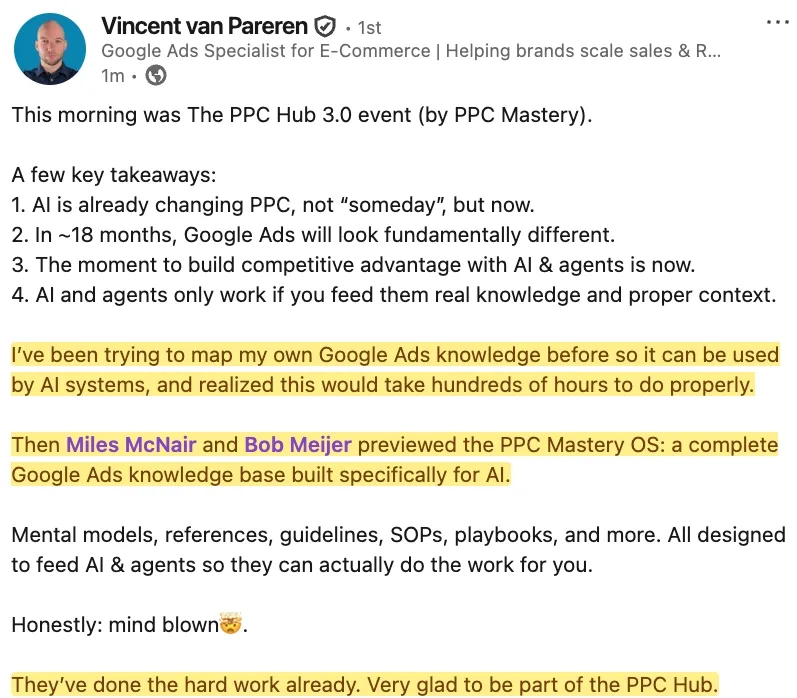
Earlier this year, we started helping members of The PPC Hub get ahead of the shift and ready to win in the Agentic Era.
Last week, I spoke to two Google Ads Specialists in The PPC Hub. They’re both leveraging AI agents in different ways:
Ramial Aqeel went deep. He told me about a normal busy morning: five terminals open, each with agents running a different task. He got hungry, went downstairs to make lunch, came back up — and all five were done. Drafts written, reports built. A year ago, those five tasks would have taken him all day.
This time it took an hour at most, and the quality was even better. He reinvests time he gets back into going deeper with clients on the business level — like focusing on how understanding unit economics improves results. He uses the extra leverage his agents give him to give more value to his clients without charging more (talk about overdelivering!).
Louis Bogdan went wide. The work that used to take him hours is close to instant now, so he lowered his prices (interesting business decision, not something I would’ve done but it allowed himself to be priced more competitively which can be a good thing), took on more clients, and stopped depending on one big “whale” client who could destroy him by leaving.
He describes his role now as operating the cockpit — strategizing and directing while the agents handle the execution. Mind you: 6 months ago, Louis was struggling to grow his business but with the power of AI agents, he signed 40+ ecom clients in just a few months. Wild!
I always find it interesting how there can be 1 major shift, and people still end up in totally different places. Louis adapted and uses AI agents to serve more clients, while Ramial now serves clients more deeply.
Both got time back and reinvested it in the business layer — growing businesses, not just ad accounts.
Final note: AI only amplifies what’s already there.
AI will only amplify what’s already there. It won’t make a mediocre specialist great — it’ll just produce mediocre output at scale.
In other words: AI is a multiplier of your skill, not a substitute for it.
Which is why your fundamentals matter more now, not less. The specialists who stop learning will fall behind because they won’t be able to judge when AI produces garbage output.
But the specialists who keep developing their own knowledge and skills are the ones who will get ahead massively, because they can build AI-powered systems that compound. They can trust AI with most execution work — because they know enough to catch it the moment it’s wrong.
The Agentic Era is already here. You can reclaim a lot of your time now if you let AI agents handle most of your execution work.
And what you do with that time is totally up to you: hire more clients without burning out, going deeper on existing projects… Or heck, even work less without sacrificing income!
My advice: get in the rabbit hole. Start learning about AI agents. Start playing around with them. It’s a lot of fun, and you’ll end up with an insane competitive edge that will serve you massively for the next 18-24 months.
To me, it reignited a fire inside of me that I hadn’t felt in a long time. It brought me a ton of new energy and excitement about the future of my work in PPC!
Don’t have time to build your own OS? Want a massive shortcut? Join The PPC Hub!
Again, building your own OS takes a loooot of time (I’m talking hundreds of hours if you want to do it well). But we’ve already done all the hard work. So if you want a massive shortcut, feel free to join The PPC Hub and start using PPC OS today.
With PPC OS, you can do full account audits and execute real tasks for you like optimizing RSAs, product feeds, Quality Scores, search terms, placements, bids, budgets and way more… As well as build new landing pages, audit unit economics, and create irresistible offers.
It’s fully customizable, and we’re constantly refining it so you can execute real work at a senior specialist-level, so you can go deeper, scale faster, and work smarter.
We’ll show you how to set it all up in just a few hours inside The PPC Hub.
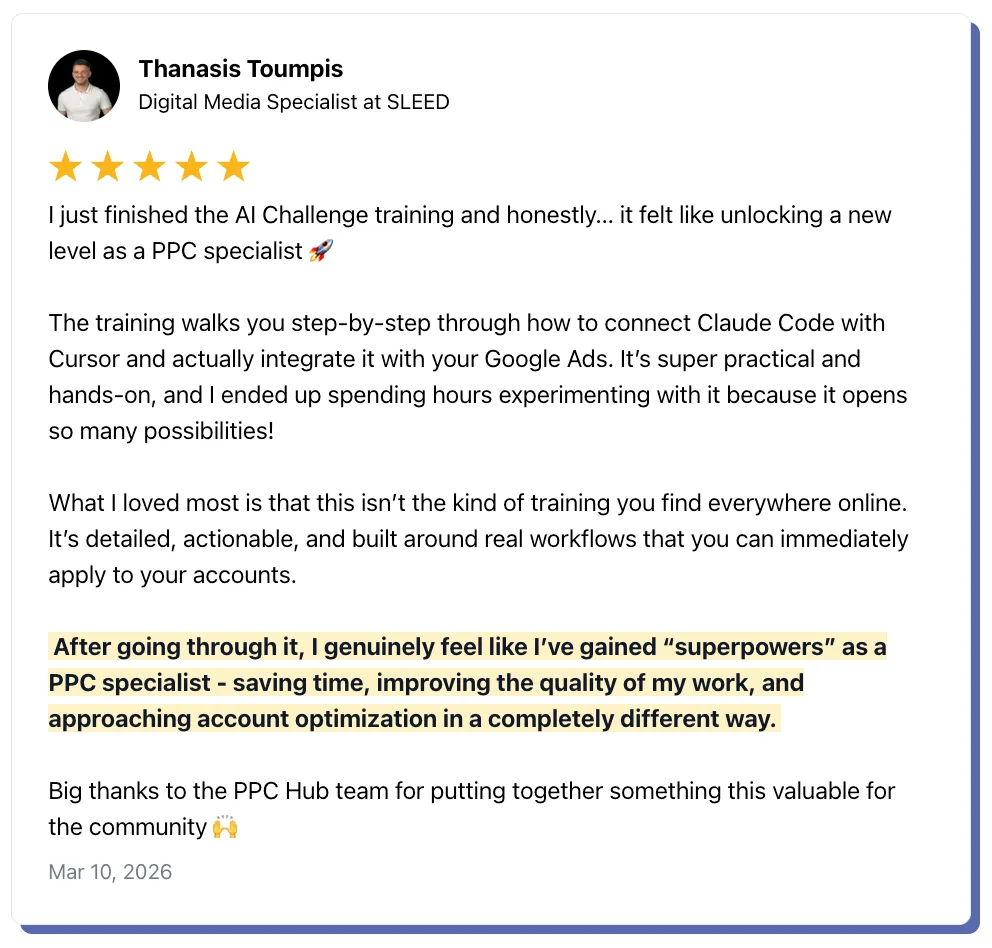
You’ll also get access to the courses that help you build the knowledge and skills to stay ahead, no matter how fast the industry changes.
If you’re interested, you can join The PPC Hub here :).
That’s all for today, thank you for reading.
See you next week!
Cheers,
Miles (& Bob)