GM, Miles here!
Here’s something I hear all the time from clients:
“We want to double our revenue this year while also dropping costs by 50%.”
Sounds reasonable, right?
- More revenue.
- Less ad spend.
- Higher margins.
Who wouldn’t want THAT?
But here’s what most business owners (and specialists) don’t understand: you can’t maximize growth and efficiency at the same time.
Not because you’re bad at your job or because Google Ads is broken. But because of how performance marketing fundamentals work.
And yet, so many specialists nod along when clients ask for both — to then spend months stuck in the middle, unable to deliver on either.
Today I want to explain why this tradeoff exists, how to think about it, and how to have smarter conversations with your clients about what to actually aim for.
Not sexy, but crucial if you want to drive results.
Let’s dive in!
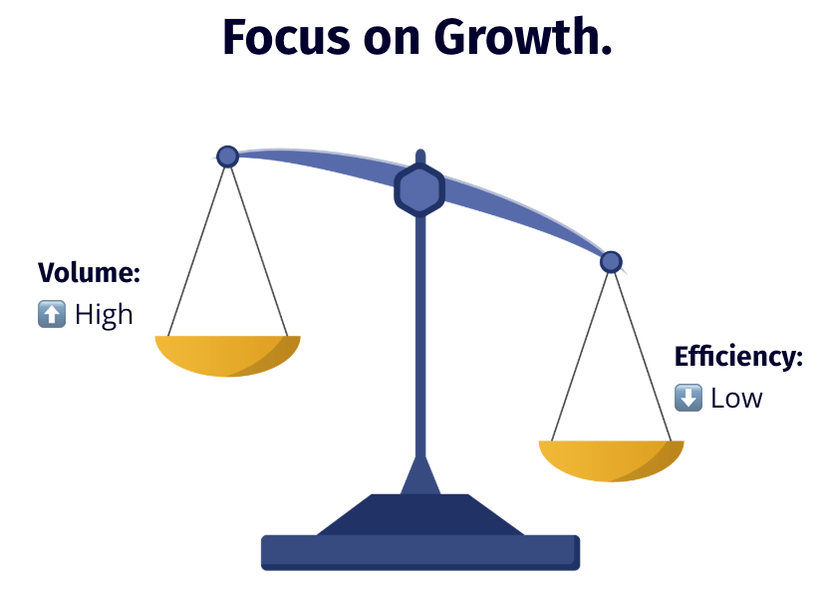
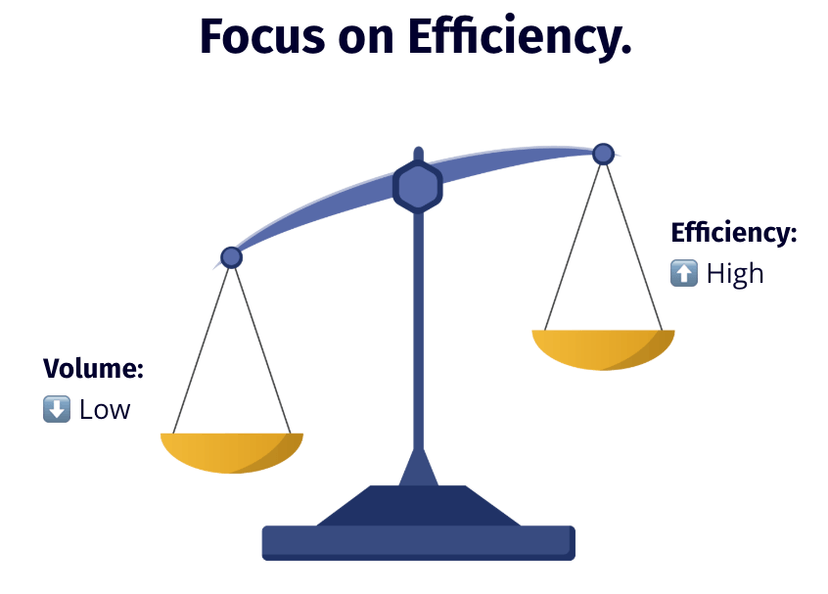
Think of growth and efficiency like a weighing scale
When one side goes up, the other comes down.
When you focus on growth:
- You bid more aggressively to win more auctions
- You expand targeting to reach more people
- You accept higher CPAs or lower ROAS to capture more volume
- Result: Volume ⬆️ Efficiency ⬇️
When you focus on efficiency:
- You bid more conservatively to protect margins
- You tighten targeting to focus on what’s proven
- You accept lower volumes to maintain strong ROAS/CPA
- Result: Efficiency ⬆️ Volume ⬇️
It’s just the nature of how the Google Ads auction and scaling dynamics work:
- To get more volume, you need to win more auctions.
- To win more auctions, you need to bid higher.
- Higher bids mean higher costs.
- Higher costs mean lower efficiency.
There’s no hack around this (unless you’re talking about ways to increase margins, AOV, and LTV so you can outspend your competitors but that’s another topic for another day).
What happens at the extremes
Let’s say you ignore the tradeoff and push hard in one direction. Here’s what happens:
100% focus on growth (the Breakeven Zone):
- You bid as aggressively as possible
- You win lots of auctions
- Volume is high
- But your profit margin is zero (or even negative, losing you money)
- You’re essentially paying to acquire customers at breakeven or a loss
Some businesses do this intentionally for market share. But it’s not sustainable long-term, and most clients don’t realize this is where “maximize growth” leads to.
100% focus on efficiency (the Starvation Zone):
- You set extremely tight CPA or ROAS targets
- You bid conservatively
- Your efficiency metrics look great
- But you’re barely winning any auctions
- Volume dries up, campaigns die, growth flatlines
I’ve seen accounts where the client was so focused on hitting a specific ROAS that they slowly starved the campaigns.
Neither extreme is healthy. The goal is to find a sustainable spot somewhere in the middle, where you find balance between growth and efficiency.
The real question isn’t “growth or efficiency” (this mindset shift changes everything)
It’s not about choosing growth OR efficiency. It’s about choosing which one is PRIMARY right now.
Most successful accounts have both growth and efficiency goals. The difference is clarity on which one leads.
- Primary focus: Guides your overall strategy and tactics
- Secondary focus: Sets protective guardrails
Here’s what this looks like in practice:
Example 1: Growth is primary
- Goal: Generate 250 closed deals in Q1
- Guardrail: Keep CAC below €500
- Strategy: Bid aggressively, expand campaigns, accept some efficiency loss — but don’t blow past €500 CAC
Example 2: Efficiency is primary
- Goal: Reduce CPA by 25% in Q2
- Guardrail: Maintain at least 100 qualified leads per month
- Strategy: Tighten targeting, cut underperformers, optimize bids — but don’t let volume drop below 100 leads
See the difference?
In both cases, you have two goals. But one leads, and the other protects.
Without guardrails:
- Growth-focused accounts overspend and blow past profitability
- Efficiency-focused accounts tighten too much and dry out
The secondary goal prevents you from flying off either end.
Signs you should focus on growth
How do you know when growth should be the primary focus? Look for these signals:
- Strong unit economics. High margins mean you can afford to bid aggressively.
- Strong product-market fit. The demand is there, conversion rates are solid. The bottleneck is traffic, not the funnel. Time to pour fuel on the fire!
- Significant market opportunity. Maybe a competitor just exited, you’re entering a new market, or there’s seasonal demand to capture. These windows don’t last forever — growth focus now makes sense.
- Operational capacity to scale. Your (client’s) sales team can handle more leads. Your warehouse can ship more orders. There’s no point driving volume if the backend can’t keep up. But if they can… Blaze it!
- Secured funding or capital reserves. You have cash to deploy. Investors expect growth. Short-term efficiency is less important than capturing market share. Spend it all!
Signs you should focus on efficiency
And here’s when efficiency should lead:
- Tight cash flow or limited budgets. Every euro counts. You can’t afford to waste spend on experiments. Protect what’s working.
- Pressure on profitability. The business needs to be profitable now, not in 18 months. Margins matter more than market share.
- Saturated market position. You’re already capturing most of the demand. Pushing harder just means paying more for the same customers.
- High customer acquisition costs. CAC is creeping up. Efficiency is slipping. Time to optimize before scaling further (or fix AOV & LTV to offset the high CAC).
- Unit economics are tight. Low margins mean you can’t afford inefficiency. Every conversion needs to be profitable or close to it.
Your focus should shift over time
Here’s something important: your primary focus isn’t permanent.
Business conditions change. Markets shift. What made sense last quarter might not make sense now.
The best specialists don’t wait for clients to raise these issues. They spot the signals first.
When you see the indicators changing, proactively open the discussion: “Based on what I’m seeing in the account, I think we should talk about shifting our focus for next quarter.”
That’s how you position yourself as a trusted business partner, not just someone who pushes buttons.
How this affects everything you do
Once you’re clear on the primary focus, it influences all your decisions:
Bid strategy:
- Growth focus → Bid more aggressively, accept higher CPA or lower ROAS
- Efficiency focus → Bid more conservatively, protect margins with lower CPA or higher ROAS
Budget allocation:
- Growth focus → Higher budgets, more room for testing
- Efficiency focus → Controlled budgets, focus on proven winners
Campaign types:
- Growth focus → Expand into mid-funnel and top-funnel (Display, YouTube, Demand Gen), maximize coverage with Broad Match and Shopping/pMax
- Efficiency focus → Double down on bottom-funnel (Search, Shopping, PMax with tight targeting)
Targeting:
- Growth focus → Broader audiences, test new segments
- Efficiency focus → Tighter targeting, focus on high-intent
Risk tolerance:
- Growth focus → More experimentation, accept some failures, take more risk
- Efficiency focus → Stick with what’s working, less experimentation, minimize risk
Everything flows from the primary focus.
That’s why getting clarity on this before you start optimizing is so important.
Take it to the next level in The PPC Hub
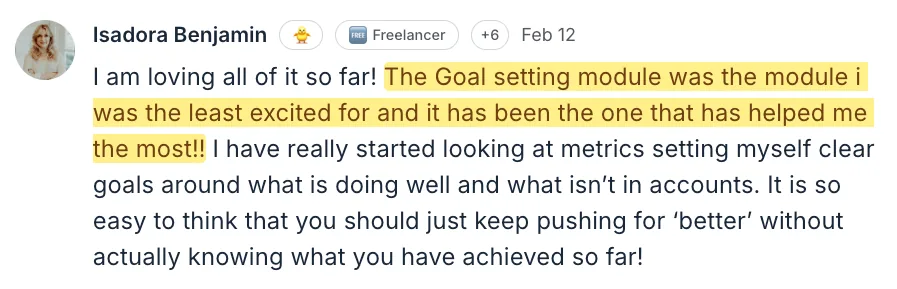
This framework is covered in depth inside our Goal Setting Mastery course that’s exclusively available in The PPC Hub. We go deep on how to determine the right focus for your clients, set balanced goals with proper guardrails, and have the strategic conversations that position you as a trusted growth partner — not just an executor.
This sets you up for long-term success.
Want to take your skills to the next level, drive the best possible results, and stay ahead in our fast-changing industry? Then consider joining The PPC Hub.
It’s how we can help you the best.
That’s all for today, thank you for reading.
See you next week!
Cheers,
Miles (& Bob)

Bob Meijer & Miles McNair
The PPC Edge Newsletter
🎁 Free gift: subscribe to The PPC Edge Newsletter and get our Google Ads Audit Templates for FREE (€199 value).
And whenever you’re ready, here’s how we can help you further:
-
Join our global community of world-class Google Ads Specialists: Stay up to date with all developments, get trained by us all year round, and learn & grow together with like-minded PPCers. Become a member of The PPC Hub (2.000+ members) // enrollment is open, monthly plans available!
-
New free email course: Become a T-Shaped Google Ads Specialist in 5 steps. This free 5-day email course reveals the blueprint to stay ahead, drive better results, and thrive as automation & AI change the industry fast.
-
Scale your Google Ads campaigns with landing pages that are built to convert (even if you are not a webdesigner or CRO Expert): Get more conversions without increasing ad spend using our proven 5-step Conversion Amplifier Framework and Custom AI tools. Join Landing Page Mastery!
-
Learn how to launch, optimize & scale Performance Max campaigns. Get the exact framework we use to scale Ecom & Lead Gen clients. Join 3.000+ PPC Experts in Performance Max Mastery (fully updated).